This time, I want to take a detailed look at the structure of MARC, the format libraries use for cataloging. Of course, you can do MARC work without knowing this structure and its principles, but I believe that once you understand them, you will be better able to handle the various situations that come up.
In this article, I will use the book 'Samgukji' (Romance of the Three Kingdoms) as an example and analyze one record's structure closely.
Getting Started with MARC
![National Library of Korea bibliographic information for [Samgukji]](https://www.gklibrarykor.com/wp-content/uploads/2023/09/%EA%B5%AD%EC%A4%91-%EB%A7%88%ED%81%AC%EB%B3%B4%EA%B8%B0.jpeg) National Library of Korea bibliographic information for [Samgukji]
National Library of Korea bibliographic information for [Samgukji]
First, this is what the bibliographic information for [Samgukji], the example used in this article, looks like when found on the National Library of Korea website. After searching for the book you want, click the [View MARC / Download] button at the top to view or download its MARC information.
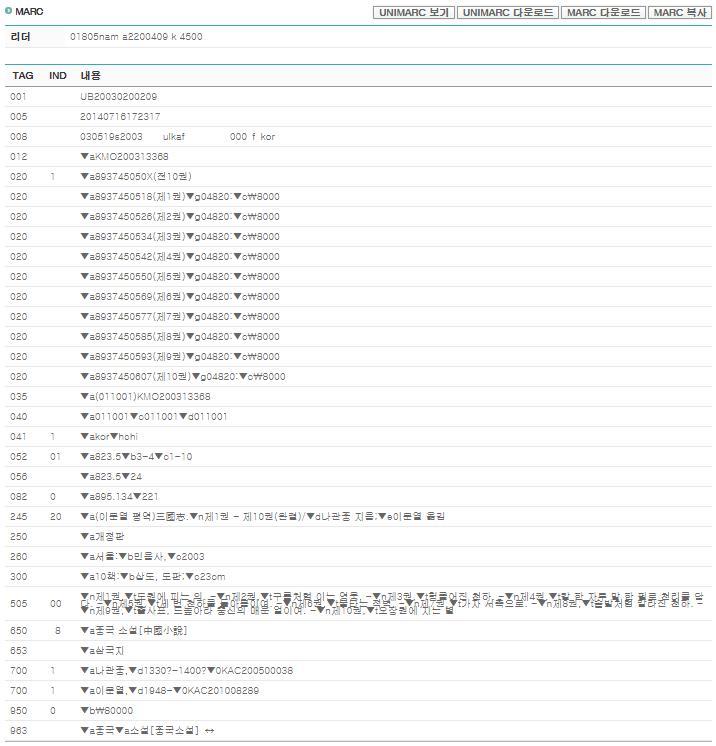 View MARC
The image above shows the cataloging result for Samgukji as seen through [View MARC]. Anyone who majored in library and information science or works in a library will probably find this screen familiar.
On this screen, you can see the bibliographic information organized around tags and divided into indicators, subfield codes, and so on.
For more on the KORMARC tags used in cataloging, the article below will be helpful.

What this article aims to cover is going one step further than the 'View MARC' screen and looking at the process that produces a screen like the one above.
You can also download the MARC file from that screen. When I downloaded the file and opened it in Hangul (a Korean word processor), the result looked like this.
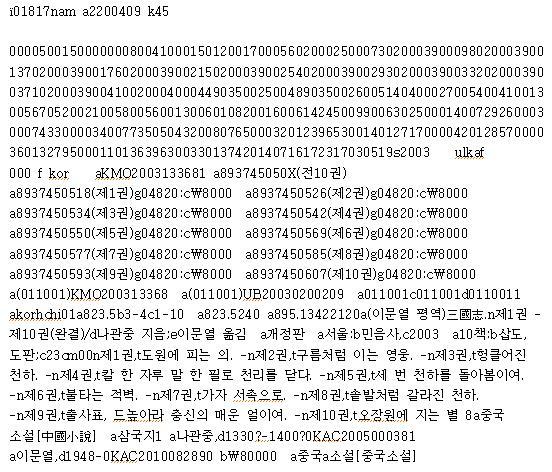 Characters that look like a jumble (raw MARC)
You will probably get a sense of something when you look at this. Unlike the neatly organized content shown on the website, it looks extremely complicated and chaotic. The order is different too: unlike the earlier content organized by tag, a long string of numbers is listed first, followed by the information about the book.
In other words, unlike the earlier view that neatly appeared in the order of tag - indicator - field, it now includes the directory, which was not visible before, and shows the information as leader - directory - field.
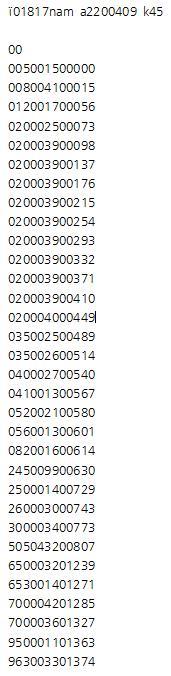 Result of organizing the numbers
The result of splitting the jumbled string of numbers into 12-digit units is shown above. If you look closely at the first three digits of each group, you will see that they are MARC tag numbers.
For reference, the '00' sitting apart at the top of the captured image should originally be part of '4500' after the leader on the top line.
Now let's use the image below to see why the numbers were split into 12-digit units, and what the leader and directory, which we could not see before, actually are.
The Structure and Principles of MARC
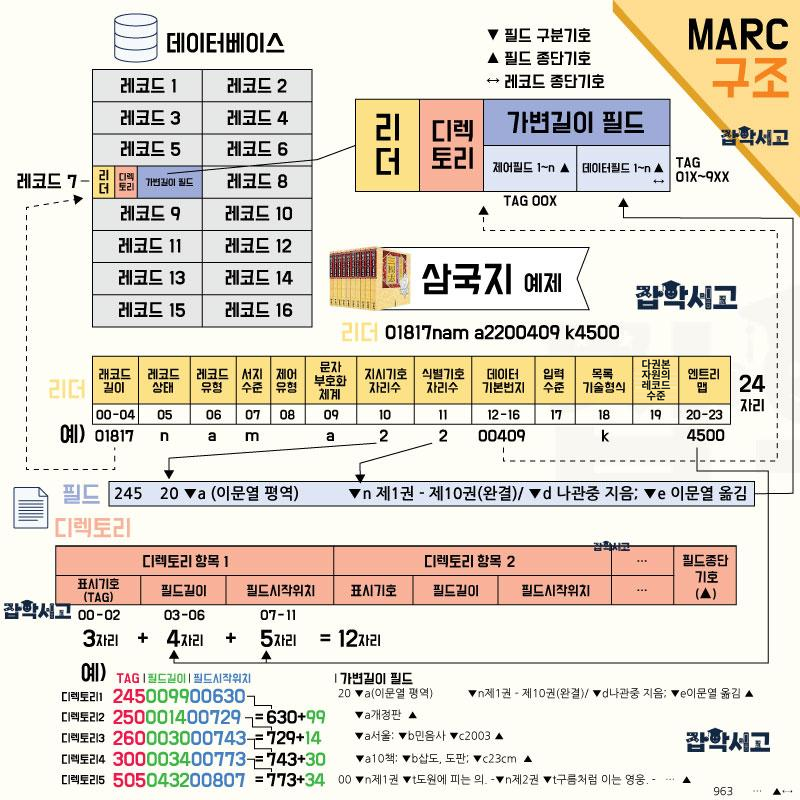 Conceptual diagram of the MARC structure
I have gathered the complicated information above into a single image so it is easy to see at a glance. It may look complicated because there is a lot of information, but if you go through it carefully one piece at a time from the top, you will see how the complicated numbers and content shown earlier are put together.
The highest-level concept is the database, which holds all the information, and within it are countless records, each holding information about one book.
(DB > Record > Leader > Directory > Field)
Each record is divided into the leader, the directory, and the variable-length fields. The leaderconsists of 24 characters and holds basic information about the record and information used for retrieval. The directoryholds information about each field, the line (row) unit in the MARC work window: TAG [3 characters], length [4 characters], and starting position [5 characters].
Each directory entry here consists of 12 characters, and in actual MARC data the entries run together without any separators until the variable-length fields begin.
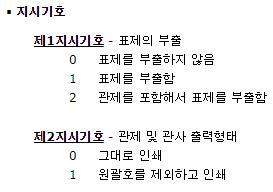 Indicators of TAG 245
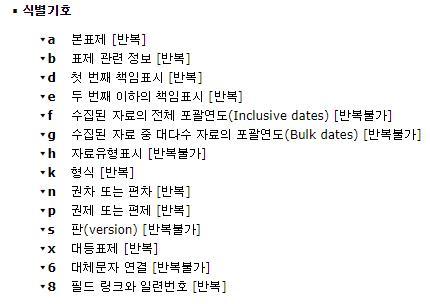 Subfield codes of TAG 245
Finally, the variable-length fieldscontain what you usually see through View MARC, such as indicators, subfield codes (▼), and bibliographic information. A field terminator (▲) is placed at the end of each field, and a record terminator (↔) at the end of each record.
That covers the structure and principles of MARC. This article is based on KORMARC for integrated bibliographic data. If a new MARC format comes out later, some parts may change, but in broad terms it will probably follow a similar approach.
If you want to master it, refer to the MARC structure, download MARC data yourself from the National Library of Korea website, and analyze each element the way this article does. That will help you become familiar with it.