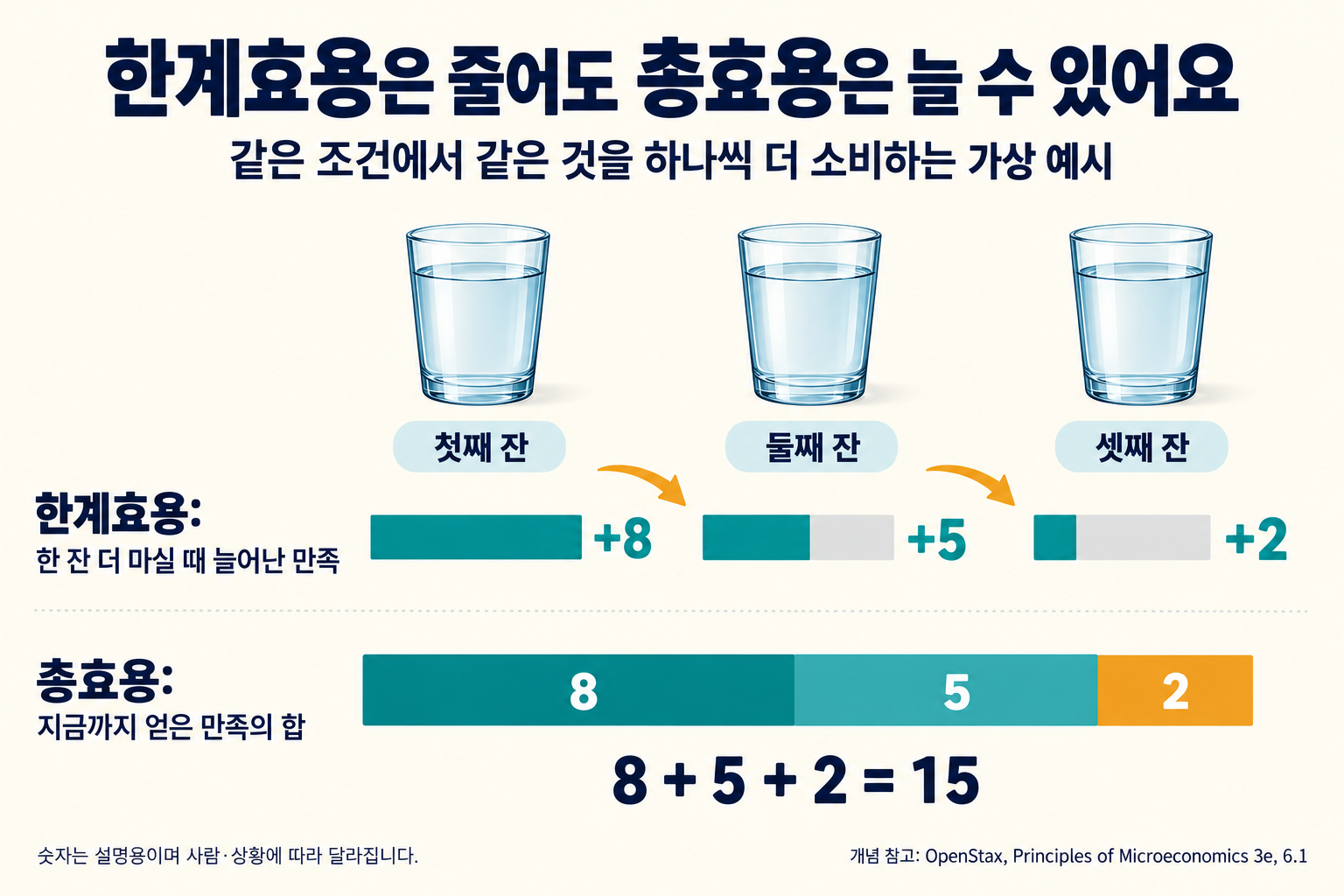
On a sweltering summer day, after a long walk, that first glass of water feels so refreshing you would not trade it for anything. Yet the second glass is not as welcome as the first, and by the fifth you no longer want to drink at all. It is the same water, but the satisfaction you get from each additional glass keeps getting smaller.
This phenomenon, in which the extra satisfaction from getting one more of something grows smaller and smaller, is called the ‘Law of Diminishing Marginal Utility’. Here, ‘marginal’ means ‘one more at the edge’, and ‘diminishing’ means ‘decreasing step by step’. It is one of the basic principles of economics, explaining what people buy, how much they buy and how they put a value on things.
In this article, we will look in turn at what marginal utility means, how this law took root in economics, the puzzle of water and diamonds, and the ways the law appears in everyday life and in policy.
Why Satisfaction Fades: How the Law of Diminishing Marginal Utility Works and Where It Applies
The Satisfaction of One More: Marginal Utility

In economics, the satisfaction a person gets from using or owning something is called utility. To understand this law, it helps to know three terms first.
- Utility: The amount of satisfaction gained from consuming a good or service.
- Total Utility: The sum of all the satisfaction gained from the entire quantity consumed so far.
- Marginal Utility: The additional satisfaction gained from consuming one more unit.
With every extra glass of water, total utility rises a little, but the size of that increase, the marginal utility, keeps getting smaller. At the point where marginal utility reaches 0, total utility is at its highest, and if you force yourself to keep drinking beyond that, you become uncomfortably full, so marginal utility turns negative. It is the same logic by which three candies are better than two, yet the twentieth candy is not nearly as welcome as the first.
How the Law Took Root in Economics

The idea that satisfaction diminishes is older than you might think.
(1) Bernoulli's Study of Gambles
In a paper published in 1738, the Swiss mathematician Daniel Bernoulli explained that the same sum of money means far more to a poor person than to a rich one. Although the study originally dealt with gambles and risk, it is regarded as the first work to state clearly the idea that marginal utility diminishes.
(2) Gossen's First Law
In 1854, the German economist Hermann Heinrich Gossen set out the principle that when the same pleasure continues, its intensity gradually declines. That is why this law is also called ‘Gossen's First Law’. His book, however, was barely read at the time.
(3) The Marginal Revolution
In 1871, William Stanley Jevons in England and Carl Menger in Austria, and in 1874 Léon Walras, who worked in Lausanne, Switzerland, each put forward a theory of marginal utility independently. This movement is called the Marginal Revolution, and when Alfred Marshall later used it to work out the demand curve, it became a foundation of today's economics.
Why Water Is Cheap and Diamonds Are Expensive

Water is essential to human life yet cheap, while diamonds, which we can live without, are extremely expensive. This puzzle, often discussed in connection with Adam Smith, is called the ‘Paradox of Value’ or the ‘water-diamond paradox’.
Seen through marginal utility, the paradox is resolved. Water is plentiful around us and we already use a great deal of it, so the marginal utility of getting one more glass is very small. Diamonds, by contrast, are very rare, so the satisfaction of owning one more is large. What sets the price is not the usefulness of the good as a whole but the usefulness of the last unit. On top of this, diamonds also cost far more to mine and polish.
For someone lost in the desert, however, a bottle of water can be more precious than a diamond. When water becomes scarce, the marginal utility of the last sip grows accordingly.
Marginal Utility in Everyday Life and Policy

This law often shows up outside the textbook as well.
(1) The Math Behind All-You-Can-Eat Restaurants
One reason buffets and all-you-can-eat restaurants can let customers eat as much as they like for a fixed price is that the more customers eat, the less satisfaction they get from one more plate, so they eventually stop on their own.
(2) Why We Buy a Variety
This law is also why people spread the same money across several things instead of buying a lot of just one. People try to divide their spending so that the marginal utility gained per unit of money becomes about equal across all goods. This is called the law of equi-marginal utility, also known as ‘Gossen's Second Law’.
(3) The Case for Taxes and Welfare
The idea that the same 100,000 won brings more satisfaction to someone who is struggling is often used as an argument supporting progressive taxation, which applies higher tax rates to higher incomes, and welfare policies.
Cases That Look Like Exceptions
A collector may feel even greater joy when filling the last empty slot, and services that become more useful when everyone uses them may bring more satisfaction as more people join. So it is more fitting to understand this law not as an iron rule that holds in every case, but as the most common tendency that explains people's choices.
Starting from the simple fact that our satisfaction dulls the more we have, the law of diminishing marginal utility explains how prices are set, how consumption is balanced and even which way policy should go.
Weighing the satisfaction that one more unit brings right now, rather than simply having more, is the first step economics offers toward understanding wise choices and consumption.