In modern society, many people experience difficulty fully acknowledging their own success and feel as though their achievements were obtained through deception. This phenomenon is called 'impostor syndrome,' a psychological state that can ultimately undermine an individual's confidence and negatively affect their mental health.
This article explores the definition and concept of impostor syndrome, examines the psychological mechanisms of self-doubt associated with success, and analyzes the social and personal factors that contribute to this syndrome. It also aims to present ways to address impostor syndrome effectively through various strategies and real-life examples for overcoming it.
What Is Impostor Syndrome? Understanding Its Definition and Concept
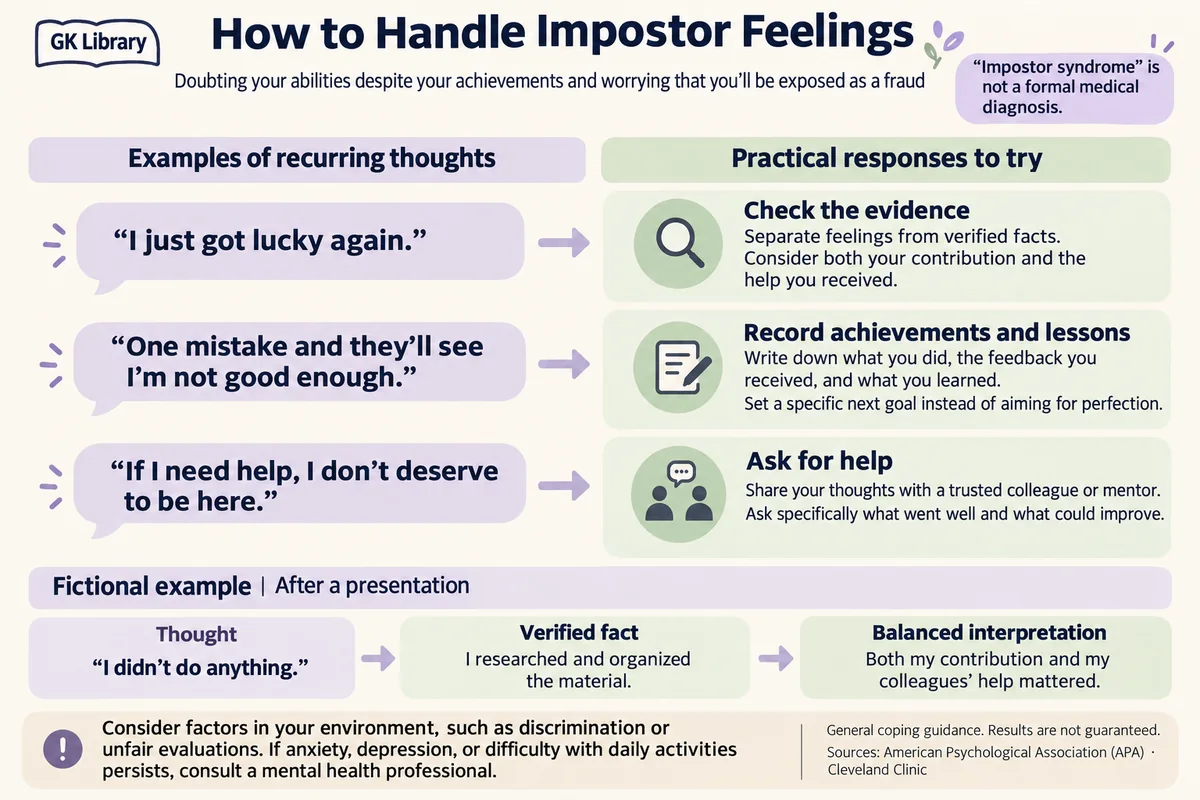

Impostor Syndrome: Definition and Concept
Impostor syndrome refers to a psychological state in which individuals cannot acknowledge their own achievements and instead believe they resulted from external factors, such as luck or help from others. It was first proposed in 1978 by psychologists Pauline Clance and Suzanne Imes and occurs particularly often among highly capable people. These individuals feel that they do not belong in their current positions and live with the fear that their incompetence could be exposed at any moment.
People who experience this syndrome may appear successful on the outside, but internally they struggle with persistent anxiety and self-doubt. It is especially common among people with academic or professional achievements, and it can cause long-term stress and anxiety to accumulate. Impostor syndrome is marked by a strong tendency to underestimate one's own abilities, attribute other people's success to their abilities, and believe that one's own success resulted from luck.
Types of Impostor Syndrome
Impostor syndrome can take various forms. Perfectionists question their abilities when they fail to meet the high standards they have set for themselves and may feel like frauds. These perfectionist tendencies amplify anxiety over even minor mistakes and lead to self-deprecation. Experts believe they must know everything perfectly and feel incompetent when they lack knowledge or make mistakes.
Other types include overworkers and soloists. Overworkers believe they must constantly work hard to achieve anything and feel undeserving of even minor achievements. Soloists lose their sense of self-worth when they receive outside help and believe they can achieve true success only by doing everything alone.
Causes of Impostor Syndrome
Impostor syndrome can arise from various social and personal factors. Childhood family environments and educational backgrounds can have a significant influence. For example, when parents or others set excessively high expectations or offer excessive praise, children may become afraid of failing to meet those expectations and lose the ability to view their achievements objectively. People also often feel inferior when comparing themselves with others under social pressure or in competitive workplaces.
In particular, structural problems such as sexism and racism can also trigger impostor syndrome. People who belong to minority groups may feel unwelcome in society and tend to underestimate themselves, unable to justify their achievements even after attaining them.
Negative Effects of Impostor Syndrome
Impostor syndrome has serious long-term effects on an individual's mental health. Persistent self-doubt and anxiety can lead to psychological problems such as depression and anxiety disorders. It can also be a major obstacle to professional performance, as the belief that one is unqualified can lead to avoiding new challenges or missing opportunities.
In particular, impostor syndrome undermines confidence and drives people to make excessive efforts to meet others' expectations, which can lead to professional burnout and declining health. People who continually question their abilities eventually become unable to truly enjoy their achievements and even lose the ability to celebrate their successes.
The Psychological Mechanisms of Self-Doubt That Accompanies Success

Success and Self-Doubt: A Psychological Dilemma
The self-doubt that accompanies success is a psychological dilemma many people face. Although success is generally seen as a positive experience, it can also place a heavy burden on individuals and cause anxiety. This psychological conflict primarily stems from an inability to properly acknowledge one's accomplishments and the pressure to meet others' expectations. The more successful people become, the more they question whether they belong in their positions, causing them anxiety and stress.
The Root of Self-Doubt: A Lack of Confidence
Psychologically, self-doubt arises from a lack of trust in one's abilities and achievements. It is directly associated with a 'lack of confidence' and becomes particularly pronounced in highly competitive environments. For example, people who receive promotions at work or achieve excellent academic results appear successful from the outside. Internally, however, they feel pressure to maintain a level of performance that matches their success, leading them to continually question their abilities.
The Vicious Cycle of Perfectionism and Self-Doubt
Self-doubt often leads to perfectionist attitudes. People experiencing impostor syndrome do not tolerate mistakes and feel a strong desire to pursue perfection. They feel that their accomplishments are not real and fear that even minor mistakes will reveal their incompetence. These perfectionist tendencies worsen self-doubt and create a vicious cycle that undermines performance. As a result, they put excessive effort into achieving their goals but blame themselves even more when the results are unsatisfactory.
Fear of Failure and Avoidance of Challenges
People who have achieved success have a strong fear of failure. They avoid new challenges because they fear that failure will serve as evidence of their limitations. They tend to settle for their current achievements and become unwilling to take on further challenges. This ultimately blocks personal growth and prevents them from exploring new possibilities. Although accepting failure and learning from it are part of success, people experiencing impostor syndrome see failure as an occasion that will expose the success they obtained through deception.
The Influence of Social Comparison
Self-doubt becomes stronger through comparisons with others. People tend to regard others' success as their own failure, envy others' accomplishments, and belittle themselves. In particular, when they recognize differences between their own performance and that of others in their social or professional environments, these comparisons deepen their self-doubt. Their own accomplishments feel meaningless and appear relatively small compared with others' achievements. This lowers their self-esteem and weakens their motivation to achieve more.
Self-Doubt That Persists Despite External Recognition
People experiencing impostor syndrome cannot fully accept recognition and praise from others. They believe that even positive evaluations or feedback from those around them have nothing to do with their true abilities and still cannot shake the feeling that they have obtained their positions through deception. This stems from a mismatch between their self-perception and others' perceptions of them and functions as a psychological mechanism that prevents them from evaluating themselves accurately. For these reasons, they continue to doubt themselves despite external encouragement and praise and find it difficult to overcome impostor syndrome.
How to Overcome Self-Doubt
To overcome the self-doubt that accompanies success, the first step is to make an effort to view one's achievements objectively. People need to record their accomplishments and acknowledge that they were based on their own efforts and abilities. They also need to abandon perfectionist attitudes and accept mistakes as opportunities for growth. Only when they overcome their fear of new challenges and value the experience of learning through failure can they escape self-doubt and continue to achieve true success.
Causes of Impostor Syndrome: An Analysis of Social and Personal Factors

The Complex Causes of Impostor Syndrome
The causes of impostor syndrome are not simple; it is a complex problem formed by intertwined social and personal factors. Various factors contribute to individuals perceiving their achievements negatively, and these factors influence one another, further intensifying the syndrome.
Social Factors: Pressure from a Performance-Oriented Society
Modern society has a firmly established culture centered on performance. This encourages constant competition and instills in people the pressure to prove their worth. From the education system to the workplace, individuals live with social expectations that they must earn recognition through excellent grades and performance. This culture of performance makes it difficult for individuals to fully accept their achievements and causes greater anxiety.
The fact that social standards for success are often unrealistic also worsens the problem. From childhood, we are expected to maintain our social standing and earn recognition through academic and professional achievements, and the obsession with success formed during this process produces constant self-doubt even after we achieve something. Such an environment instills a fear of falling short of expectations and is a major social factor contributing to impostor syndrome.
Personal Factors: Perfectionism and Self-Deprecation
Among personal factors, perfectionist tendencies play a particularly significant role in the development of impostor syndrome. When evaluating their own performance, perfectionists set high standards and regard themselves as failures if they do not meet them. This amplifies self-doubt and prevents them from viewing their accomplishments as a reflection of their true abilities, even when they receive recognition.
The family environment can also serve as a personal factor contributing to impostor syndrome. Childhood experiences of excessive expectations or comparisons from parents or teachers can lead to a lack of self-efficacy even in adulthood. These environmental factors, which lead people to continually compare themselves with others and feel inadequate, prevent them from trusting their own achievements even after they become adults.
Social Comparison and the Influence of Media
Social comparison is another important factor that reinforces impostor syndrome. In particular, in modern society with its widespread social media, people can easily encounter others' success and often feel relatively inadequate as a result. Comparing others' accomplishments with their own circumstances makes them feel inferior, and these comparisons deepen their self-doubt.
A media environment that constantly exposes people to glamorous images of successful individuals makes their own accomplishments seem relatively unimpressive, deepening their distrust of their own achievements. Through these comparisons, individuals come to feel like frauds and become unable to acknowledge themselves even after achieving results.
Gender and Race: The Influence of Social Prejudice
Identity factors such as gender and race can also worsen impostor syndrome. Women and racial minority groups, in particular, have historically tended to be undervalued or excluded. These social prejudices undermine their trust in themselves and make them feel that their accomplishments are not valid even when they receive recognition. Women tend to underestimate themselves even when they achieve more at work, and this phenomenon further intensifies impostor syndrome.
Racial minorities may also experience impostor syndrome more frequently because of social inequality. They fear that their accomplishments will not be evaluated fairly because of social prejudice, leading to a lack of confidence. These social and structural problems make impostor syndrome even more complex.
The Need for a Comprehensive Approach
Impostor syndrome is a multidimensional problem, and addressing it requires considering both social and personal factors. Because performance-oriented social pressure, individual perfectionist tendencies, social comparison, and identity factors such as gender and racial discrimination interact in complex ways, overcoming this syndrome requires an approach from multiple angles. Impostor syndrome can be overcome effectively only when personal efforts are accompanied by social support and institutional improvements.
Strategies for Overcoming Impostor Syndrome: Methods and Examples

Strengthening Self-Awareness
Above all, increasing self-awareness is important for overcoming impostor syndrome. People need to practice evaluating their achievements objectively and feeling an appropriate sense of pride in them. To do so, it is essential to record their accomplishments in detail and confirm for themselves that these resulted from their own abilities. Taking time to recognize their accomplishments can reduce unnecessary self-doubt and help them develop a positive self-perception.
Avoiding Social Comparison
One of the main factors that worsens impostor syndrome is constant comparison with others. Social comparison diminishes individuals' achievements and makes them feel incompetent. To overcome this, they need to focus on their own progress rather than on others' success. Setting small goals and gradually achieving them is an effective way to develop a sense of personal accomplishment. It is important to follow one's own path without dismissing others' accomplishments as one's own failures.
Overcoming the Fear of Failure
The fear of failure has a particularly severe impact on people experiencing impostor syndrome. However, failure is an essential part of growth, and successful people have also experienced countless failures. Rather than fearing failure, it is important to accept it as an opportunity for growth and use the lessons learned in the process to achieve better results. Acknowledging what one has learned from failure, instead of doubting oneself because of it, helps reduce the fear of new challenges.
Making Use of Support Systems Around You
Making good use of the support systems around you is an effective way to overcome impostor syndrome. You can restore your confidence by openly sharing your feelings with friends, family, and colleagues and receiving their feedback. In particular, realizing that you are not alone through conversations with people who have had similar experiences can provide psychological comfort and peace of mind. These support systems offer substantial help during emotionally difficult times.
Considering Professional Help
If impostor syndrome has a serious impact on daily life or is difficult to overcome alone, professional help is necessary. Psychological counseling or coaching is a useful tool for sorting through one's emotions and overcoming impostor syndrome. Professional advice can help people understand themselves more deeply and build a positive self-image. This is a great help in managing their emotions more systematically and freeing themselves from anxiety.
Celebrating Achievements and Acknowledging Yourself
Finally, it is important to develop the habit of celebrating one's achievements. Acknowledging and celebrating even small achievements, as well as major accomplishments, can strengthen a positive self-image. Fully enjoying moments of achievement and using them to form positive evaluations of oneself plays a significant role in easing impostor syndrome. Celebrating what one has achieved can increase confidence and serve as a starting point for achieving better results.
Impostor syndrome is a psychological problem shared by many people, and overcoming it requires reflecting on one's inner self and establishing a positive self-image. By using appropriate strategies based on an understanding of its social and personal factors, it is possible to free oneself from the psychological burden it causes.
Through this, people can fully accept their achievements and regain true confidence. Those who have overcome impostor syndrome will be able to experience greater success and satisfaction based on their belief in themselves.