Love is one of the most powerful and complex emotions in human life. While this complexity of love is fascinating in itself, understanding and assessing our types of love plays an important role in personal growth and the improvement of interpersonal relationships.
Psychology also studies behaviors and tendencies related to types of love, and identifying the type of love we are experiencing can help us understand and develop both ourselves and others.
The Importance of Analyzing Types of Love in Psychology
 What Is Love in Psychology?
The analysis of types of love is considered a very important topic in psychology. People differ individually in how they express and experience love.
By classifying and understanding various types of love, psychologists seek to understand the nature of love and study its effects on individual behavior and personality.
Through this analysis, we gain a deeper understanding of love, which can help us form and maintain better relationships.
Personal Growth and Understanding Through Assessing Types of Love
 The Need to Identify Types of Love
Assessing types of love is a very useful tool for personal growth and understanding. If we know our own type of love, we can better understand our own needs and desires, which can contribute to self-development.
Assessing types of love also plays an important role in relationships with others. If we identify the other person's type of love, we can better understand their behavior and reactions and build a healthier relationship in which we accept and respect each other.
Classifications and Characteristics of Types of Love
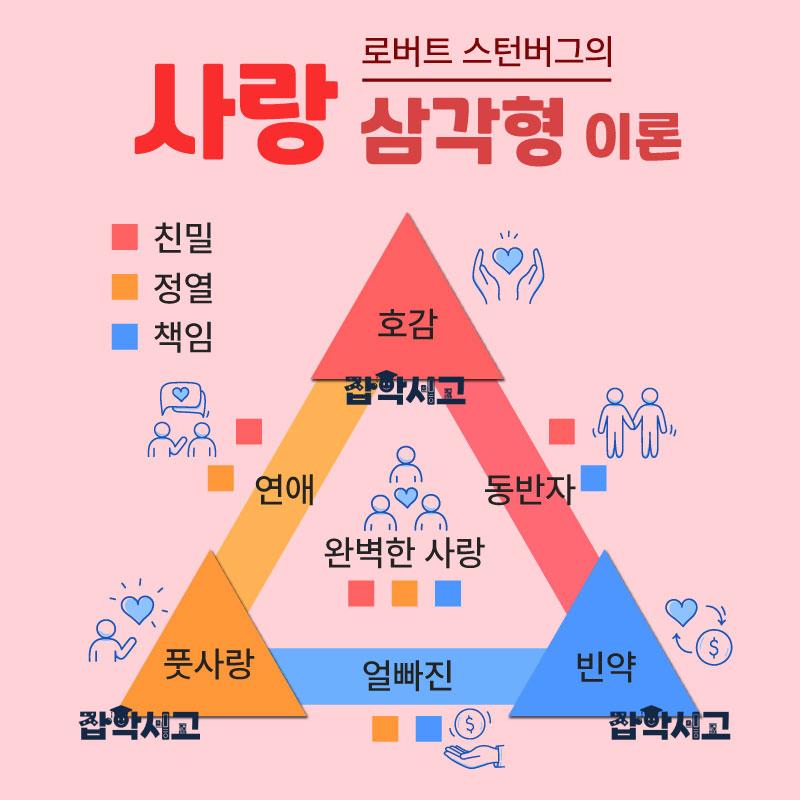 Robert Sternberg's Triangular Theory of Love
Love is a complex emotion that can be classified into various types and dimensions. Among these, the most widely cited classification approach is psychologist Robert Sternberg (Robert Sternberg)'s 'triangular theory of love (Triangular Theory of Love).'
Sternberg divided love into three main components. These are passion (Passion), intimacy (Intimacy), and commitment (Commitment), and he explained various types of love through different combinations of these three components.
The image above was created as a graphic to aid understanding, and viewing it alongside the information summarized below will be helpful.
Affection (Friendship) (Liking)
Characteristics: Includes only intimacy
This is love based on deep intimacy without passion or commitment. It is mainly found between friends.
Infatuation (Infatuated Love)
Characteristics: Includes only passion
The expression 'falling in love' fits this type well, and it is characterized by strong physical attraction or intense emotions. An example would be a fan who likes a particular celebrity very much.
Empty Love (Empty Love)
Characteristics: Includes only commitment
This is a relationship maintained solely by commitment, without emotional intimacy or passion. For example, it is a form of relationship that can be seen in marriages arranged for strategic reasons.
Romantic Love (Romantic Love)
Characteristics: Includes intimacy and passion
This is love that involves both strong attraction to each other and deep intimacy. It is generally the form of relationship found in dating.
Companionate Love (Companionate Love)
Characteristics: Includes intimacy and commitment
It is characterized by deep intimacy and commitment that endures over a long period. It can be seen among friends who have been together for a long time or elderly married couples.
Fatuous Love (Fatuous Love)
Characteristics: Includes passion and commitment
This is a form of love based on strong passion in which commitment develops quickly, as in a quick marriage.
Perfect Love (Consummate Love)
Characteristics: Includes intimacy, passion, and commitment
This is a complete form of love in which all three components are present in balance. It is considered the ideal form of love that many people seek.
Each type can appear at different stages of a relationship or in various situations, and one type can change into another over time.
These types of love can also be interpreted differently depending on personal experiences, cultural backgrounds, personalities, and other factors.
In psychology, analyzing types of love is a very important tool for understanding and improving our loving relationships. Assessing types of love gives us opportunities to understand ourselves and others and to grow.
By examining the classifications and characteristics of various types of love, we can form and maintain better relationships. By understanding love from a psychological perspective, we can enrich our interactions with ourselves and others.
Through this understanding, we will be able to overcome the complexity of love and achieve personal growth and improvements in interpersonal relationships.