This article will cover the basic things you should know when attending a job interview at a company, organization, or similar workplace. Since knowledge about writing personal statements and attending interviews will come into use in some way in your working life, you need to have a basic understanding of it.
However, attending an interview without knowing the minimum interview skills or appropriate attitudes can lead to misunderstandings, such as appearing insincere or lacking determination despite your intentions, so you need to be careful.
This article will set out the essential points you should know about these interview precautions and considerations.
Before proceeding, please refer to the material below for guidance on writing a personal statement. Familiarizing yourself with it alongside this article may be helpful.
 How to Write a Personal Statement (Read More)
Interview Precautions
 Pay Attention to Your First Impression and Attitude
An interview is an occasion when staff members or executives from a company or organization meet an applicant for the first time. From a psychological perspective, the primacy effect plays a significant role here. In other words, people form judgments about someone to some extent based on their first impression, and that impression stays in their memory for a long time.
Attire
For this reason, wearing a suit or neat clothing can help you create a more professional and trustworthy image. Even if you are told to dress comfortably, you should be careful because your clothing can affect the impression the interviewer forms of you.
Greetings
Also, please remember to offer at least a brief greeting when entering or leaving the interview room. As the saying goes, greeting people well is half the battle in social life, and greetings are the foundation of interpersonal relationships. When you first come face to face with someone, it is a good idea to begin the conversation casually with a greeting.
Posture
You should also pay attention to your posture throughout the interview so that you do not appear overly nervous or arrogant. If possible, keeping your legs neatly together and resting both hands on your knees will make you appear well-mannered and conscientious.
It is also important to make eye contact with the interviewer when speaking, and when there are several interviewers, you should mainly look at the interviewer who asked the question while occasionally looking at the others nearby.
Also, if other applicants enter the interview room with you, listening carefully when they speak as though their story were your own, rather than listening indifferently, and even giving a slight nod can leave a good impression.
Points to Keep in Mind When Answering
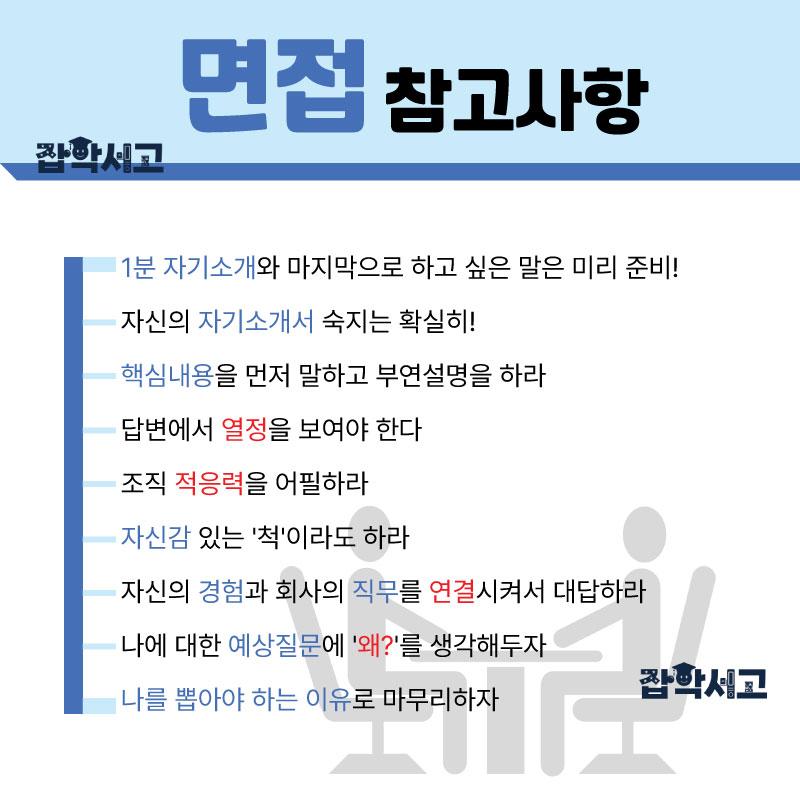 Points to Keep in Mind During Interviews
1-Minute Self-Introduction and Closing Remarks
The basic things you should prepare for an interview are a 1-minute self-introduction and what you would like to say at the end. Since most companies routinely ask about these things, applicants can prepare them in advance, and they provide an initial opportunity to leave an impression on the interviewer.
Also, since most questions are based on your résumé and personal statement, you should at least be thoroughly familiar with everything written in your own personal statement.
For your 1-minute self-introduction, it is a good idea to briefly state the key points about who you are, then explain why you applied to this company, what you have to offer toward that goal, and how you will carry out your work and benefit the company or organization in the future.
In particular, it is important to mention your expertise related to the role. This is because the company will ultimately want the applicant to adapt well to the work and produce results worth more than what it invests in them, such as their salary.
Answering Questions
 Make the Case for Why You Belong Here
When answering an interviewer's question, stating the main point first and then providing additional explanation helps the interviewer focus on what you are saying and makes your main point clearer.
You should also highlight your enthusiasm to grow at this company and make a positive contribution, and clearly explain that you can get along with its members and adapt well to its organizational culture.
No matter how capable someone is, it would be difficult to find an organization in South Korea that welcomes a talented person who cannot get along with its members.
Always Remember 'Why?'
Another keyword you must keep in mind during an interview is 'Why?' Interviewers do not ask questions without a reason. Their questions are intended to find out something about an applicant or examine aspects of them that are hidden.
Every answer, including why you specifically applied to this company, why you want to do this work, and why you changed jobs or careers, needs a sound reason so that you can make a logical case to the interviewer.
Emphasize Your Relevance to the Role
Even if you have no experience directly related to the work you applied for, it is very important to connect the various experiences you have had in life to that work. No experience in life is ever useless, and thinking about how to connect it to the work is a point applicants should particularly keep in mind.
 Closing Remarks Matter Too
In your final remarks, explaining why this company or organization should hire you, what role you can play there, and how you can demonstrate your trustworthiness can help you finish the interview on a positive note.
This concludes our discussion of precautions, points to keep in mind, and brief interview tips for companies, organizations, and other places that require interviews.
Because interviews are nerve-racking occasions in which you present yourself to people you are meeting for the first time, they are by no means easy, but I hope that even if you feel nervous, you will at least 'pretend' to be confident and succeed in finding a job.