When a new market opens up, companies rush to attach the word ‘first’ to themselves. They believe that getting in before everyone else is the way to win all the customers. Yet a look at history shows that for every company that blazed the trail and stayed number one to the end, there is another that gave up its place to a company that came after it.
The advantage a company enjoys because it was the first to enter a market is called ‘first-mover advantage’. It is also known as the pre-emption effect, while the opposite advantage, which a late entrant gains by watching and learning from the trial and error of those ahead of it, is called second-mover advantage.
In this article, we will look in turn at the principle behind first-mover advantage, the disadvantages pioneers face, the surprising results that research has revealed, and strategies for choosing when to enter.
Lead or Follow? How First-Mover Advantage Works and Where It Ends
Three strengths gained by entering first

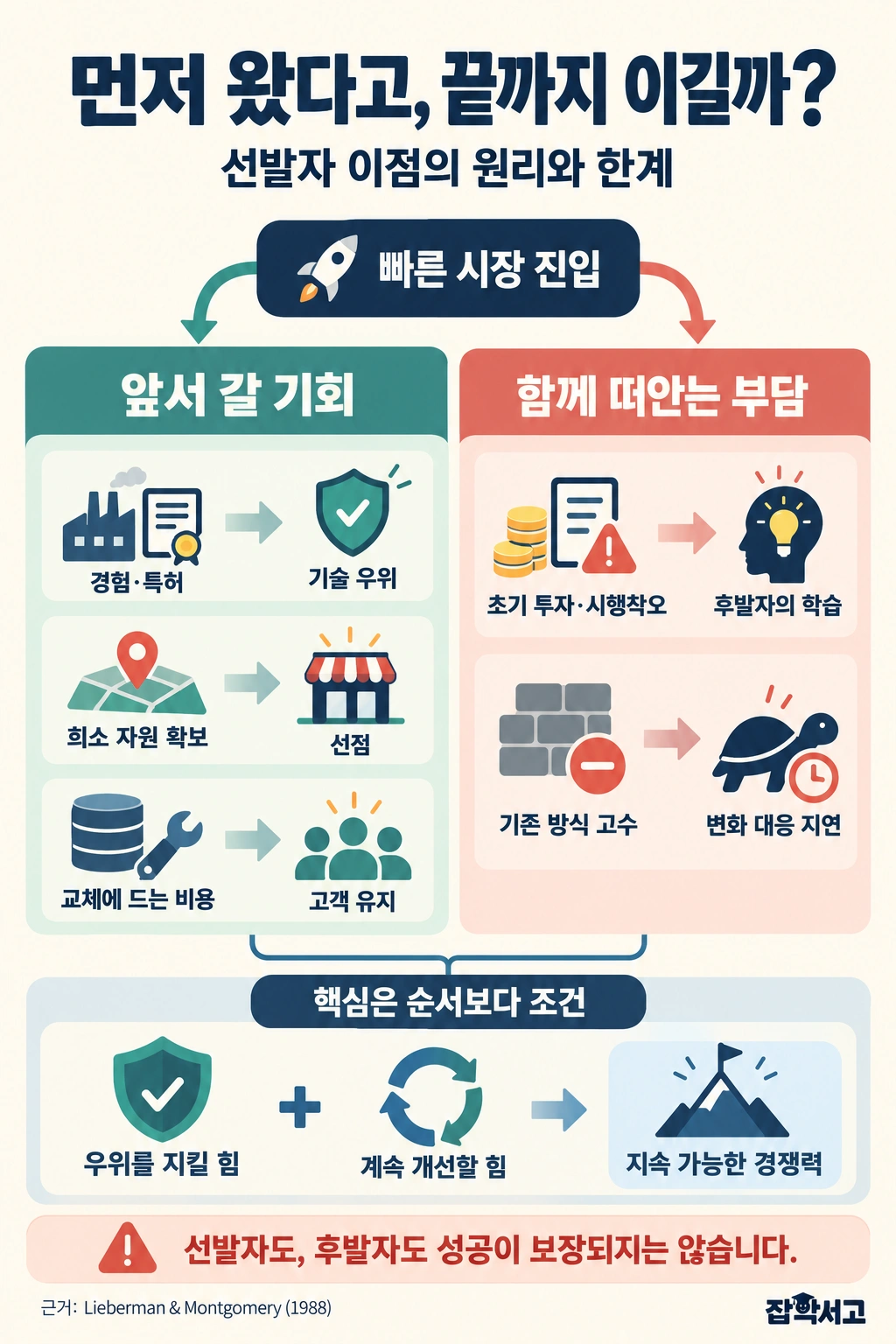
In 1988, Marvin Lieberman and David Montgomery of Stanford University in the United States published a landmark paper on first-mover advantage. They divided the strengths gained by companies that enter first into three broad types.
(1) A technology lead
The company that makes a product first can obtain patents and, through the experience of making it in large numbers, lower its production costs faster than others. A company that follows usually finds it costs more to make the same product, at least at first.
(2) Pre-empting the best resources
Prime locations, outstanding talent and reliable suppliers of raw materials go to whoever arrives first. A frequently cited example is America’s Walmart, which secured its position by opening stores in small towns that had no large discount stores.
(3) Switching costs that keep customers
Customers who have grown used to the first product they tried rarely switch to another. This is also why brands such as Coca-Cola and Kleenex, which are used almost as names for whole product categories, lead their markets for so long.
These three strengths can also reinforce one another. A company that wins customers first sells more and lowers its production costs, then uses those lower prices to attract still more customers, widening its lead.
The high price pioneers pay

Going first comes at a price, too. The earlier research also pointed out the disadvantages that first movers face.
- Free riding (Free-Rider Effect): Companies that follow can copy, at far lower cost, the technology and market research that the first mover spent heavily to develop.
- Market education cost (Market Education Cost): A great deal of advertising money is needed to explain from scratch why customers need an unfamiliar product.
- Uncertainty (Uncertainty): Large investments must be made without knowing what customers really want or which technology will become the standard.
- Complacency (Incumbent Inertia): Once established, a company tends to be tied to its existing facilities and ways of doing things, and to respond sluggishly to new change.
The Newton, a personal digital assistant that Apple launched in 1993, is counted as the product that opened up its market, but it was expensive and often misread handwriting, so it never caught on widely. That place was taken by the smaller, easier-to-use Palm Pilot.
The surprising results of research

For a long time, many studies reported that companies entering first enjoyed a high market share of around 30% on average. But there was a big trap hidden in these results.
(1) Counting only the survivors
The existing data left out almost all first movers that had already failed and disappeared. Averaging only the companies that survived made it easy to conclude that going first leads to success.
(2) A second look through historical records
In 1993, Peter Golder and Gerard Tellis re-examined the historical records of about 500 brands in 50 product categories. They found that 47% of the companies that had pioneered a market failed, and their average market share was just 10%. In durable goods, where technology changes quickly, the failure rate was more than twice as high as in nondurable goods.
(3) The real winners were fast followers
Many of the companies that led their markets for a long time entered about 13 years later than the pioneers on average. Amazon, which started later than Book Stacks Unlimited, an online bookstore that opened in 1992, eventually taking over the market is a similar example.
Knowing when to enter

In the end, what matters is not being ‘the very first’ but choosing ‘the right time’. It helps to separate the situations in which first-mover advantage grows from those in which it shrinks.
(1) When going first pays off
Services that become more valuable the more people use them, products that are a hassle to switch away from, and technologies that can be firmly protected by patents all favor whoever establishes a position first, for a long time.
(2) When following pays off
In markets where technology changes quickly or customers’ tastes are not yet settled, the fast follower strategy, entering with a better product after watching the mistakes of those ahead, comes into its own.
(3) Why what comes after going first matters more
Being called a first mover is only the starting line. A lead lasts only if the company keeps improving its products and working to keep its customers. Only companies that quickly build the experience they gained early and the voices of their customers into their next products can hold on to their initial advantage for long.
First-mover advantage gives early entrants a clear opportunity, but it does not guarantee victory in itself. That is because going first also means shouldering costs and risks.
Rather than getting carried away by the thrill of moving faster than others, look at both when the market will be ripe and what your own strengths are. That is the first step of a strategy that turns opportunity into results.