The owner of a popular neighborhood bakery is lost in thought. She wants to grow sales, but it is hard to decide whether to sell more bread to regulars, open another shop in the next neighborhood, or start a completely new menu or business. The tool that neatly sorts the options at such a daunting crossroads of growth into four boxes is the “Ansoff Matrix.”
Put simply, the Ansoff Matrix is “a table that splits ‘what to sell (products)’ and ‘whom to sell to (markets)’ into existing and new, showing the four growth strategies a company can choose.” It is also called the Product-Market Growth Matrix, and it also shows that each box carries a different level of risk.
In this article, we will look in turn at the background of how the Ansoff Matrix was born, what the four growth strategies involve, and real examples along with its limits.
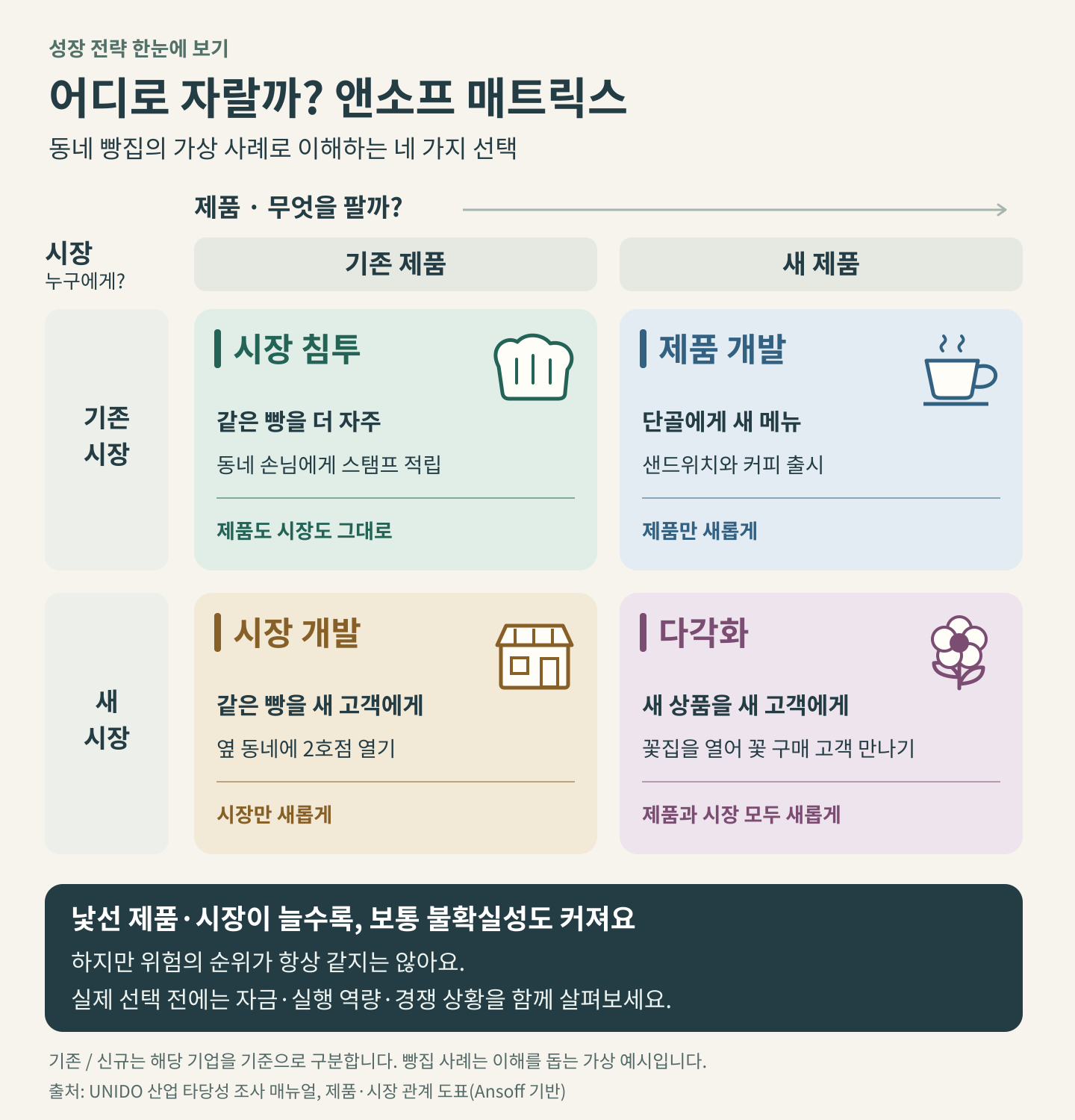
A Four-Way Growth Map Drawn with Products and Markets
How Was the Ansoff Matrix Born?

The person who created the Ansoff Matrix was Igor Ansoff, a Russian-born American management scholar. Born in Vladivostok in 1918, he moved to the United States in the mid-1930s, earned a doctorate in applied mathematics from Brown University in 1948, and worked at the RAND Corporation analyzing weapons procurement problems for the U.S. Air Force. In 1957 he moved to the aircraft company Lockheed, where he took charge of diversification work, looking for ways for the company to branch out into new businesses. That same year, he first introduced this framework in his paper “Strategies for Diversification,” published in the Harvard Business Review.
At the time, many companies were focused only on increasing sales and did not systematically consider which direction to grow in. Ansoff argued that the options become clear when growth is viewed along two axes, products and markets. With his 1965 book “Corporate Strategy,” he contributed greatly to opening up the field of strategic management, and today he is sometimes called “the father of strategic management.”
4 Growth Strategies in Four Boxes

The matrix has products on the horizontal axis and markets on the vertical axis, and each is split into existing and new to create four boxes.
(1) Market Penetration
A strategy of selling more existing products in existing markets. Companies run more discount events, reward coupons and advertising so that regulars buy more often, or win over competitors’ customers. Because it deals with products and customers the company already knows well, it carries the lowest risk of the four strategies.
(2) Market Development
A strategy of selling existing products in new markets. Opening branches in other regions, exporting overseas, and supplying a product once sold for home use to companies or schools also fall into this category.
(3) Product Development
A strategy of offering new products to existing customers. Because it introduces new menus or new features by borrowing the strength of a brand that customers already trust, investment in research and development is important.
(4) Diversification
A strategy of entering new markets with new products. Because both the product and the customers are unfamiliar, it carries the greatest risk of the four strategies. Generally, the further one moves from market penetration toward market development or product development and then diversification, the more there is to learn and the greater the risk of failure.
Understanding the Four Choices Through a Bakery and Real Companies

If we put the bakery owner’s dilemma from earlier into the four boxes, the options become clear at a glance.
- Market Penetration: Hand out stamp cards to regulars and offer a breakfast set discount so they buy the same bread more often.
- Market Development: Sell the same bread at a second shop in the next neighborhood and through online delivery to meet new customers.
- Product Development: Launch new sandwich and coffee menus for existing customers.
- Diversification: Take on a completely new field, such as opening a flower shop or jumping into the café interior business.
Diversification That Builds on Existing Strengths: Fujifilm
Not all diversification is a reckless gamble. When the photographic film market shrank sharply as digital cameras took over, Japan’s Fujifilm drew on the collagen research it had built up making film and on antioxidation technology that keeps photos from fading, entered the cosmetics field in 2006, and released anti-aging skincare products the following year. It focused on the fact that collagen, the main ingredient of film, is also the main component of human skin. Diversification connected in this way to technology or capabilities a company already has is called “related diversification,” and it can reduce risk compared with unrelated diversification into a completely unconnected field.
Limits to Keep in Mind When Using the Ansoff Matrix

The Ansoff Matrix is simple enough for anyone to use easily, but for that same reason it also misses some things.
(1) It does not capture competitors’ reactions
The table only shows our own company’s options; situations where competitors cut prices or jump into the same market must be considered separately.
(2) The standard for “new” is vague
Making a truly new product often naturally means meeting unfamiliar customers. That is why some critics say the line between product development and diversification becomes blurred.
(3) Execution capability must be checked separately
Whichever box you choose, the table alone cannot tell you whether you have the people, money and organizational flexibility to pull it off. That is why it is best used together with other tools such as SWOT analysis or industry structure analysis.
The Ansoff Matrix has been used in business for more than half a century, turning the vague goal of growth into four concrete paths. Whether to expand step by step from familiar ground or take a big leap into unfamiliar territory ultimately depends on how much risk we can handle.
Taking a cool-headed look at the products and customers we have now, and weighing which box to move toward along with its risks, is the first step of a steady growth strategy.