A good teacher often asks “Why did you think that?” instead of giving the answer right away. It can feel frustrating at first, but as you answer one question after another, you find yourself moving closer to the answer on your own. This old way of teaching, which began on the streets of Athens some 2,400 years ago, is the ‘Socratic Method.’
Put simply, the Socratic Method means ‘a way of conversing in which the teacher, instead of handing over knowledge, keeps asking questions so that the learner discovers contradictions and gaps in their own thinking and reaches a conclusion for themselves.’ It is often cited as a prototype of learning that builds the power to think, not the habit of memorizing right answers.
In this piece we will look in turn at the meaning and origins of the Socratic Method, the stages a dialogue tends to follow, how it is used in classrooms and lecture halls, and points to watch when putting it into practice.
The Art of Dialogue That Grows Thinking Through Questions and Answers
What Is the Socratic Method?
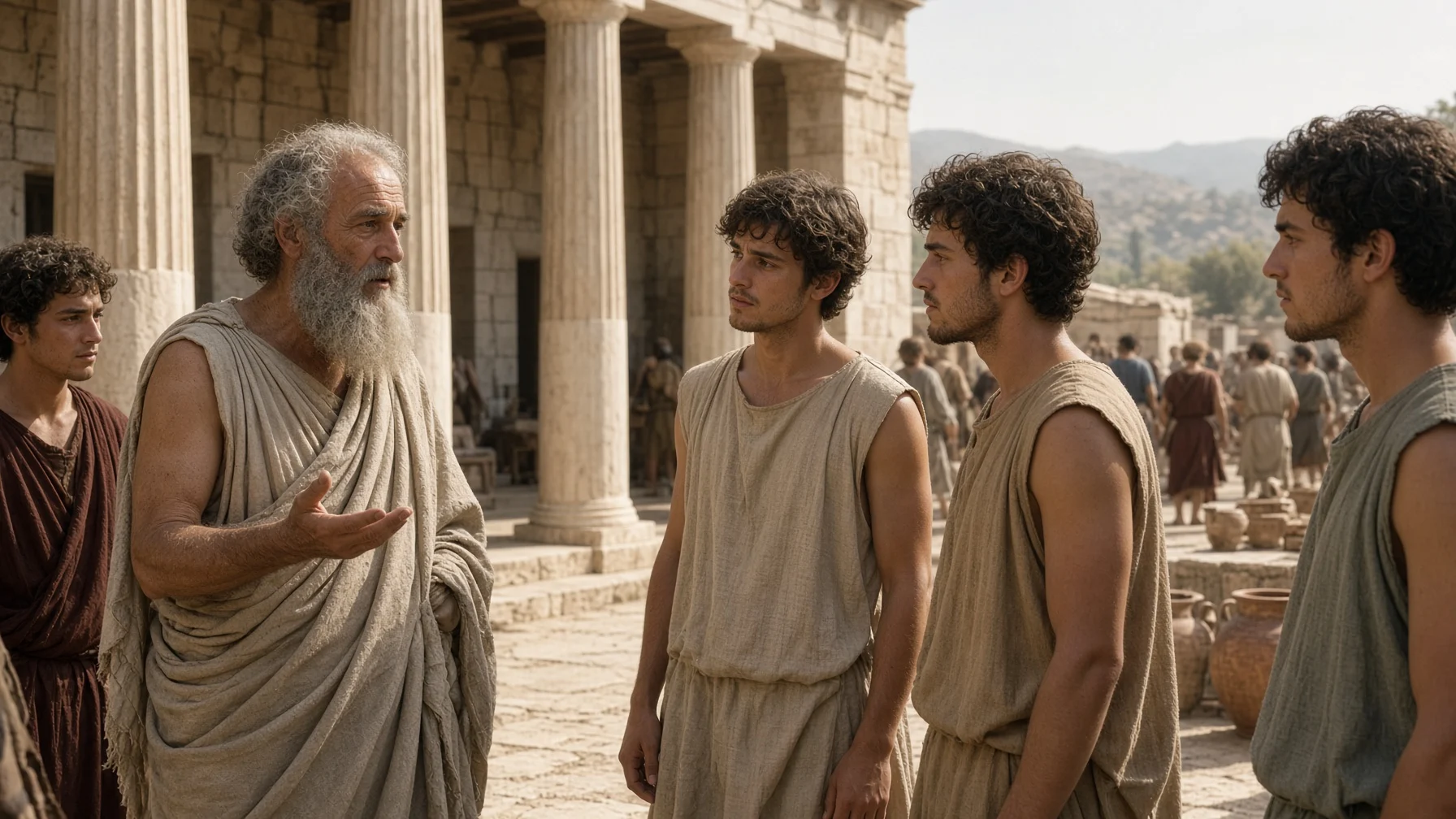
The ancient Greek philosopher Socrates left not a single book. Most of the dialogues we know are preserved in the dialogues written by his student Plato.
(1) Philosophy That Began with Questions
When Socrates’s friend Chaerephon brought back an oracle from the Temple of Delphi saying that “no one is wiser than Socrates,” Socrates treated the words as a riddle. He went around questioning people reputed to be wise and found that they believed they knew what they did not. He concluded that his only advantage was knowing that he did not know.
(2) The Nickname Midwifery
In Plato’s dialogue Theaetetus, Socrates compared his method to the work of a midwife who helps deliver a child. The point is not to insert knowledge but to help thoughts already inside the other person come out. For that reason the method is also called ‘Maieutics.’
Four Stages in the Flow of Question-and-Answer
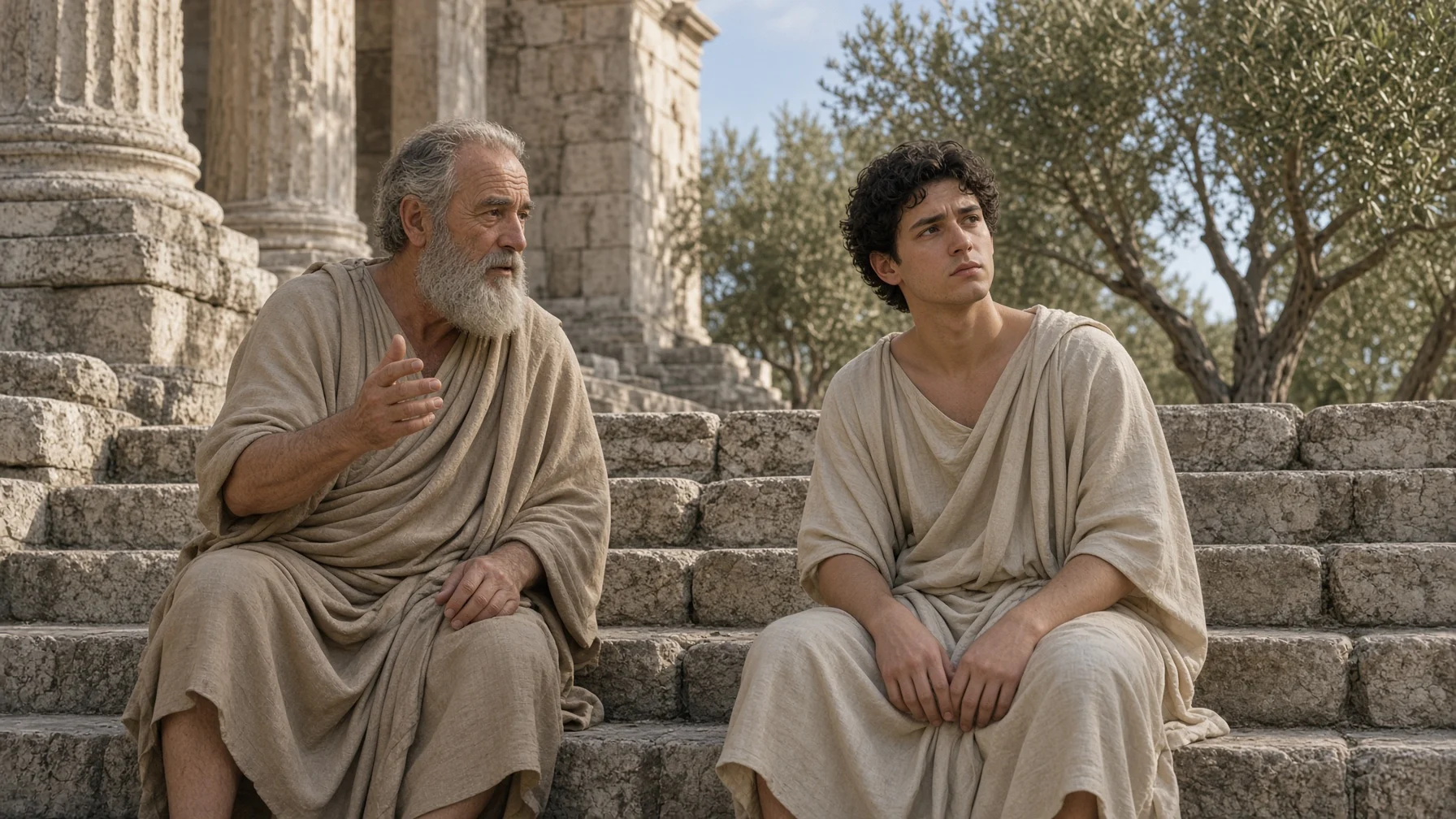
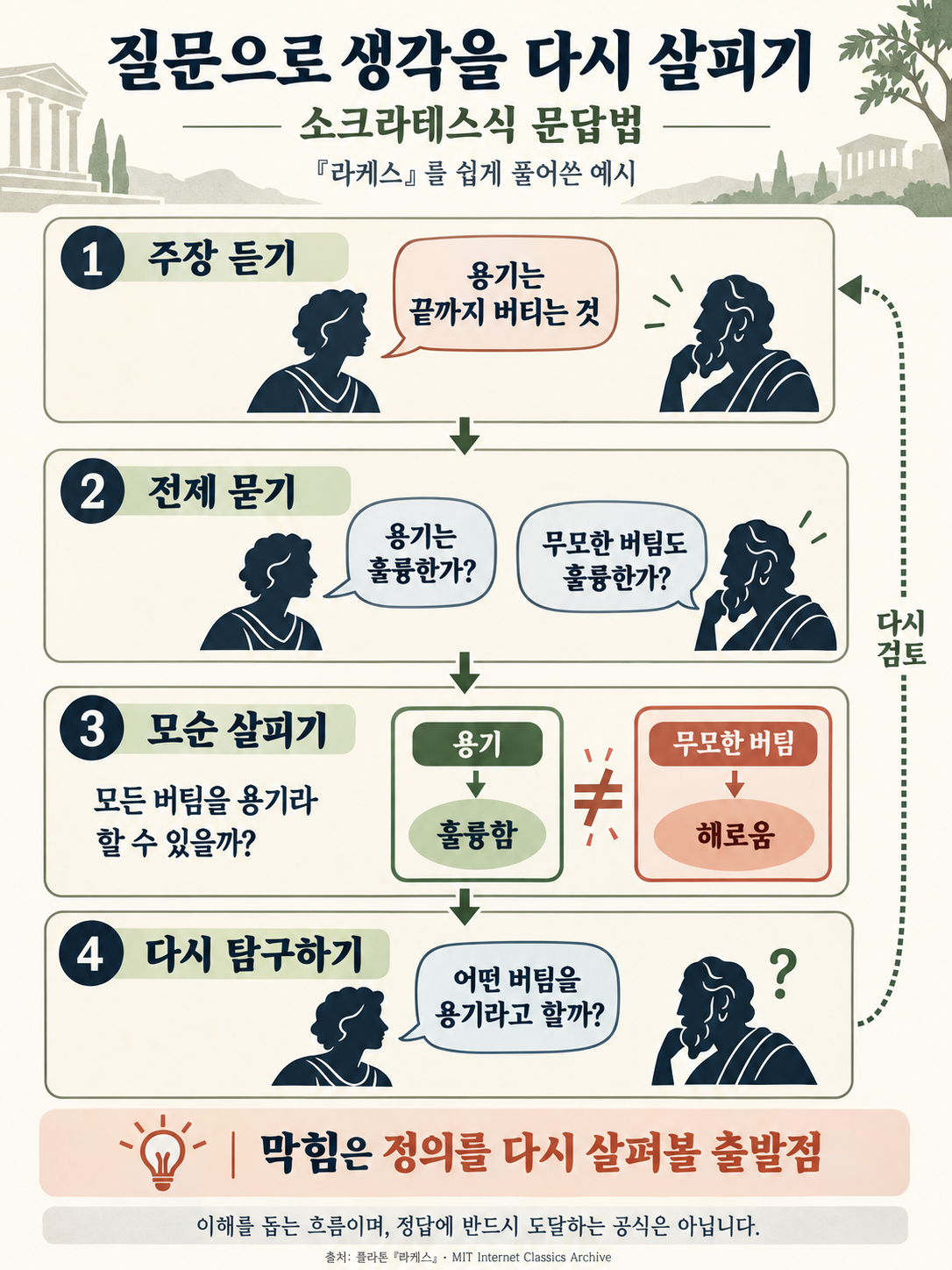
At the center of Socratic dialogue is ‘Elenchus,’ the probing of the other person’s claims. A simplified version of the flow scholars have outlined goes as follows.
- Hearing the claim (Thesis): The other person first states what a concept means, for example “Courage is holding out to the end.”
- Checking the premises (Premises): Questions the other person is likely to accept are asked in turn, such as “Is courage something excellent?” and “Is reckless endurance also excellent?”
- Finding the contradiction (Contradiction): The other person is led to see for themselves that what they agreed to does not fit their original claim.
- Impasse and a fresh start (Aporia): The other person reaches a stuck state of “I no longer know,” and that becomes the occasion to search together for a better definition.
What matters here is not treating the impasse as failure. The view is that genuine learning begins only after one leaves the state of mistakenly thinking one knows.
The Socratic Method in the Classroom

This method of learning through questions is still used today in many educational settings, in forms that keep changing.
[Case 1] Meno and the Square Problem
In Plato’s dialogue Meno, Socrates asks a boy who has never studied geometry—someone who attended Meno—what the side of a square with twice the area should be. The boy first answers that doubling the side will do, then realizes he is wrong. Socrates only keeps asking questions while drawing figures on the ground, and the boy finally finds for himself that using the diagonal of the original square as a side will work. Socrates explained this not as something newly taught but as the soul recalling what it already knew—Plato’s ‘Anamnesis,’ or theory of recollection.
[Case 2] Case Teaching at Harvard Law School
When Christopher Columbus Langdell became dean of Harvard Law School in 1870, he replaced lectures that had students memorize law with case teaching in which students read actual cases and, answering the professor’s questions, work out legal principles. The approach became the standard for legal education in the United States and spread to other professional programs such as business schools.
[Case 3] Student-Led Socratic Seminars
In middle and high schools, students use ‘Socratic seminars’ in which they sit in a circle and exchange questions about a text they have read in advance. While an inner circle discusses, an outer circle listens and takes notes before sharing views, and the teacher’s role is less to give answers than to help the conversation continue.
Practices and Cautions for Asking Good Questions

The question-and-answer method does not work by asking many questions alone. The direction of the questions and the atmosphere of the dialogue have to be in place together.
(1) Types of Questions That Widen Thinking
In education, questions are often sorted using categories from the critical-thinking researcher Richard Paul. Typical types include questions that clarify meaning (“For example?”), examine premises (“What did you take for granted?”), ask for evidence (“How do you know?”), invite other perspectives, weigh consequences, and reflect on the question itself.
(2) So It Does Not Become Humiliation
If questions keep pressing hard, learners tend to shrink rather than think. The philosopher Peter Boghossian has also warned that the method, used badly, can leave learners feeling shame or humiliation. What is needed is respect for the process of thinking rather than blame for wrong answers, and the patience to wait long enough.
Socrates said that “the unexamined life is not worth living.” His method is not a technique for finding right answers quickly, but closer to an attitude of realizing what one does not know and searching together for better answers. In an age overflowing with information, the power to ask good questions becomes even more precious.
Asking once more before giving the answer: that is the first step toward learning that thinks for itself.