Imagine looking for a travel book in a bookstore. One day you want a travel guide to ‘Japan’; another day you want one ‘published in the 2020s and built around photographs.’ But the shelves are arranged in only one order, so finding books by country is easy while finding them by publication year or format is hard. Splitting a subject into several aspects in advance and combining them when needed—that is ‘Faceted Classification.’
Put simply, faceted classification means ‘dividing a subject into several non-overlapping aspects—such as object, material, activity, place, and time—and joining the symbol for each aspect to build a single class number.’ A facet is one of the cut faces of a gemstone, and the word carries the idea of viewing one subject from many sides.
In this piece we will look in turn at the basic idea of faceted classification, Ranganathan’s Colon Classification, how it differs from enumerative classification, and the facets found on today’s search screens.
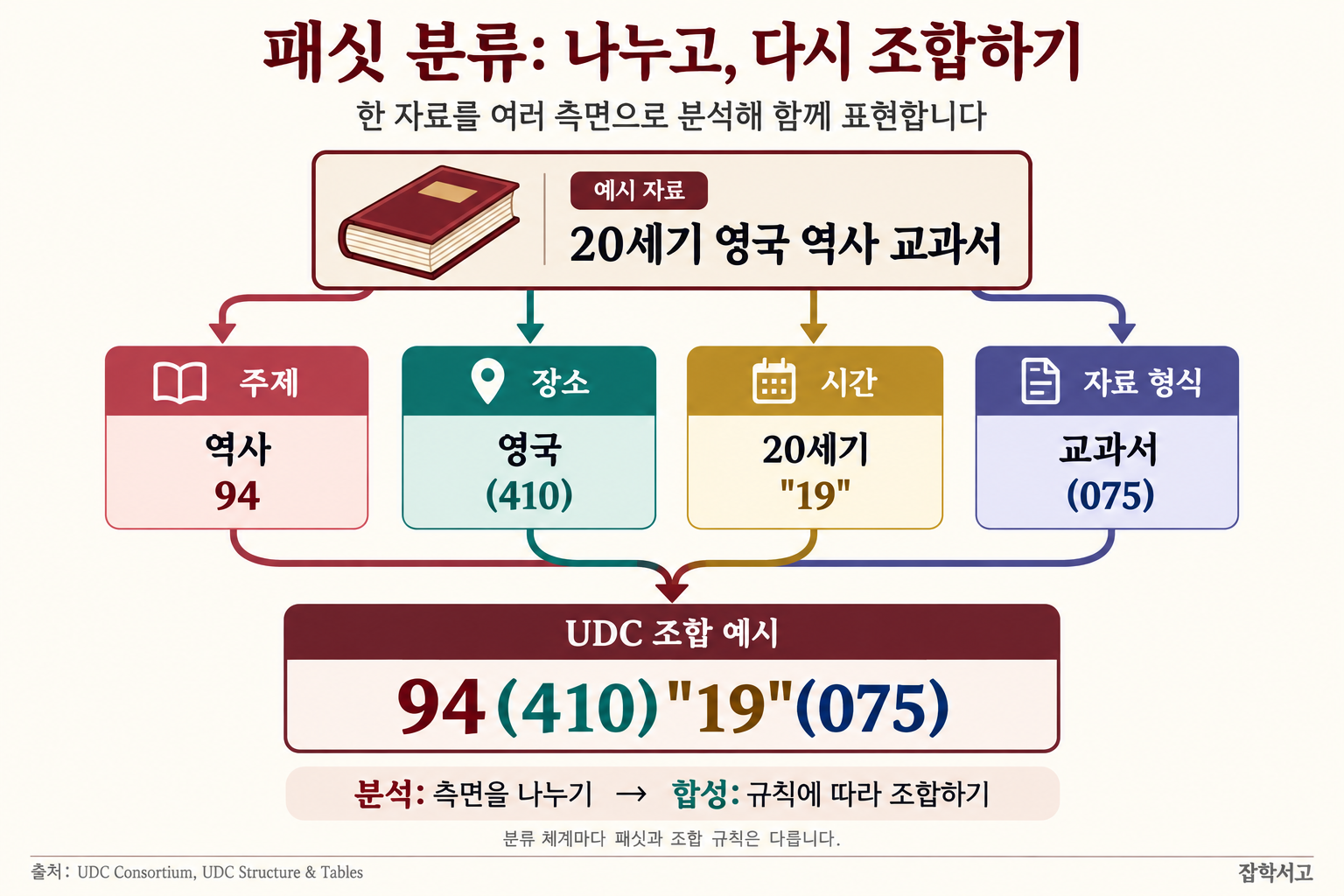
The Principle of Breaking Knowledge into Pieces and Reassembling It
What Is Faceted Classification?

Library classification divides broadly into two branches: listing every subject in the world in advance, and breaking subjects apart and assembling them when needed.
(1) Enumerative Classification
All possible subjects are divided from the top down and written out in a schedule, and when a book arrives the best-fitting slot is chosen from among them. Its weakness is that a new subject not in the schedule has no proper place to go.
(2) Analytico-Synthetic Classification
A book’s subject is first analyzed into several aspects, and then the symbols assigned to each aspect are synthesized according to rules. Faceted classification belongs here, and even a subject that was never in the schedule can get a new number by combining the pieces.
Good facets must be clear in meaning, must not overlap, and together must cover the subject without gaps. Some facets, such as time, place, and form, apply across almost every field, while others are used only within a single field.
Ranganathan’s Colon Classification and PMEST

The first person to systematize faceted classification was India’s S. R. Ranganathan (Shiyali Ramamrita Ranganathan), famous for the Five Laws of Library Science. In 1933 he published the Colon Classification, so named because it linked facets with colons (:). The story goes that he got the idea while studying in London, after seeing a Meccano construction toy, which builds many different shapes from interlocking parts.
Ranganathan held that every subject breaks down into five fundamental categories, which he called PMEST after their initials.
- Personality: The central object of the subject (e.g., ‘lungs’ in medicine).
- Matter: The material or property of the object (e.g., ‘tuberculosis’).
- Energy: The process or operation applied to the object (e.g., ‘treatment’).
- Space: The geographic place related to the subject (e.g., ‘India’).
- Time: The period or year related to the subject (e.g., ‘1950’).
Under this framework, even a complex subject such as ‘research on the X-ray treatment of pulmonary tuberculosis conducted in India in 1950’ can be expressed as a single class number by joining symbols in PMEST order under medicine. From the fourth edition (1952), which formalized PMEST, the comma, semicolon, and period, besides the colon, were assigned to different facets so that the symbol alone shows which aspect it represents, and in the early 1960s the time facet, which had shared the period with place, switched to the apostrophe.
How Does It Differ from Enumerative Classification?

The Dewey Decimal Classification (DDC) and the Korean Decimal Classification (KDC) are basically enumerative, but they adopted some of the strengths of facets by providing auxiliary tables for adding region, period, or form. Even so, the two approaches start from different places.
(1) Strengths of Faceted Classification
When a new subject appears, existing pieces can simply be combined, so the schedule does not need major revision. And if subjects are recorded by several aspects, users can find materials in whatever order they like, whether they start from a country or from a period.
(2) Limitations of Faceted Classification
The notation becomes long and complex, making it awkward to use as a call number on the shelf. A concept may fit into two or more facets, so classifiers’ judgments can differ. For this reason the Colon Classification is used mainly in libraries in India, while enumerative systems remain widely used around the world.
- Classification Research Group: A research group formed in Britain in 1952 that carried on Ranganathan’s ideas and developed a number of faceted classifications for specialized fields.
Facets Brought Back to Life on the Search Screen

A book can sit in only one place on the shelf, but in a digital catalog a single item can carry several facets at once. Thanks to this, the idea of faceted classification, which was awkward on the shelf, regained its strength on the search screen.
- Faceted Search: Next to the search results it shows lists of facets such as subject, author, year, and language, along with the number of items under each, letting users pick them one by one to narrow the results. It is a common sight on today’s library catalog search screens.
- Online Shopping Mall: Screens where you pick filters such as price range, brand, color, and size one after another follow the principle of faceted classification exactly.
- Universal Decimal Classification: By giving each facet, such as language, form, place, and time, its own distinctive symbol, it added the flexibility of combination to Dewey-style classification.
Faceted classification is a way of classifying that, instead of slotting a subject into predetermined boxes, divides it into several aspects and reassembles them as needed. The idea, which began with Ranganathan’s Colon Classification, was criticized as complicated on the shelf, but today it is used every day in library searches and shopping-mall filters.
Looking first at the many faces information has before lining it up in a single row—that is the first step in organizing information so the materials you want can be found quickly.