When we type a keyword into a search box and skim the results, we usually check only the few items that rise to the top. Yet it is not easy to tell whether those few are really the material we need, or just a pile of similar titles. In the field that evaluates information retrieval, this “what matched and what was missed” is split into two numbers. Those numbers are precision and recall.
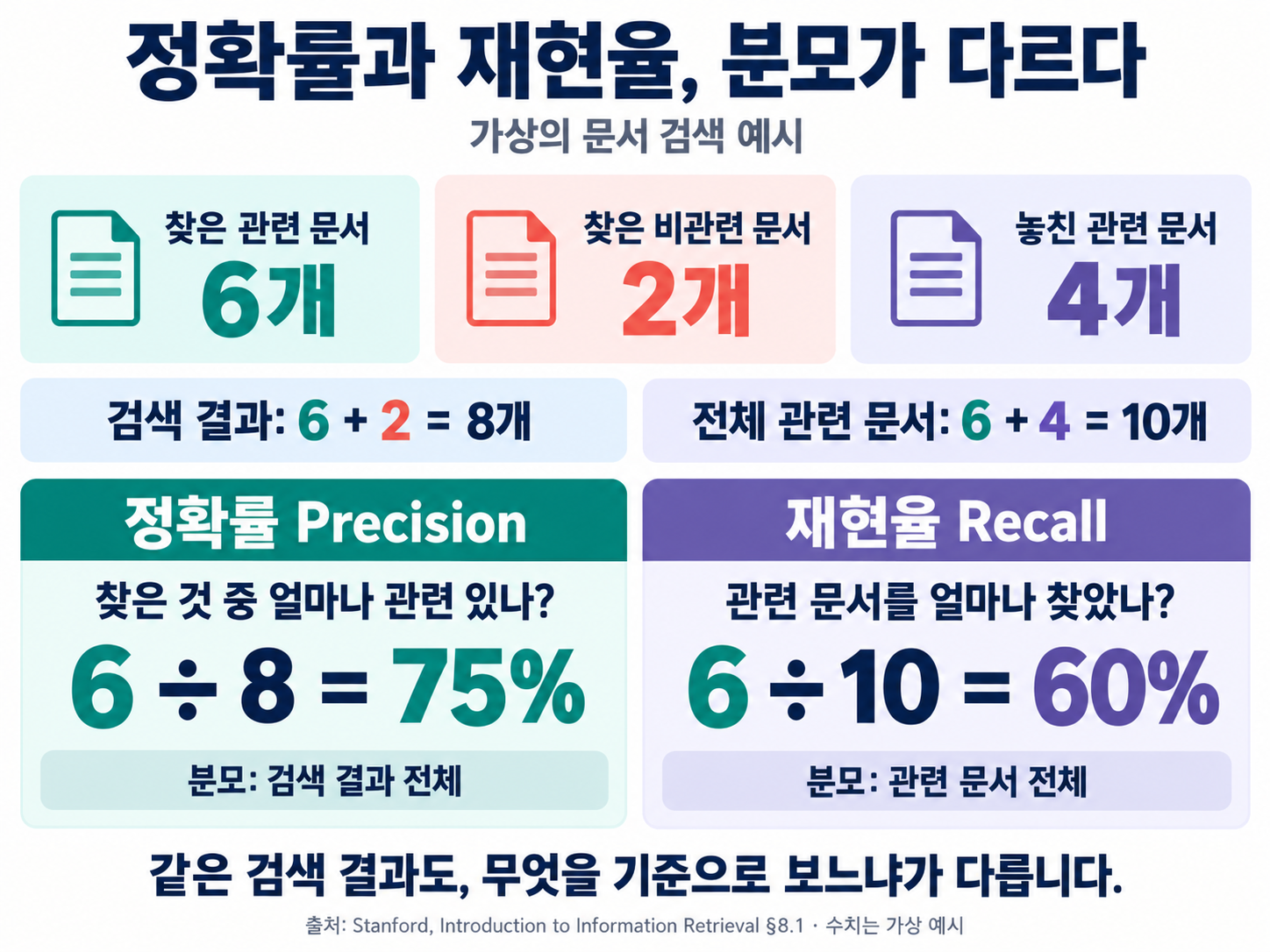
Put simply, precision is the share of retrieved documents that are actually relevant, and recall is the share of all relevant documents that the search actually found. The two ask different questions. One is “How apt are the results we brought back?” The other is “How little did we miss of what we should have found?” They sit a little apart from the everyday sense of “being accurate.” Here, precision points to the purity of the result list, and recall to how wide a net was cast.
In this piece we will look in turn at the definitions of precision and recall, the trade-off between them, the F1 score that views both at once, and why classical search evaluation relies on these measures.
Two Measures for Search Results: Precision and Recall
The Different Questions Precision and Recall Ask

Evaluation in information retrieval usually starts like this. For a given query, relevant and non-relevant documents are decided in advance, then compared with the set of results the system returns. Two ratios are at the heart of that comparison.
- Precision: of the documents the search retrieved, the share that are actually relevant.
- Recall: of all relevant documents, the share the search actually found.
An easy analogy is choosing books for an assignment in a library. If you pick ten books from the shelves and nine match the topic, precision is high. If the library holds twenty related books and you pick only two, recall is low. The same act of “finding” scores differently depending on what you measure against. The feeling users have that “search works well” often mixes these two axes.
A Trade-off: Raise One, and the Other Wobbles

If the system aims only to raise precision, it keeps only the documents it is very sure about. The results look clean, but relevant documents that sat near the boundary can be filtered out. If it aims only to raise recall, it pulls in a wide range of documents that might be relevant. Fewer items are missed, but irrelevant ones mix in more easily. The relationship is a lot like tightening or loosening the filters in a search box.
(1) When high precision matters
Users who see only a few results on the first screen, as in web search, want those few to be right. Odd results mixed in make it easy to give up on the search.
(2) When high recall matters
In specialized search—law, medicine, patents—where related material must be gathered without gaps, it is safer to miss no documents even if there is some noise.
So it is hard to call a system “good” while looking at only one side. Bring everything back and recall approaches 1, but precision can sink to the floor; bring almost nothing back and precision may look high while recall is empty. Good search is closer to choosing how much weight each axis should carry for the purpose at hand.
F1: Tying the Two into One Line

Even after looking at precision and recall separately, a single summary score is sometimes needed. What is often used then is an F measure, and among those the balanced F1. F1 is the harmonic mean of precision and recall: if either one is much lower, the score falls with it. Think of it as reacting more strongly to the weaker side than an arithmetic mean would.
For example, if precision is very high and recall very low, F1 does not follow the high side; it is pulled toward the low one. Conversely, F1 rises steadily only when both are reasonably high. But a high F1 does not mean it fits every use case. As we saw earlier, some tasks prize precision and others recall. F1 is a tool for comparing quickly with one number; it does not replace the purpose itself. Even with the same score, the habit of reading again along both axes—why that score appeared—is needed.
Why Classical Search Evaluation Uses These Measures

Precision and recall fit the classical frame of information retrieval evaluation well. The approach known as the Cranfield paradigm compares systems against a fixed document collection, a set of queries, and relevance judgments made by human assessors. Later large-scale evaluations such as TREC broadened the same idea. Relevance and non-relevance are the baseline, and what the system retrieved is measured with precision and recall.
Of course real search is more complicated. Relevance differs a little from person to person, and knowing every relevant document in advance is hard. With ranked results, the habit of looking at only the top few must also be reflected. Even for the same query, research for an assignment and skimming the evening news ask for different balances. Even so, the reason these two measures have lasted is clear: they separate the quality of what was retrieved from the breadth of what was not missed. Whether we use a search engine or a library catalog, when we look at a result list we are already asking these two questions in our heads. The metric names may feel unfamiliar, but the sense of them is already well known.
Precision shows how apt the results found are; recall shows how much of what should have been found was gathered. Raise only one side and the other tends to wobble, and F1 summarizes that tension in a single line. More useful than memorizing the numbers is noticing which side your search is weighting right now.
When you look at search results, asking both “Did I pick only what matches?” and “Did I leave anything out?”—that is the first step toward understanding information retrieval.