This time, we will look at the features, rankings, and market share of OTT services, which let you watch video content on all kinds of devices. Domestic OTT services hit their peak during the COVID-19 era and seem to have slowed down somewhat now, but they are still very popular thanks to their distinctive content.
 The concept of OTT services
OTT servicestands for Over The Top and refers to a type of service that lets you watch content in every genre, such as dramas, variety shows, and documentaries, anytime and anywhere over the internet. Brands like Netflix, which almost everyone has heard of, along with Wavve, TVING, and Coupang Play, can be seen as representative OTT services today.
It can essentially be seen as an upgraded version of the old VOD services, and it can be further divided into SVOD and AVOD.
SVODstands for Subscription Video On Demand and refers to a service where you pay a set monthly fee and can freely watch all the content offered, without limit, for the set period. Netflix, Wavve, TVING, and others can be classified as representative SVOD services.
AVODstands for Ad-based Video On Demand. Its defining feature is that all content can be watched on a free basis, but ads are inserted throughout the videos, so viewers have to watch at least some of them while enjoying the main content. YouTube is a representative example of this kind of service.
This article introduces the features, rankings, and market share of OTT services based on SVOD. AVOD was excluded because, if it were included, YouTube would be overwhelmingly dominant and its characteristics are different.
Market Share and Rankings of OTT Services in Korea
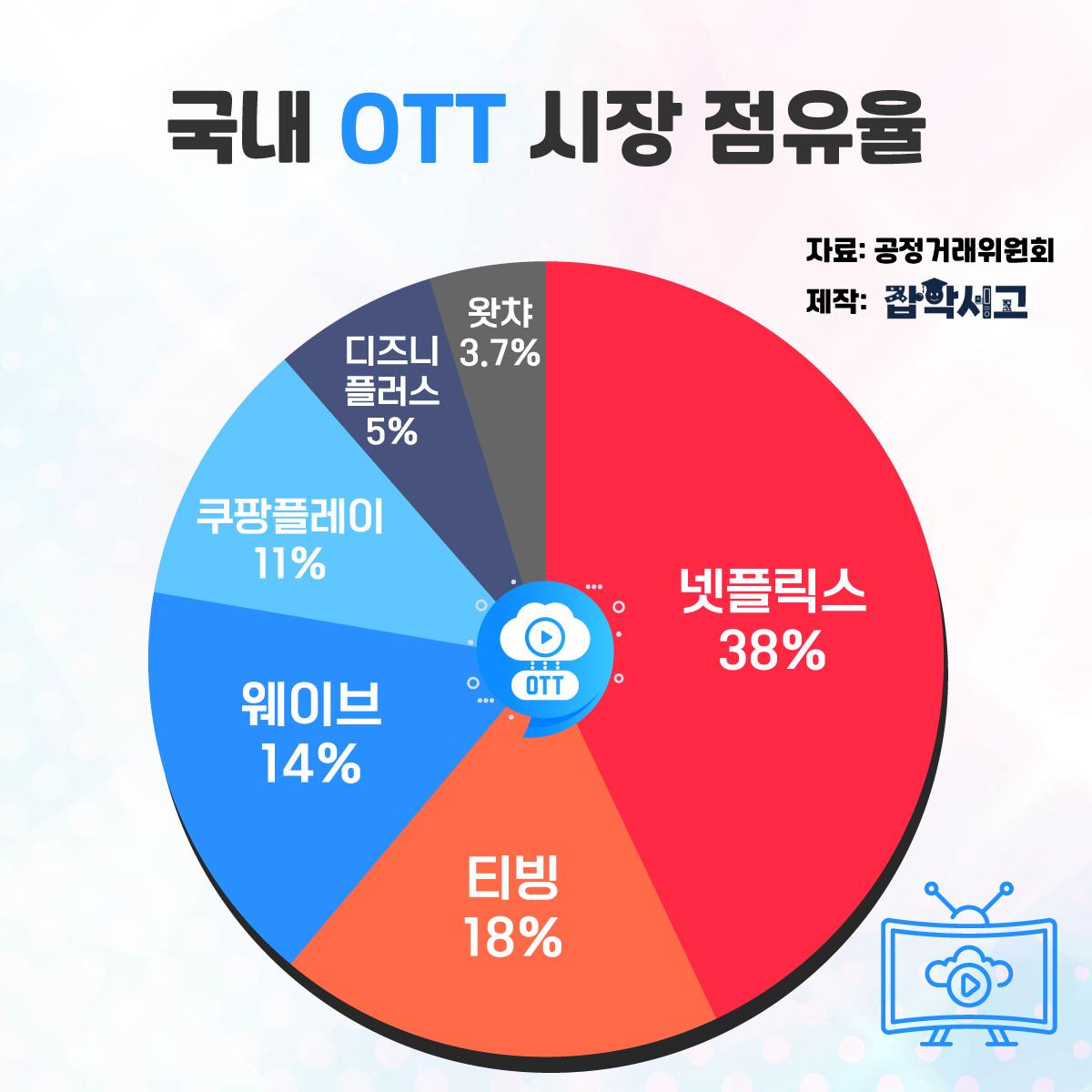 Korean OTT market share (source: Korea Fair Trade Commission)
The representative OTT services available in Korea are Netflix, Wavve, TVING, Coupang Play, Disney+, and Watcha. There used to be an even wider variety of services, but as competition intensified, services merged, and the OTT services run by telecom companies, oksusu (SK) and Seezn (KT), disappeared after being merged into Wavve and TVING, respectively.
As a result, six main services are now in operation, and Netflix ranks first among OTT services in Korea with a 38% market share. It is followed by TVING in second with 18%, Wavve in third with 14%, Coupang Play in fourth with 11%, Disney+ in fifth with 5%, and Watcha in sixth with 3.7%.
OTT services are on a growth trend, with total revenue rising by about 25–30% every year, but content investment and competition have become just as fierce, so each service is in a different situation. Looking only at the recent state of affairs, Netflix is the only OTT service in Korea that is turning a profit, while the other services recorded net losses due to heavy spending on content investment. Of course, revenue and profit can only be viewed as trends, and since this is a rapidly changing market, it is hard to know exactly when and how things will shift.
Types and Features of Various OTT Services
The features of domestic OTT services below are based on the six brands introduced above, listed in order of market share at the time of writing.
1. Netflix
 Netflix logo
Netflix operates on a monthly subscription plan, so you can only watch content if you pay a monthly fee. Put another way, it also means that as long as you pay, you can watch without limit.
With a market share of about 40% in Korea, it holds an unrivaled first place, and it is extremely competitive because it has a vast library of content, including original content. Its original titles, which become hits one after another just when you think they’ve run out, add to Netflix’s fame.
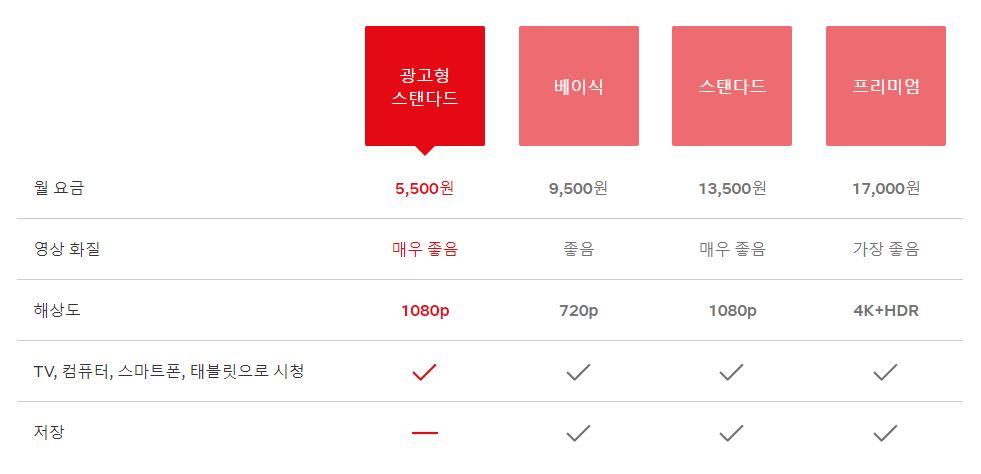 Netflix plans
It originally operated as a representative SVOD service without ads, but after adding a cheaper plan with ads, its concept shifted slightly to a hybrid VOD.
Since it is a globally influential company that invests enormously in original content and has a huge content library, it looks likely to maintain a high market share for some time.
2. TVING
 TVING logo
TVING is both a company and an OTT brand that was part of CJ E&M, one of the CJ affiliates, before becoming independent. It is neck and neck with Wavve in the race for second and third place, and it has recently grown a little bigger after merging with Seezn.
Its content consists mainly of programs from CJ-affiliated channels, and on top of that it has joined forces with JTBC, so the two broadcasters create synergy and exert influence together.
It may seem to be at a disadvantage against Wavve, which brings together the three terrestrial broadcasters, but by strengthening competitive content through recruiting star producers and continuously investing in film and original content, it is maintaining a successful run.
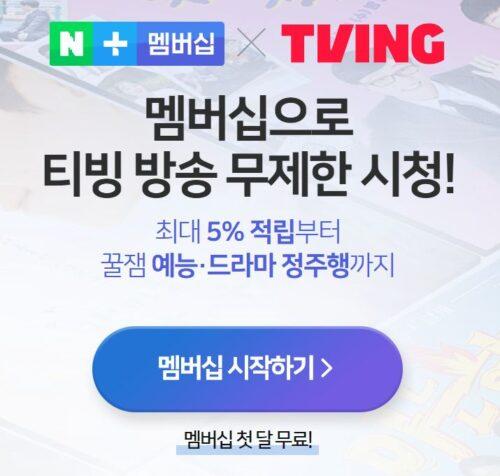 TVING, operated in partnership with Naver
Like Netflix, TVING has different pricing tiers, but to use the service efficiently, it is best to use the Naver membership it has partnered with. The Naver membership costs 4,900 won a month, which is cheaper than TVING’s monthly plans, and you also get many additional benefits across Naver services, so this method is recommended if you plan to use TVING.
3. Wavve
 Wavve logo
Wavve is an OTT service created as a joint venture between Korea’s three terrestrial broadcasters (KBS, SBS, MBC) and the telecom company SK Telecom. It is the only platform of all where you can watch content from all three terrestrial broadcasters, and recently it has also been putting a lot of effort into Wavve original content.
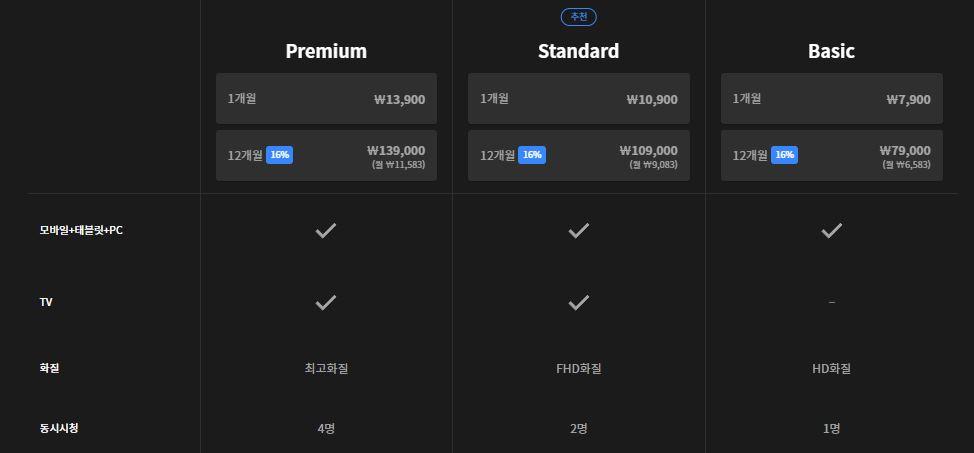 Wavve plans
It is a useful service for viewers who enjoy content from the three well-established terrestrial broadcasters, and its plans are broadly divided into Premium, Standard, and Basic. It doesn’t have a powerful Naver partnership like TVING, but first-time pass buyers can try it for 100 won for one month, so it is worth taking advantage of this perk at least once.
4. Coupang Play
 Coupang Play logo
Coupang Play is the OTT service offered by Coupang and a latecomer that started later than the other platforms. There were concerns since it jumped late into an already crowded market, but it has been growing rapidly thanks to the advantage that users of the monthly subscription (WOW membership) of Coupang, which has practically conquered the e-commerce market, can use it for free. Because of this pricing structure, existing Coupang users can use it alongside other OTT services, so its nature is a little different.
Coupang Play’s pricing structure appears to be modeled on the services of Amazon, the American e-commerce company. This is because Amazon, like Coupang, is an e-commerce company and also runs an additional OTT service called Amazon Prime Video.
Coupang also produces original content, but what sets it apart most is sports broadcasting. It is differentiating itself with a service the other major platforms haven’t touched, and it has also gained popularity by occasionally offering event-style services in which it invites famous overseas sports teams to play matches.
5. Disney+
 Disney+ logo
Disney+ is a platform run by Disney, the global content giant, and it appeared as a latecomer in 2021 amid enormous attention. At launch, it drew attention as a powerhouse that could threaten Netflix, but in Korea at least, it has been struggling. With its original content failing at the box office and some shortcomings in its service being highlighted, it remains stuck at a single-digit market share in Korea.
Disney+ holds, all at once, Disney’s own well-established content along with acclaimed brands that have led worldwide hits, such as Marvel, Pixar, Star Wars, National Geographic, and Star.
As a latecomer, it falls behind other platforms in the sheer quantity of content, but because the quality of each title is outstanding, it is better suited to occasional binge-watching than to paying a steady monthly fee.
6. Watcha
 Watcha logo
Watcha started as a movie review app but gradually expanded its services to become the OTT service company it is today. After struggling because it fell behind other platforms in original content and volume, it launched a webtoon service within Watcha as a differentiation strategy.
By linking with its Watcha Pedia service, which provides information, reviews, and ratings for content, it makes exploring the content you want to watch more convenient. Rather than being mainstream, it has a lot of niche content, making it a platform with a strong base of enthusiasts, so it seems best to keep this in mind and use the platform as a supplementary service depending on your own taste in content.
So far, we have looked at the types, features, rankings, and market share of the OTT services available in Korea. Since this is a fiercely competitive market that is growing fast and changing rapidly, each platform is likely to offer good services in terms of both quality and quantity in order to compete for the time being.
From the standpoint of viewers and subscribers, this environment has no downside at all, so we hope you find the platform that suits you based on the plans you think are reasonable and the content on offer, and enjoy consuming content.