
Have you ever dripped a few drops of water onto a heated frying pan? If the pan is moderately hot, the drops sizzle and disappear in no time. But heat the pan much hotter, and something strange happens. The drops gather into round beads, glide around the pan as if skating, and last far longer than you would expect. In other words, they evaporate more slowly in the hotter place.
This phenomenon is called the 'Leidenfrost effect.' When a liquid touches a surface far hotter than its own boiling point, its underside vaporizes the instant it makes contact, forming a thin layer of vapor, and the liquid floats on top of it. The effect is named after the German physician Johann Gottlob Leidenfrost, who described it in detail in 1756 in a treatise on the properties of water.
This article walks step by step through how droplets float, the different stages of boiling, examples you can see in the kitchen and the laboratory, and what the phenomenon means in industry.
How the Leidenfrost Effect Works and How It Is Used
A Droplet Floating on a Cushion of Vapor
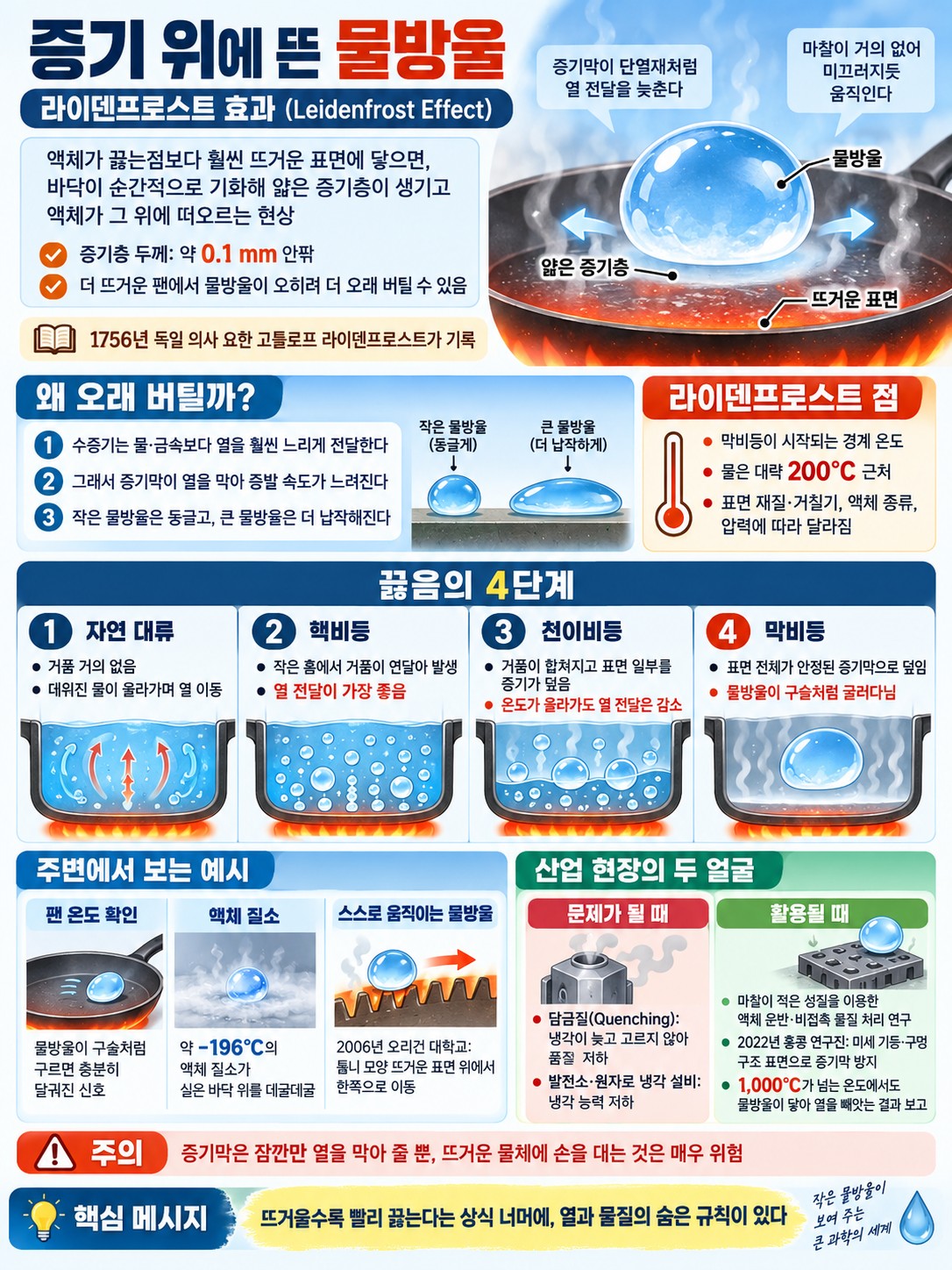
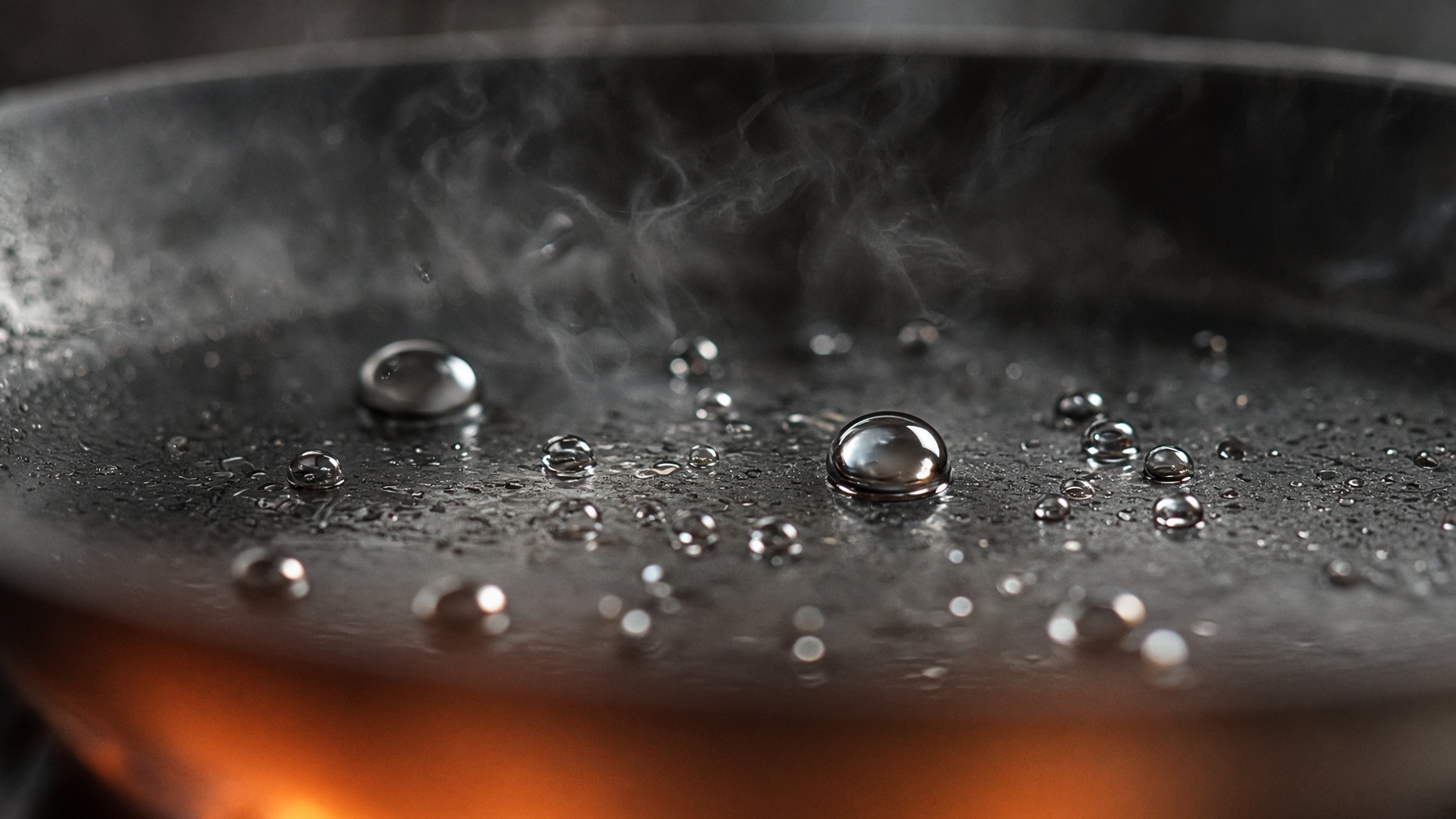
When a water droplet touches a very hot surface, the part in contact with the surface evaporates instantly. The vapor produced has no time to escape and forms a thin film between the droplet and the surface. This vapor film is only about 0.1 mm thick, yet that is enough to lift the droplet. The droplet ends up as if sitting on a cushion that floats on constantly renewed vapor.
The secret to the droplet's long life lies in this vapor film. Water vapor conducts heat far more slowly than water or metal. Because the hot surface and the droplet do not touch directly, heat passes slowly through the vapor film, and evaporation slows down accordingly. That is why a droplet that vanishes within a few seconds on a moderately hot pan can last anywhere from tens of seconds to over a minute on a much hotter one.
A droplet on a vapor film also has almost no friction with the surface. It slides easily with the slightest tilt or breeze, and the way it rolls this way and that across the surface looks like an air hockey puck. Small droplets keep a nearly spherical shape thanks to surface tension, but as droplets grow larger they flatten under their own weight, and the vapor trapped underneath can even burst up through the middle.
The Four Stages of Boiling
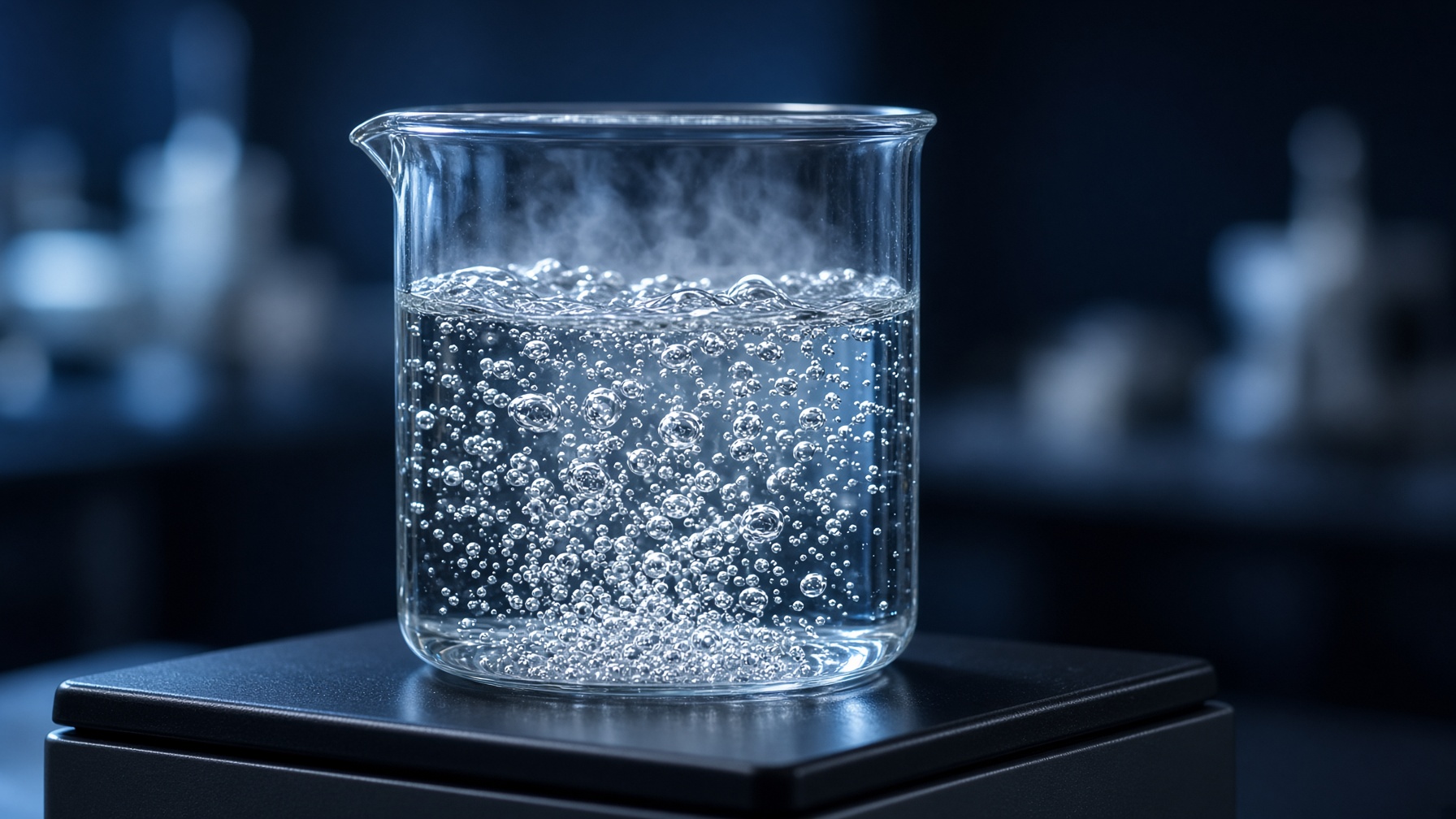
The Leidenfrost effect is tied to the fact that the way a liquid boils changes with surface temperature. As the surface temperature is raised little by little, boiling generally goes through the following stages.
(1) Natural Convection
When the surface is only slightly above the boiling point, hardly any bubbles form; instead, warmed water rises and carries the heat away.
(2) Nucleate Boiling
As the temperature rises further, bubbles form one after another in tiny pits on the surface and float up. This is the stage in which the bubbles stir the water and heat is transferred most efficiently.
(3) Transition Boiling
When there are too many bubbles, they merge and vapor begins to cover parts of the surface. Even though the temperature keeps rising, heat transfer actually decreases.
(4) Film Boiling
This is the stage in which the entire surface is covered by a stable vapor film. The threshold temperature at which film boiling begins is called the 'Leidenfrost point,' and for water it is usually around 200°C.
What we see when water bubbles away in a kettle is mostly nucleate boiling. Water drops sizzling and vanishing quickly on a frying pan are also in this stage, while drops rolling around like beads mean the film boiling stage has begun.
The Leidenfrost point is not a fixed value. It varies with the material and roughness of the surface, the type of liquid, and the pressure. The smoother the surface, the more evenly the vapor film forms, so droplets float more easily even at lower temperatures.
Examples in the Kitchen and the Laboratory

The Leidenfrost effect can be seen closer to home than you might think.
- Checking pan temperature (Water Drop Test): When water dropped onto a stainless steel pan beads up and rolls around, it is taken as a sign that the pan is hot enough.
- Liquid nitrogen: Liquid nitrogen boils at about −196°C, so even a room-temperature floor is an extremely hot surface to it. Spilled liquid nitrogen rolling and skittering across the floor works on the same principle.
- Self-propelled droplets (Leidenfrost Ratchet): In 2006, researchers at the University of Oregon in the United States reported that water droplets on a hot surface cut into a sawtooth pattern run off on their own in one direction. This happens because the vapor escapes to one side along the slopes of the teeth and pushes the droplet along.
The vapor film acts as a shield that blocks heat for a moment, but it does not hold out for long. Relying on this effect to touch a hot object is extremely dangerous.
Two Faces in Industry
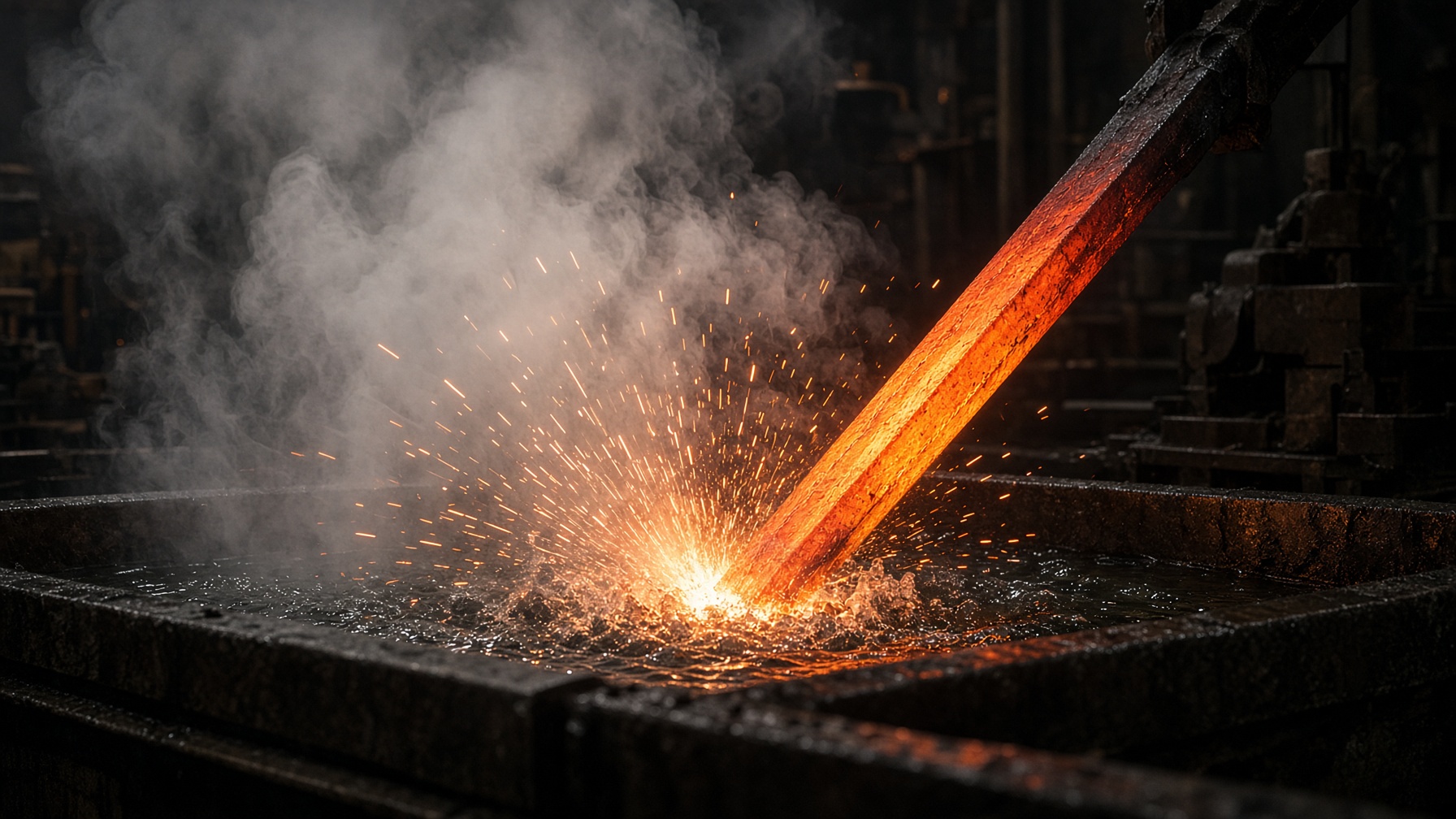
In industry, the Leidenfrost effect is usually an unwelcome guest. In quenching, where hot metal is plunged into water to harden it, a vapor film forming on the metal surface can slow cooling and make it uneven, degrading quality. In equipment that removes heat with boiling water, such as power plants and nuclear reactors, film boiling greatly reduces cooling capacity, so designers build in margins to avoid it.
Scientists have therefore studied surfaces that prevent vapor films from forming. Etching tiny pillars or holes into a surface gives the vapor a way to escape, so the film does not form easily. In 2022, a research team in Hong Kong published a study in the journal Nature in which they used such structures to make water droplets touch the surface and draw heat away even at temperatures above 1,000°C.
Conversely, there are also attempts to put the vapor film to deliberate use. Researchers are exploring ways to use its frictionless gliding to move liquids in a desired direction or to handle materials without contact.
Looking beyond the common belief that hotter always means faster boiling is the first step toward understanding the hidden rules of heat and matter.