In Yellowstone National Park in the United States, there is a special place where tourists wait while watching the clock. On flat ground where nothing much seems to be happening, hot water and steam shoot high into the sky when the time comes. The column of water, which lasts for a few minutes, vanishes as if it had never been there, and a little over an hour later it surges up again. This natural fountain, which seems to let the earth exhale at a steady rhythm, is a ‘Geyser.’
Simply put, a geyser is ‘a hot spring where groundwater heated underground forcefully gushes out along with steam at regular intervals.’ Unlike ordinary hot springs, where water always sits in a pool or flows out quietly, its biggest feature is that it repeatedly rests and then erupts.
In this article, we will look in turn at where the name geyser came from and the conditions under which geysers form, the principle by which the water shoots out, the world’s representative geysers, and why geysers disappear so easily and what hidden value they hold.
The Underground Pressure Cooker: The Secret of Geysers
The Origin of the Name and the Conditions for Formation
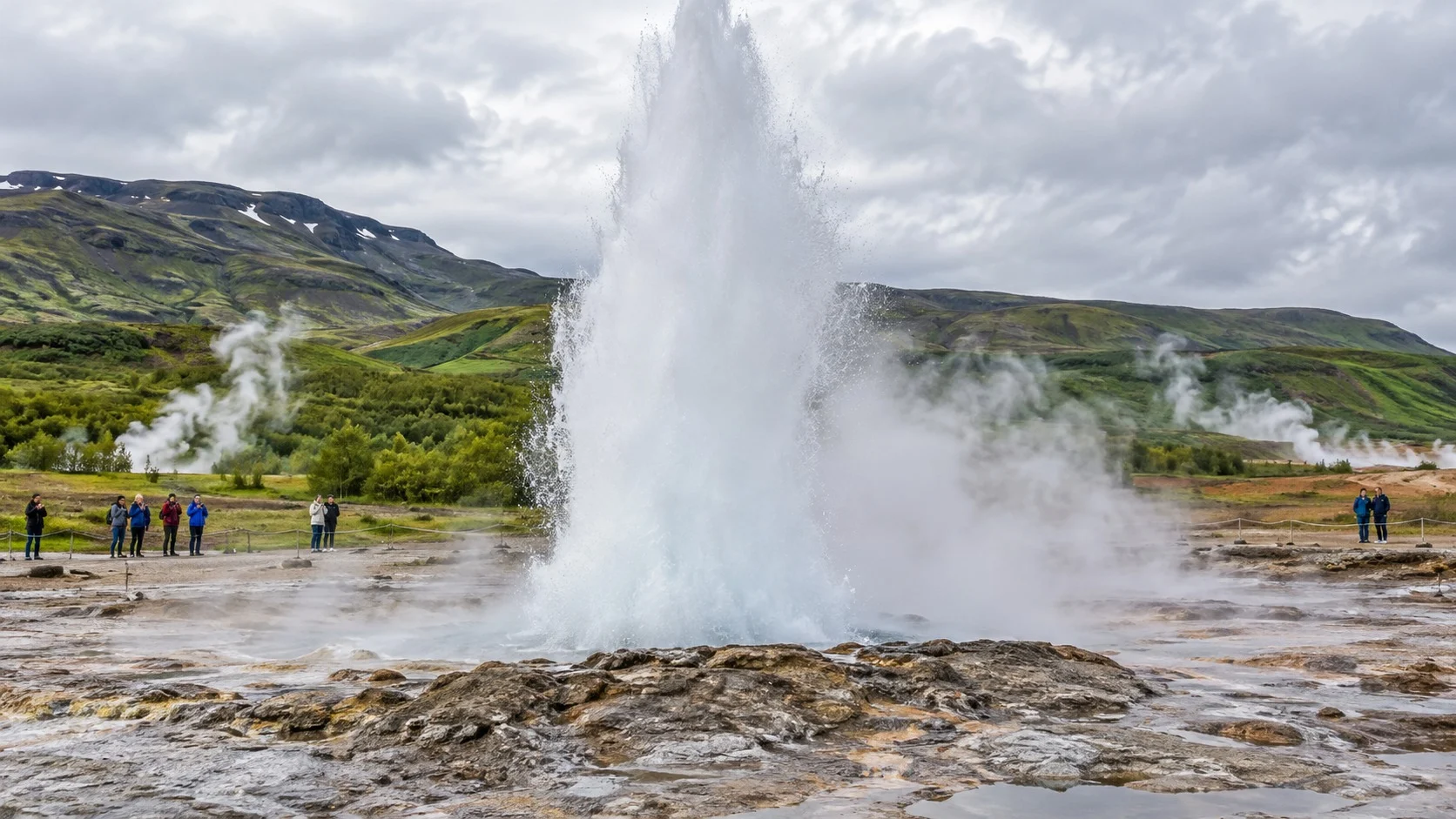
The English word geyser comes from the name of ‘Geysir,’ a geyser in southwestern Iceland. It means ‘the one that gushes’ in Icelandic, and when the word entered English in the late 18th century, it became a common noun for the same phenomenon.
You might think geysers exist in any volcanic region, but in reality they are among the rarest landforms on Earth. That is because the following three conditions must all be met at once.
- Heat: There must be magma at a shallow depth underground to heat the surrounding rock.
- Water: Rainwater or snowmelt must seep deep underground and be replenished steadily. It usually descends to a depth of about 2,000m, where it meets hot rock.
- Plumbing System: A storage space that holds the water and a narrow passage leading to the surface must be in place, in just the right shape.
The third condition is especially demanding. If the bedrock is soft, the passage is worn away with every eruption and the geyser is quickly ruined. That is why, even in volcanic regions with many hot springs, mud pots, and steam vents, geysers that actually spout water appear only rarely.
How Water Shoots Into the Sky
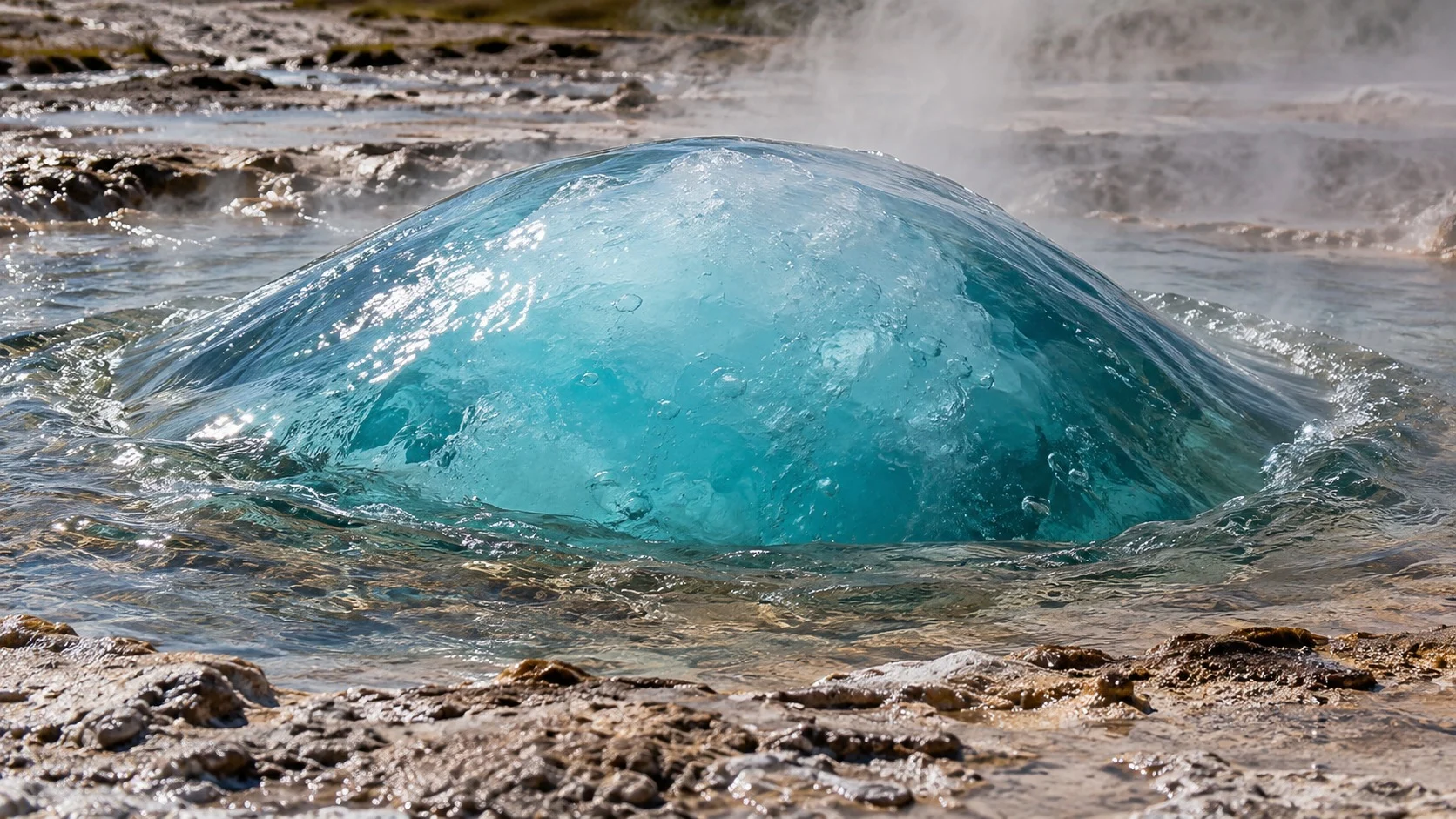
The way a geyser works resembles a pressure cooker in the kitchen. A single eruption takes place roughly through the following three stages.
(1) The water fills up and heats up
While groundwater fills the storage space and the passage, the water at the bottom is heated by the hot rock. Because the passage is narrow, convection, in which water mixes up and down and cools, does not occur easily.
(2) The upper water acts as a lid
The weight of the column of water above presses down on the water below. Since higher pressure also raises the boiling point, the water at the bottom cannot boil even well above 100℃ and holds out as a liquid. Such water is called superheated water.
(3) The pressure is released and everything boils at once
When bubbles finally form at the bottom and rise, a little water overflows from the mouth. The moment the column of water becomes lighter and the pressure drops, the superheated water turns into steam all at once, its volume expands greatly, and water and steam shoot forcefully out of the mouth.

When the eruption ends, the remaining water cools below the boiling point, groundwater seeps in again, and the same process repeats from the beginning. Meanwhile, whitish or grayish stone builds up around the mouth of a geyser. This is geyserite (siliceous sinter), formed when silica dissolved in the hot water settles out as it cools at the surface.
Representative Geysers of the World
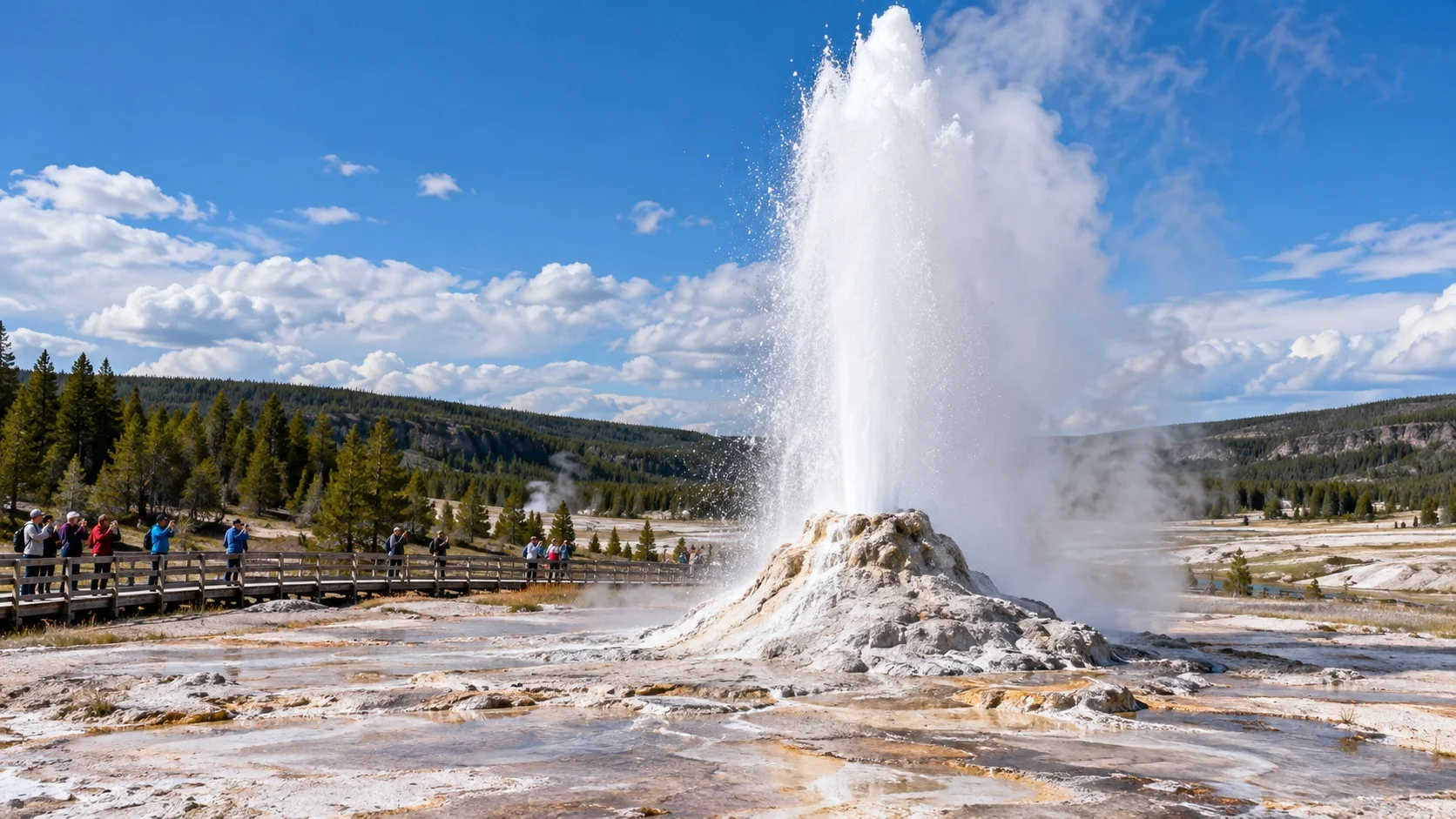
Geysers are broadly divided into two types: fountain geysers (Fountain Geyser), which burst out violently several times from a pool of water, and cone geysers (Cone Geyser), which send up a thin, steady jet of water from a cone-shaped mound built up of geyserite.
Yellowstone National Park
It is the place with the most geysers in the world, with about 300–500 gathered there, accounting for roughly half of all geysers on Earth. Its star, Old Faithful, is a cone geyser named by an expedition in 1870, and it earned the name ‘Old Faithful’ by erupting about every 92 minutes on average. Steamboat Geyser in the same park is the tallest active geyser today, shooting water more than 90m into the air during major eruptions. However, its intervals between eruptions vary wildly from three days to decades, so it is hard to know when it will go off.
Iceland
Geysir, the namesake itself, alternates between active and dormant periods. Strokkur, right next to it, shoots water up for a few seconds every few minutes, making it a famous spot where any tourist can easily see an eruption.
Other places counted among the representative geyser regions include Russia’s Kamchatka Peninsula, El Tatio in Chile, and New Zealand’s North Island.
Easily Lost Geysers and Their Hidden Value
Geysers are not long-lasting landforms. Eruptions can stop when minerals build up and clog the passage, or when an earthquake changes the underground structure. Human activity is also a major threat. Quite a few geysers have died after their mouths were clogged by stones or trash thrown in by onlookers, and there are cases where geysers stopped erupting after a geothermal power plant was built nearby and drew on the groundwater.
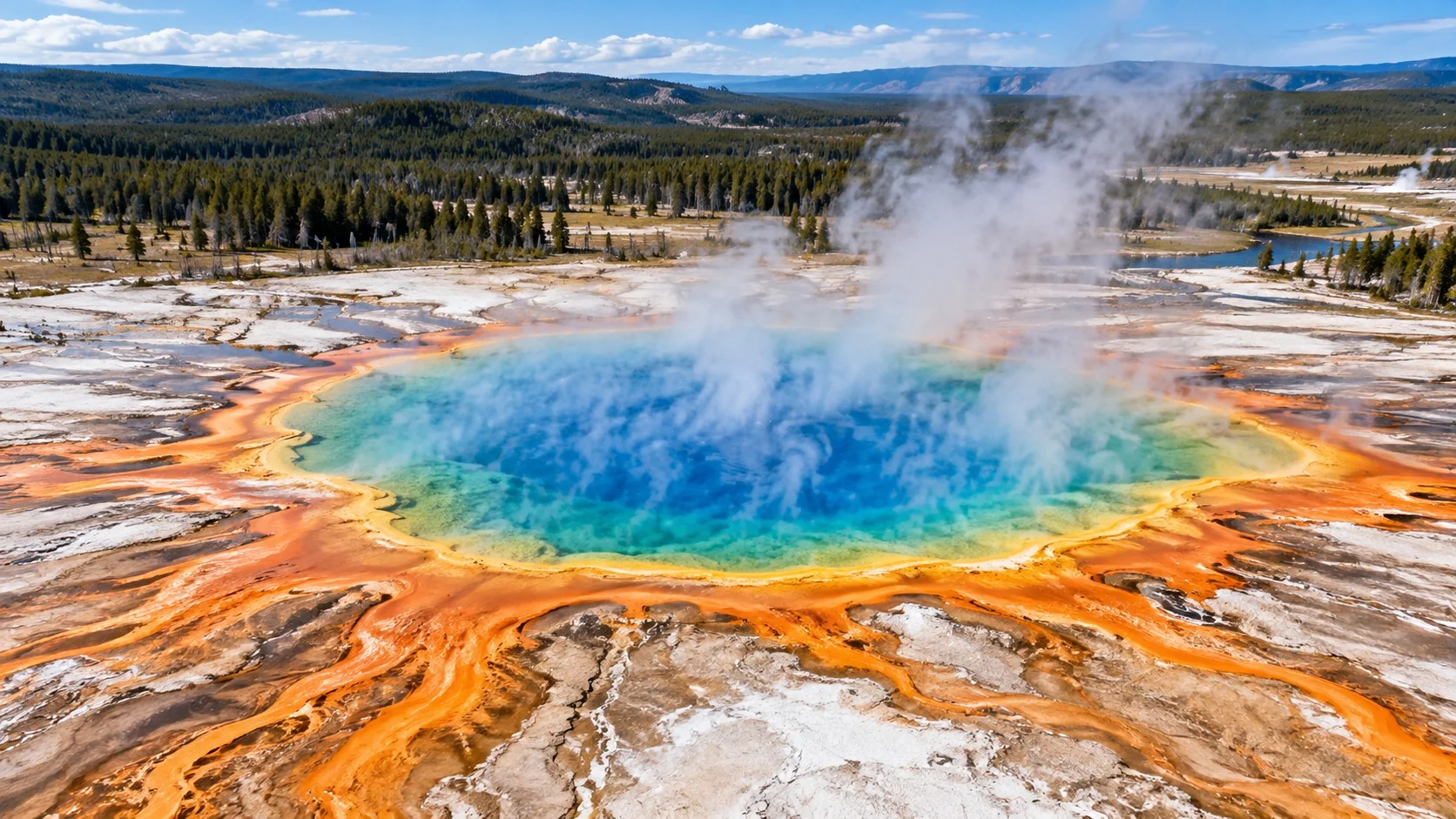
Geysers are also places that made us rethink the limits of life. Until the 1960s, scientists believed that life could not survive above about 73℃. But heat-loving bacteria were found one after another in Yellowstone’s hot water, and a heat-resistant enzyme obtained from one of them, Thermus aquaticus, became a key ingredient of the polymerase chain reaction (PCR) used in genetic testing. These microbes are also why the areas around geysers look stained yellow, orange, and green.
Similar eruptions have been observed beyond Earth as well. Plumes of water vapor have been spotted near the south pole of Saturn’s moon Enceladus, and nitrogen erupting on Neptune’s moon Triton.
Geysers, born only when underground heat, water, and exquisite plumbing come together, show us right before our eyes that the Earth is alive and moving. Thinking about the science of pressure and boiling points contained in a single surging column of water is the first step of science in reading our living Earth.