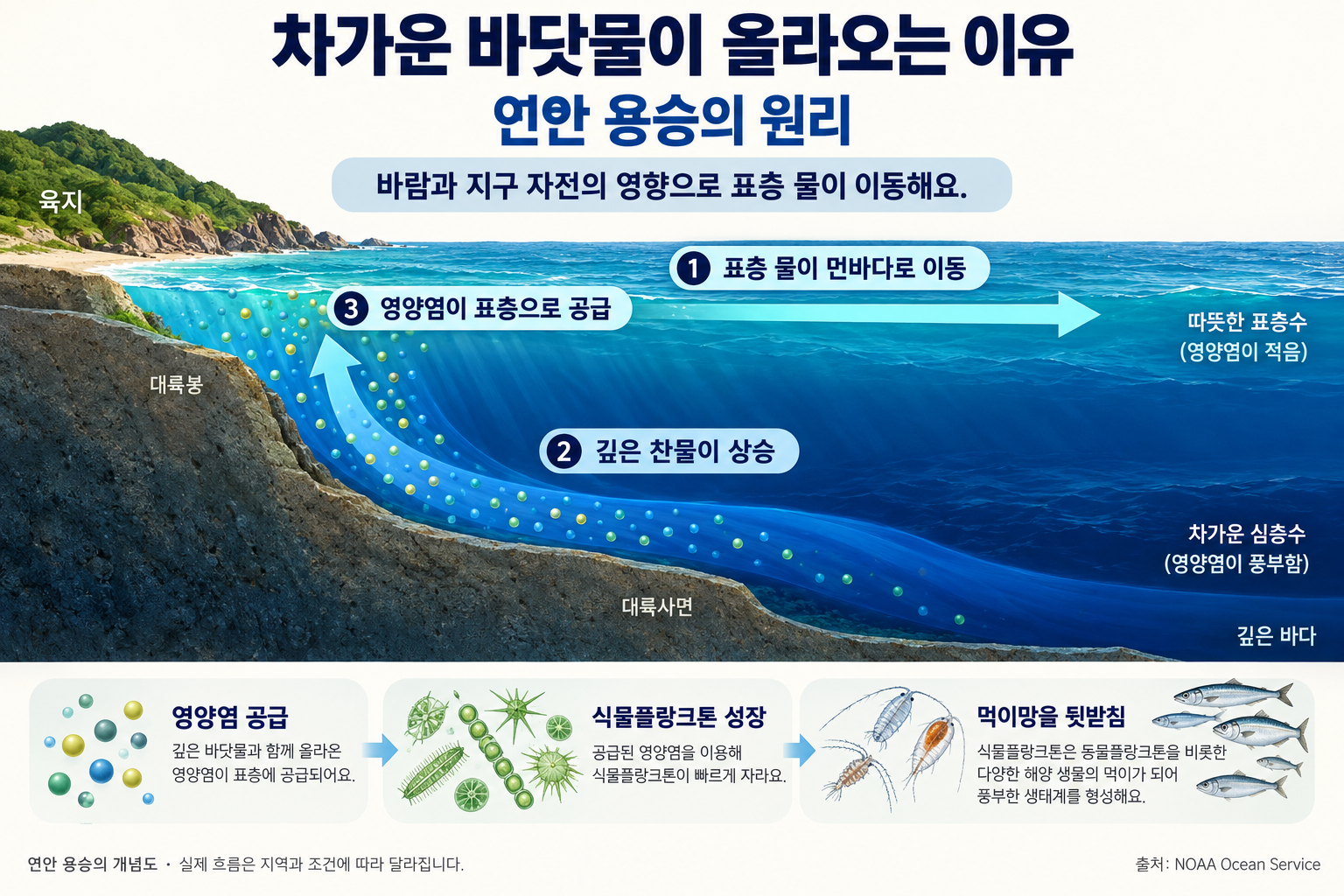
Have you ever visited a beach on Korea's east coast in midsummer, only to find the water so cold you just dipped your feet and got out? It's not unusual for a sea that was warm just a few days earlier to turn ice-cold overnight. The answer to the puzzle of why the sea gets colder on a blazing sunny day is a phenomenon in which cold water rises from deep below: “upwelling.”
Put simply, upwelling is “the process in which cold, nutrient-rich water from the deep rises to fill the gap left by surface water pushed away by the wind.” This cold water may be unwelcome to swimmers, but for marine life it is a precious visitor delivering food, and it is also the driving force behind some of the world's greatest fishing grounds.
In this article, we will look in turn at how upwelling works, the world's major upwelling regions, its effects on marine ecosystems and weather, and the future of upwelling amid El Niño and climate change.
How Cold Water Rises from the Deep and What It Does
Why the Wind Pushes Seawater Sideways
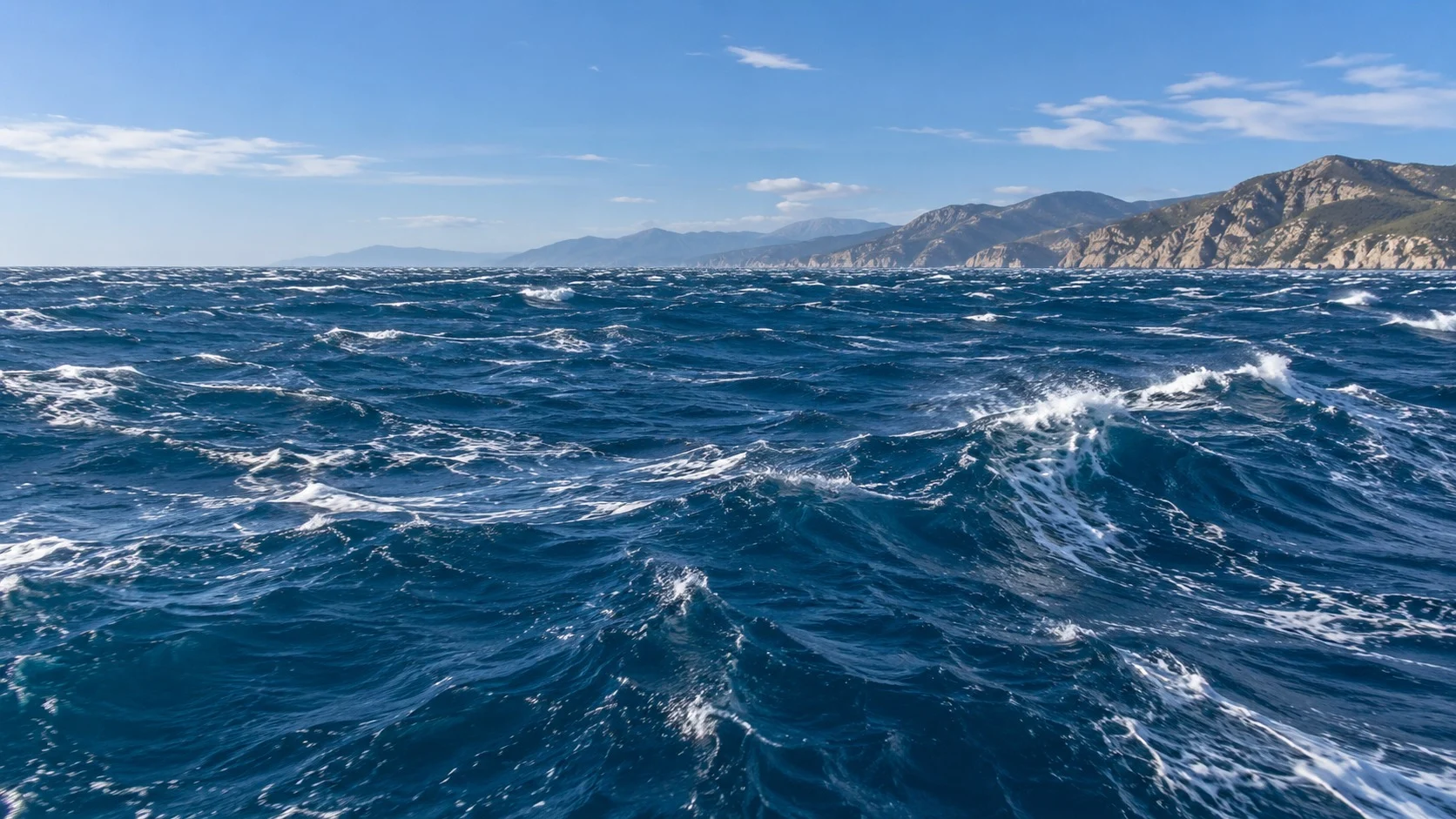
To understand upwelling, you first need to know how wind and seawater move together. When wind blows over the sea, it drags the surface water along, but that water doesn't flow straight in the direction the wind is blowing.
- Coriolis Effect: Because the Earth rotates, moving objects are deflected to the right in the Northern Hemisphere and to the left in the Southern Hemisphere.
- Ekman Spiral: The surface water flows at about 45 degrees to the wind direction, and each layer below is dragged along by friction and turned a little further, forming a spiral.
- Ekman Transport: Adding up all these layers, the surface water as a whole moves at right angles to the wind direction.
This principle began with the Norwegian explorer Fridtjof Nansen, who observed during an Arctic expedition that sea ice drifted about 20–40 degrees to the right of the wind direction. The Swedish oceanographer Vagn Walfrid Ekman worked it out mathematically and published it in 1905. Conversely, when the wind piles surface water up against the coast, the water accumulates and then sinks; this is called downwelling. Upwelling and downwelling are a pair of motions that mix seawater up and down.
Where Does Upwelling Happen?
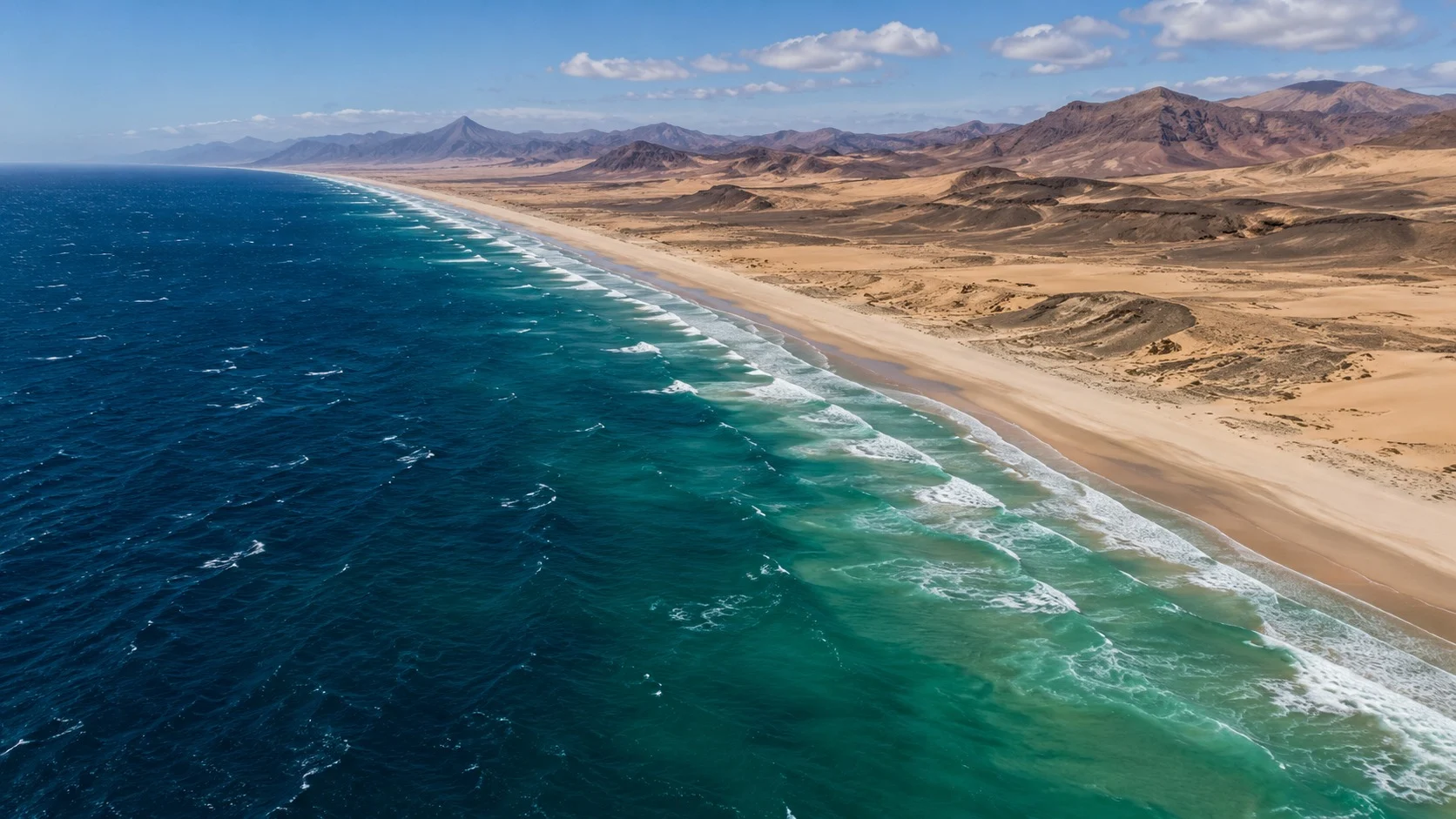
When surface water drains away to one side, water from below rises to fill the gap. The places where upwelling occurs can be broadly divided into three types.
(1) Coastal Upwelling
It occurs when wind blows parallel to the coastline and pushes surface water out toward the open sea. This is the best-known form, and cold water typically rises at about 5–10 m per day. Typical examples are the Humboldt Current off Peru and Chile, the California Current off the US West Coast, the Canary Current off northwest Africa and the Benguela Current off southwest Africa.
(2) Equatorial Upwelling
Near the equator, the trade winds blowing from the east split the surface water apart, sending it north in the Northern Hemisphere and south in the Southern Hemisphere. Cold water wells up in between, creating a band of rich ocean along the equator in the Pacific. This band is so full of phytoplankton that it shows up clearly even in satellite images.
(3) Korea's Cold Water Belts
When southerly winds persist in summer, upwelling also occurs along the southern part of Korea's east coast, producing cold water belts. Because the water temperature can drop sharply and suddenly, fish in aquaculture farms are sometimes harmed, so Korea's National Institute of Fisheries Science issues cold water belt advisories to warn people.
How Upwelling Changes the Sea and the Weather
In the deep sea, nutrients such as nitrates and phosphates accumulate as the remains of organisms that sank from above decompose. Upwelling lifts this fertilizer up to the sunlit surface layer.
It Creates the World's Best Fishing Grounds
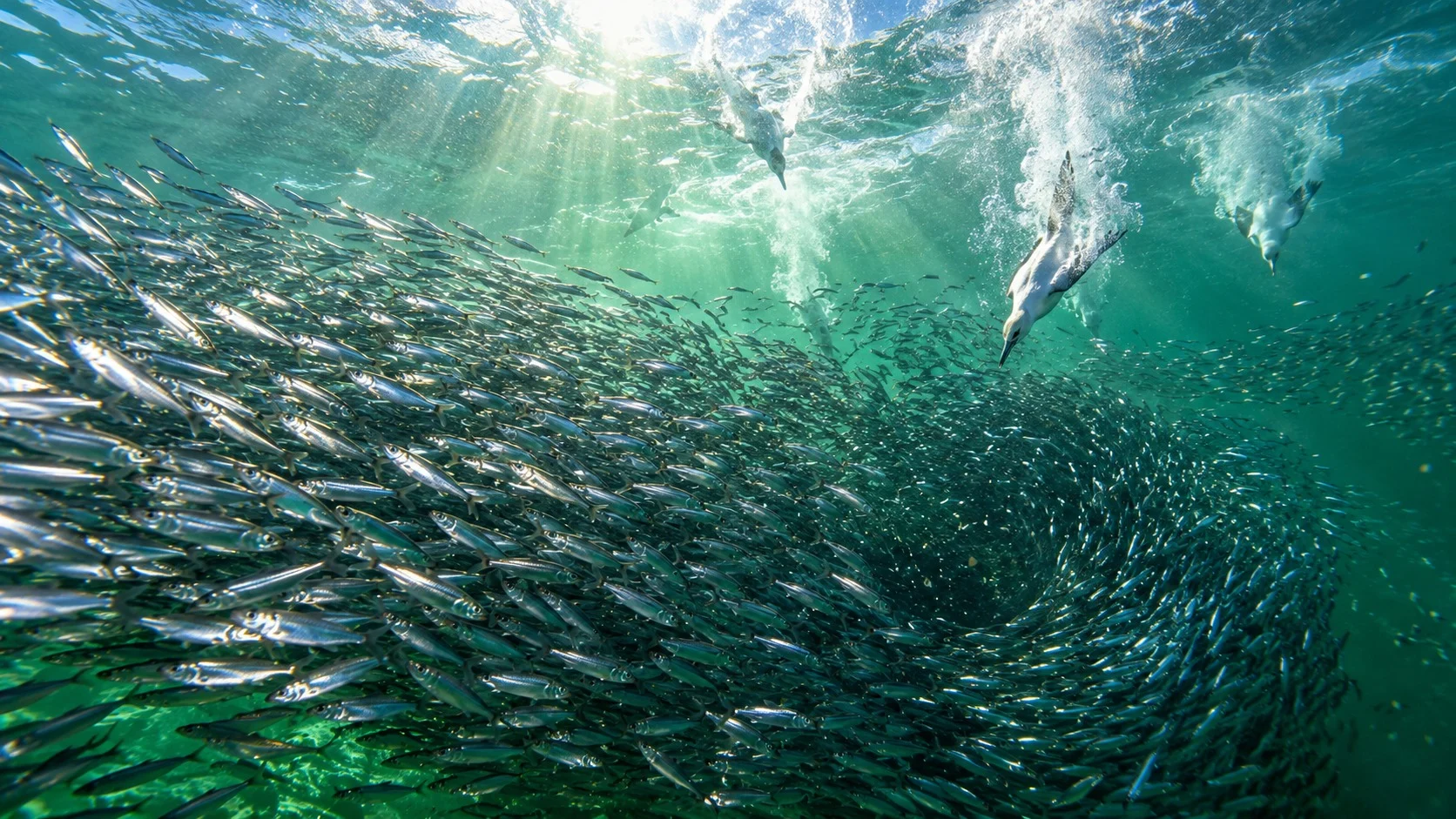
Meeting these nutrients, phytoplankton multiply explosively, and the food chain extends to the zooplankton that eat them, to small fish such as anchovies and sardines, and on to larger fish, seabirds and marine mammals. The five major upwelling regions make up only about 5% of the ocean's area, yet about 25% of the world's marine fish catch comes from them. The anchovy fishery off Peru is a prime example.
It Brings Fog and Deserts
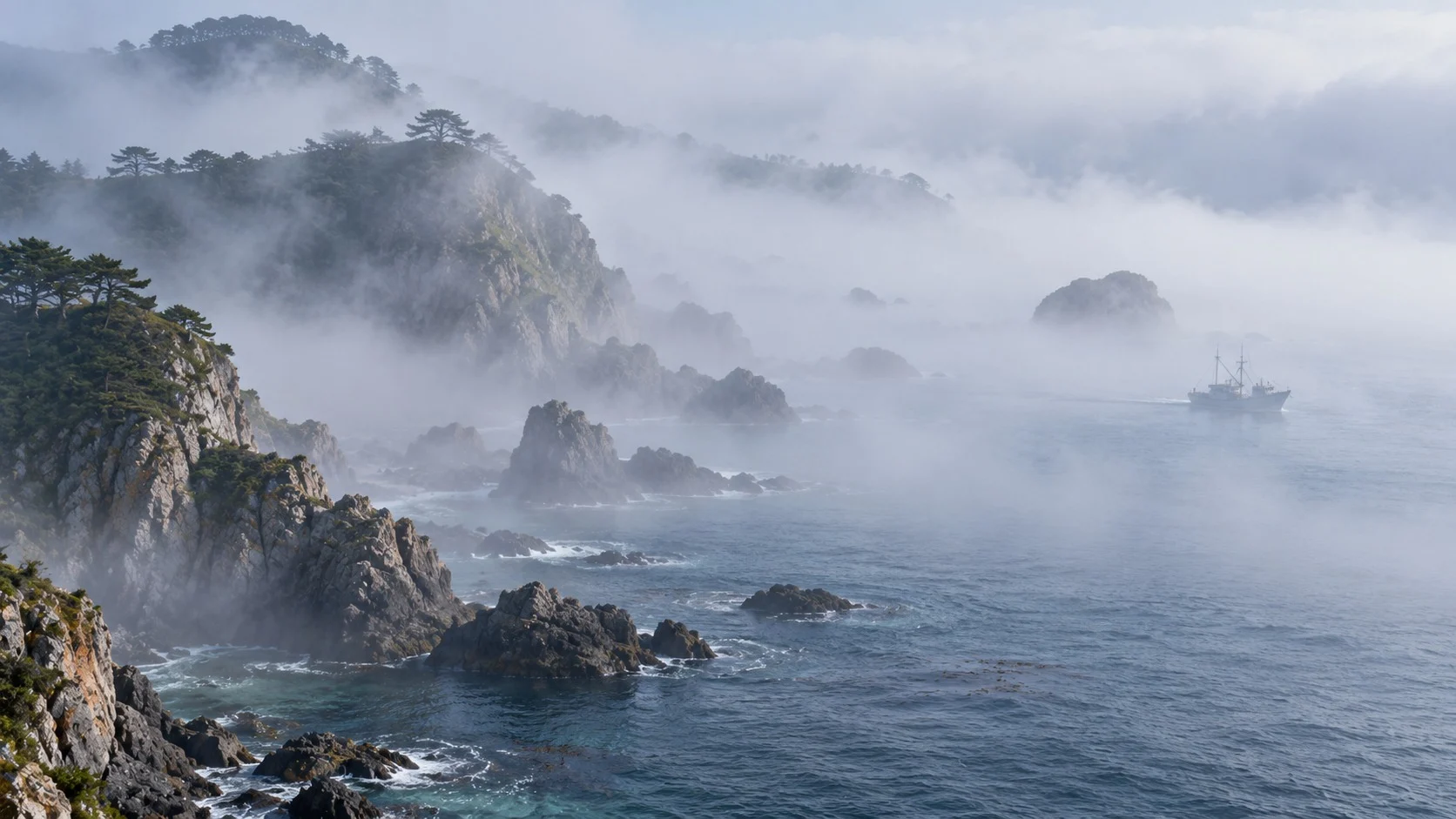
Cold seawater also cools the air above it, producing thick sea fog and low clouds. San Francisco in the United States, cool and often foggy even in summer, is a good example. On the other hand, because the air is cooled from below, rain clouds struggle to grow, so arid land can form along the coast, as in Chile's Atacama Desert and Namibia's Namib Desert.
Upwelling amid El Niño and Climate Change
Because upwelling is driven by wind, it weakens when the wind weakens. That makes it highly sensitive to changes in weather and climate.
(1) When El Niño Comes, the Sea Goes Hungry
When El Niño sets in and the trade winds weaken, upwelling off Peru declines and warm, nutrient-poor water covers the coast. In 1972, El Niño combined with overfishing caused Peru's anchovy catch to collapse sharply.
(2) Overfishing Shakes the Food Chain
In upwelling regions, one or two species of small fish such as anchovies or sardines usually serve as the waist of the food chain, linking the levels above and below. Catching too many of these fish also reduces the seabirds and larger fish that feed on them.
(3) Watching the Effects of a Warming Ocean
There is a hypothesis that as the Earth warms, the temperature difference between land and sea will grow and coastal upwelling may strengthen, while there are also concerns that a warmer surface layer will make the water mix less easily. Scientists keep a close watch on these changes by using satellites to observe sea surface temperature and chlorophyll concentration.
Upwelling is easily remembered only as the cold water at the beach, but in reality it is part of a vast cycle that lifts nutrients from the seabed and feeds countless living things. Thanks to this motion, created by the wind, the Earth's rotation and seawater working together, the fish on our tables exist too.
Knowing that a single breath of wind can awaken the deep sea is the first step toward learning to read the ocean.