When a friend shows up twenty minutes late, the first thought that comes to mind is often “they just have no sense of time.” Yet when we are the ones running late, what comes to mind first are the circumstances: the traffic was bad, the bus came late, an urgent call came in just as we were leaving. In this example, explaining the friend’s lateness too much in terms of personality while giving too little weight to their circumstances is the Fundamental Attribution Error. It should be distinguished from the actor-observer bias, which concerns differences in how we explain our own behavior and other people’s behavior.
Put simply, the fundamental attribution error means “the tendency, when looking at another person’s behavior, to underestimate the power of the situation they are in and to overestimate the influence of inner traits such as personality or attitude.” Stanford University psychologist Lee Ross gave it this name in 1977 and described it as a concept at the very starting point of social psychology.
In this piece we will look in turn at what attribution means and the experiments that first revealed this error, how the error arises and where it shows up in everyday life, and how it differs across cultures and how to reduce it.
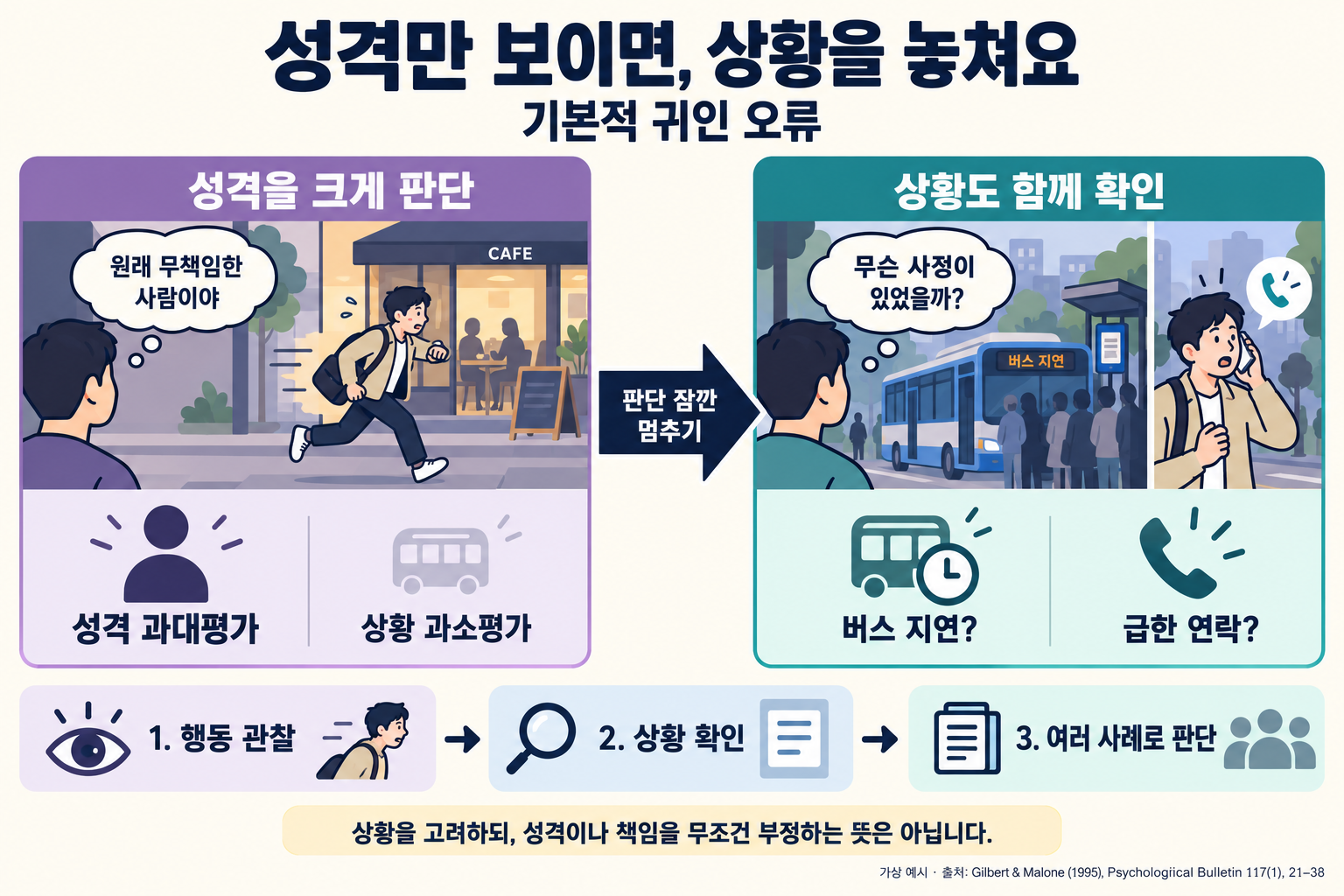
The Mental Habit of Reading Others’ Behavior as Personality
What Is the Fundamental Attribution Error?

Attribution is the process of judging what to credit as the cause of a behavior or event. In 1958 the Austrian-born psychologist Fritz Heider argued that people are always looking for causes, much like naive scientists, and divided those causes into two broad kinds.
- Dispositional Attribution: a judgment that locates the cause of a behavior inside the person, such as their personality, ability, or attitude.
- Situational Attribution: a judgment that locates the cause of a behavior in outside circumstances, such as the weather, rules, or pressure from other people.
The fundamental attribution error is what happens when, in explaining other people’s behavior, this scale tips too far toward dispositional attribution. Harvard University’s Daniel Gilbert also refers to the same phenomenon as “Correspondence Bias,” meaning that when we see a behavior, we immediately assume there is a personality trait that matches it exactly.
Two Experiments That Revealed the Error

What makes this tendency surprising is that it appears even when people clearly know how powerful the situation is. Two classic experiments show this well.
(1) The Castro essay experiment (1967)
Edward Jones and Victor Harris had participants read essays that either supported or criticized the Cuban leader Fidel Castro. Even after being told that the writers had not chosen their positions but had written as assigned, participants judged that those who wrote supportive essays actually liked Castro more.
(2) The quizmaster experiment (1977)
Lee Ross and his colleagues randomly divided participants into questioners and contestants. Because the questioners wrote questions from fields they knew well, they naturally had the advantage, yet the contestants and onlookers rated the questioners as more knowledgeable people. They mistook the advantage given by the role for the person’s own ability.
Understanding the Fundamental Attribution Error Through Easy Examples

This error shows up even more often outside the lab, in scenes we encounter every day.
[Example 1] The seminary students in a hurry
In 1973 John Darley and Daniel Batson asked seminary students to go to another building to give a talk. On the way, there was a person slumped over and groaning. About 63% of the students who had been told they had plenty of time helped, but only about 10% of those who were urged on because they were late stopped. What decided whether they helped was not so much their faith or character as the situation of “how much of a hurry they were in.”
[Example 2] The car that cut in and the unfriendly clerk
When a driver suddenly cuts in front of us, it is easy to conclude they are a rude person, but they might have been rushing to the hospital. A curt store clerk may likewise have been serving ten customers alone.
Why does this happen? When we look at another person, what catches our eye is the person themselves, while the circumstances surrounding them are hard to see. Gilbert explained that we first observe a behavior and almost automatically infer a personality trait, and only correct that judgment by taking the situation into account when we have the mental room to do so. When we are tired or busy, we end up skipping this final correction step.
Conversely, when we look at our own behavior, the circumstances around us are plain to see, so we readily attribute it to the situation. This tendency to explain others and ourselves differently is called the “Actor-Observer Bias.” A 2006 meta-analysis found that this gap is smaller than once thought, and research on it is still ongoing.
Cultural Differences and Ways to Reduce the Error

The size of the fundamental attribution error also varies by culture. In a 1984 study by Joan Miller, Americans became more inclined to explain others’ behavior in terms of personality as they grew older, whereas Indians cited situations and relationships more often. In 1994 Michael Morris and Kaiping Peng compared news coverage of two shootings that took place in the United States in 1991 and found that English-language newspapers emphasized the perpetrators’ personalities, while Chinese-language newspapers put more emphasis on the situations the perpetrators were in.
(1) Think of the situation first
When someone’s behavior bothers you, try to come up with even just one circumstance that might lead that person to act that way.
(2) Put yourself in their place
Simply asking what you would have done in the same situation makes your judgment far more generous.
(3) Don’t jump to conclusions from a single action
It is not too late to judge someone’s personality after you have seen the same pattern repeat across many situations.
The fundamental attribution error is a natural habit of mind that makes personality look large and the situation look small in other people’s behavior. This habit lets us judge quickly, but it can also lead to misunderstandings, hasty blame, and unfair evaluations. Especially in settings where people are being judged, such as job interviews or performance reviews, a small misunderstanding can have large consequences.
Taking one more look at the situation someone is in when they make a mistake: that is the first step toward fair judgment that protects both people and relationships.