Scatter a handful of salt onto a campfire and the flames flash yellow for a moment; fireworks paint the night sky red, green, and blue. Behind this shift of color with whatever you feed the fire lies a chemical principle: each element has its own appointed color of light. The experiment that identifies metal elements in a sample from flame color alone is the flame test.
Put simply, a flame test is the phenomenon in which a metal element or its compound, placed in a flame, emits light of a color unique to that element—or the analytical method that uses the effect to identify the element. It is a classroom staple because a single flame can hint at composition without expensive gear, yet its principle reaches all the way to atomic structure and the nature of light.
In this piece we will look in turn at what a flame test means and how the colors arise, the flame colors of individual elements, the history of finding new elements and the use in fireworks, and finally the laboratory method and its limits.
A Fingerprint of Light for Every Element: The Flame Test
What Is a Flame Test?

Alchemists knew long ago that the color of a flame changes with whatever is put into the fire. Ordinary flames, though, already glow orange and yellow themselves, so the sample’s color mixed in and was hard to tell apart.
The person who solved that problem was the chemist Robert Bunsen of Heidelberg University in Germany. Bunsen designed a burner that mixes air and gas in controlled amounts to produce an almost colorless, clean flame, and that Bunsen burner is still a standard laboratory tool. On a colorless flame the sample’s own color stands out clearly, and from then on the flame test became a trustworthy method of analysis.
What decides the color in a flame test is not the whole compound but the metal element inside it. Whether it is sodium chloride or sodium nitrate, as long as sodium is present the same yellow flame appears.
How Flame Colors Arise, and the Colors by Element
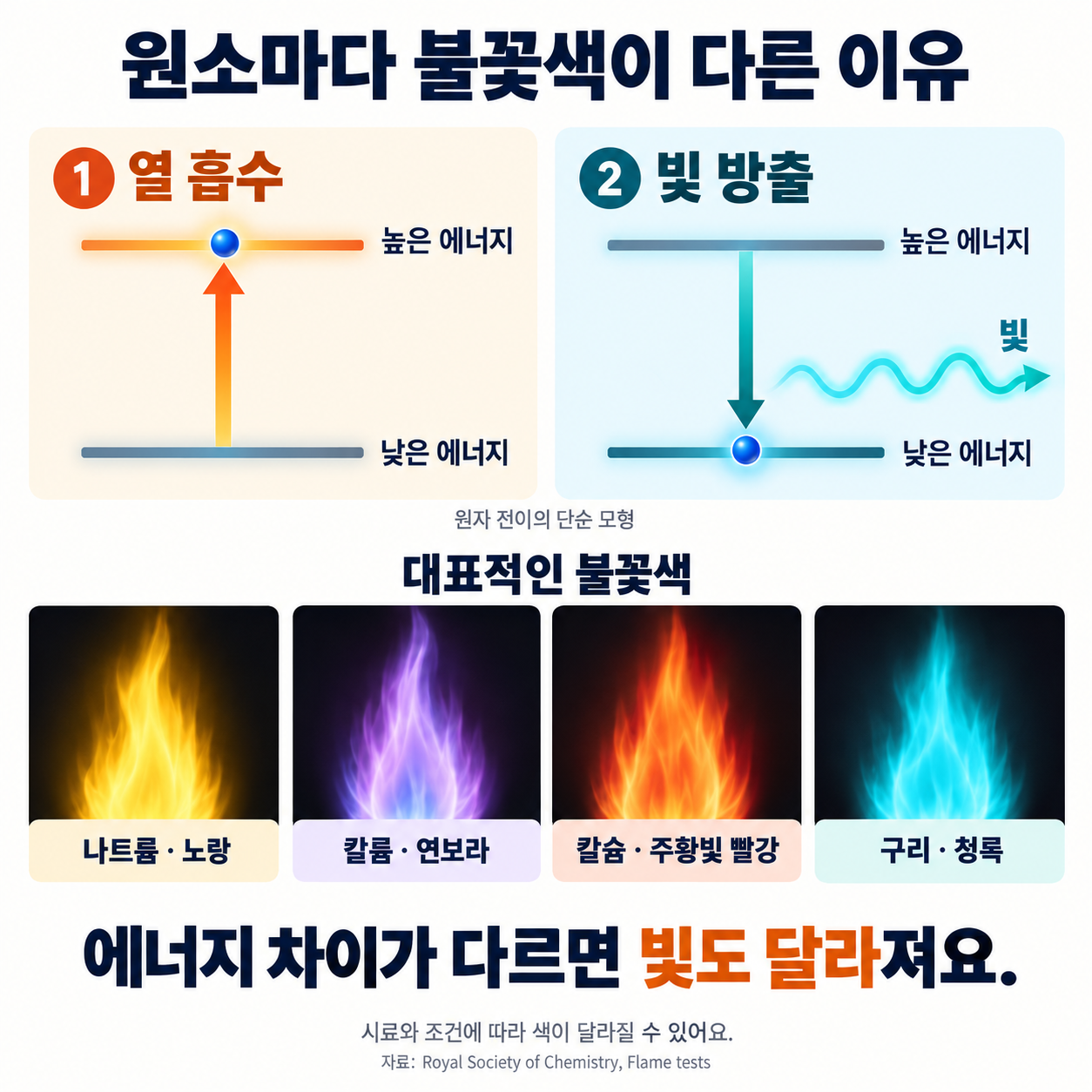
Flame color comes from the motion of electrons inside atoms. The process can be divided into three steps.
(1) Absorbing energy
Electrons in metal atoms heated by the flame absorb energy and jump to a higher energy state than their usual place. That is called an excited state.
(2) Emitting light
An excited state is unstable, so the electron soon returns to its original lower energy state and releases the energy difference as light.
(3) A unique color
Because the spacing of the energy levels where electrons can sit differs from element to element, the wavelength of the light emitted also differs. That difference shows up as a difference in flame color.
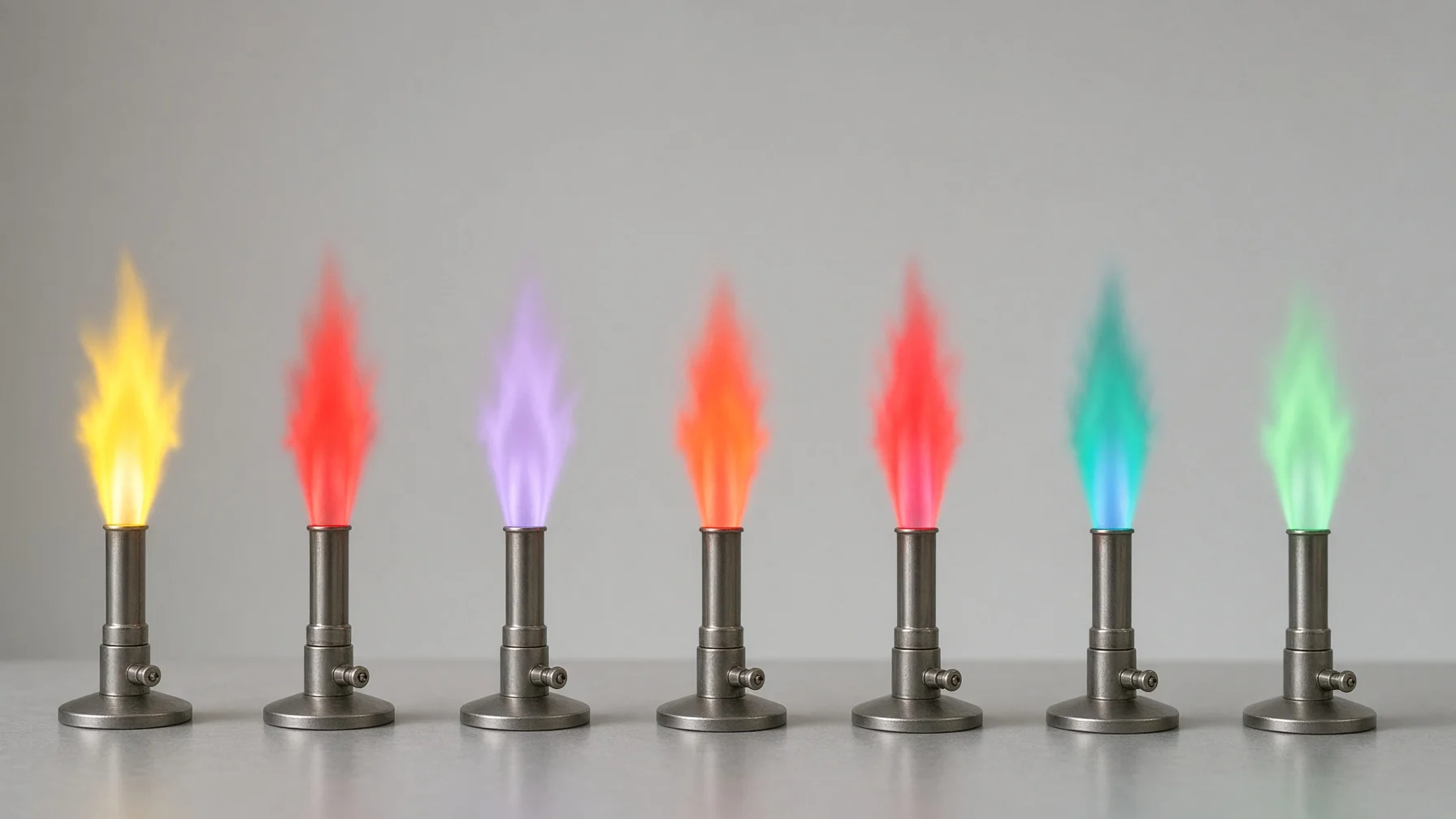
Typical flame colors by element are as follows.
- Sodium: Intense yellow. Light at about 589 nm comes out strongly.
- Lithium: Deep red (crimson).
- Potassium: Pale lilac (violet).
- Calcium: Orange-tinged red.
- Strontium: Bright crimson.
- Copper: Blue-green.
- Barium: Pale yellow-green.
Sodium’s yellow light is easy to see in everyday life. The sodium lamps that turn roads and tunnels yellow use exactly this light from sodium atoms. When soup boils over and tints a gas-stove flame yellow, that too is the sodium in the salt of the broth.
Finding New Elements and Coloring the Night Sky

The flame test became more than a simple experiment—it became a tool for finding new elements. In 1859 Bunsen, together with the physicist Gustav Kirchhoff, built a spectroscope that splits flame light with a prism. Colors that look alike to the eye show bright lines in different places for each element when viewed through a spectroscope.
New Elements Found with the Spectroscope
In 1860 the two were analyzing mineral water when they found two sky-blue lines never seen before, and named the element cesium after the Latin word for sky blue (caesius). The next year they found rubidium by following a deep red line; the name itself comes from the flame’s color (from Latin rubidus). Soon after, thallium with its green line and indium with its indigo line were discovered the same way. In 1868, during a total solar eclipse, a yellow line was observed in sunlight that matched no known element, and that element received the name helium—from the Greek for the Sun—before it was ever found on Earth.
The Colors of Fireworks
Fireworks use the same principle. Red comes from strontium, green from barium, yellow from sodium, and blue from copper compounds. Among them, a clear, deep blue is sensitive to temperature and is often counted by pyrotechnicians as the hardest color to produce well.
How to Run a Flame Test—and Its Limits
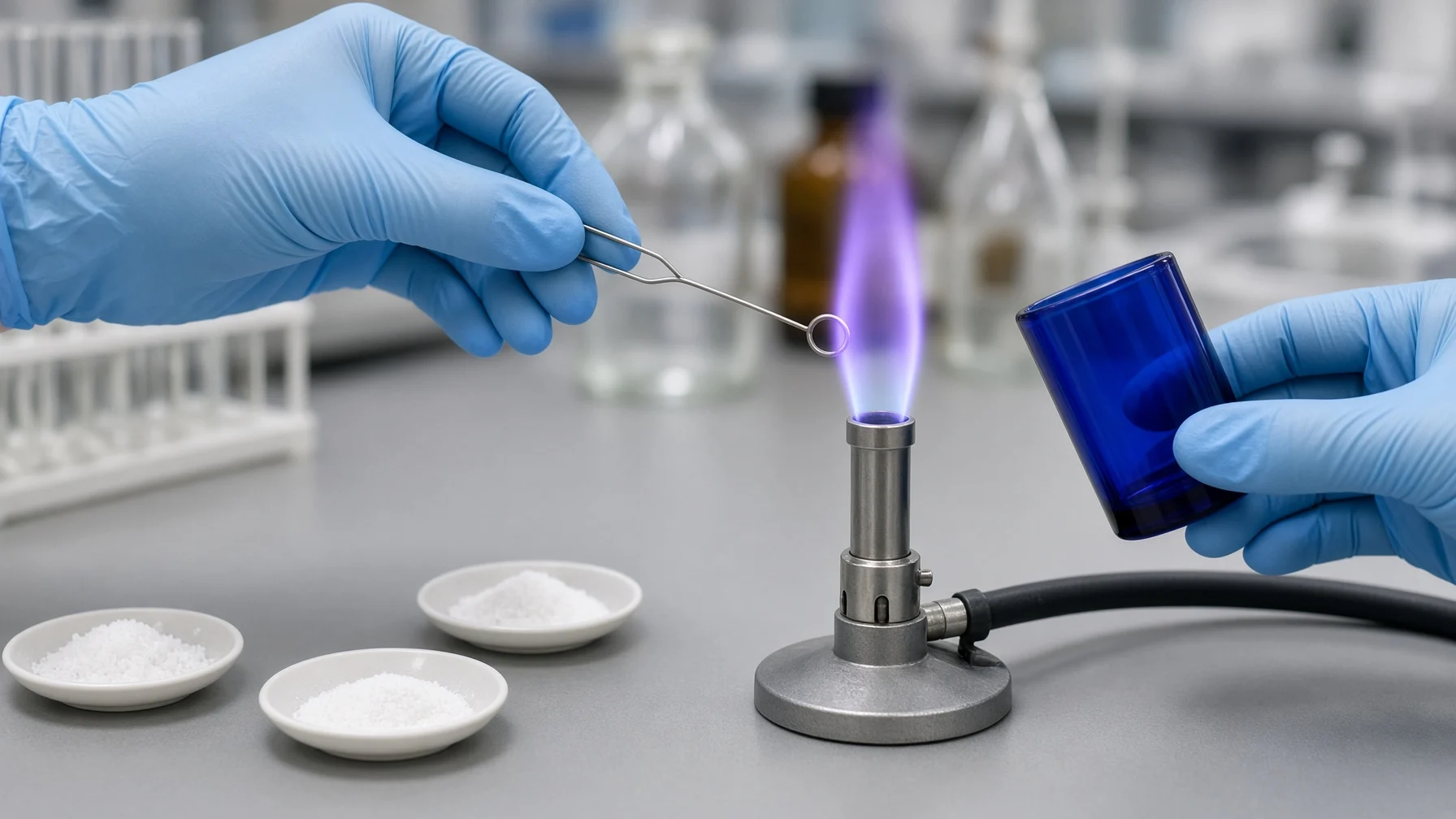
A school flame-test experiment is simple. Dip a platinum or nichrome wire in dilute hydrochloric acid and heat it in the flame until no color remains, then touch the sample, put the wire into the hotter outer flame, and watch the color.
The flame test does have several clear limits, though.
(1) Interference from sodium
Sodium’s yellow is so strong that even a tiny amount can mask other colors. So when checking potassium’s violet, one looks through cobalt glass that filters out the yellow.
(2) Similar colors and subjectivity
Red-family colors such as lithium, strontium, and calcium are hard to tell apart by eye, and judgment can vary from person to person.
(3) Limits on which elements you can confirm
Not every metal gives a clear flame color, and exact amounts are hard to measure. For precise composition analysis today, instrumental methods such as atomic emission spectroscopy are used.
The flame test is an experiment that lets you see with your own eyes that each element emits its own appointed light. The moment Bunsen and Kirchhoff split that light, spectroscopy opened, and the same principle leads all the way to reading the composition of distant celestial bodies from starlight.
Remembering that even the color of a single flame holds an atomic story is a first step toward scientific thinking that understands the invisible world of matter.