This time, I want to look at the concept and types of scales, which are widely used for statistical analysis in fields such as sociology, psychology, and statistics. Since the concept may feel a little unfamiliar to those encountering it for the first time, I created separate images to make it easy to understand.
To briefly pin down the concept first, a scale is the systematic assignment of numbers to the attributes of a target, such as an object or a person, in order to express its characteristics as statistical numbers.
The types of scales are the nominal scale, the ordinal scale, the interval scale, and the ratio scale, and each has different characteristics and carries different information.
 The four types of scales: nominal, ordinal, interval, and ratio
If we rank the four types of scales by the information they contain, the order is [nominal scale < ordinal scale < interval scale < ratio scale], with the nominal scale containing the least information. Now I will introduce the nominal, ordinal, interval, and ratio scales mentioned here one by one, in order.
1. Nominal Scale
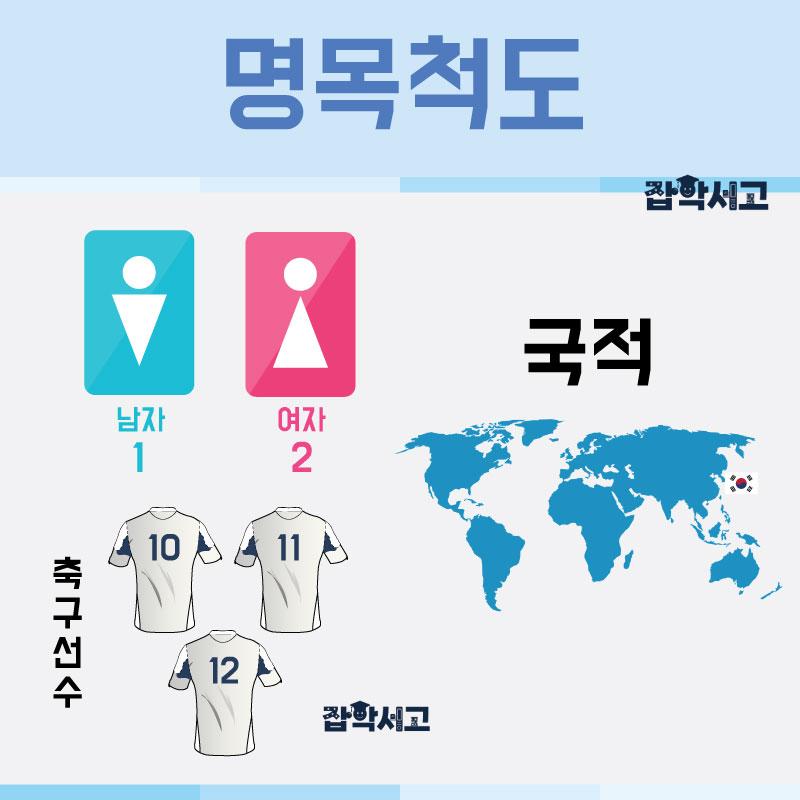 Examples of a nominal scale
First, a nominal scale (naming scale) assigns numbers in place of names or labels, such as male (1) and female (2). Here the numbers merely indicate that the attributes are different and carry no other information.
Typical examples of a nominal scale are numbers used to distinguish targets by their attributes, such as gender (male 1, female 2), player numbers (No. 9, No. 10, No. 11), and nationality (Korea, Japan, China, the United States).
Comparison method: identification, classification
Operations: =
Statistics: mode
Applicable statistical methods: nonparametric statistics, frequency analysis, cross-tabulation analysis
2. Ordinal Scale
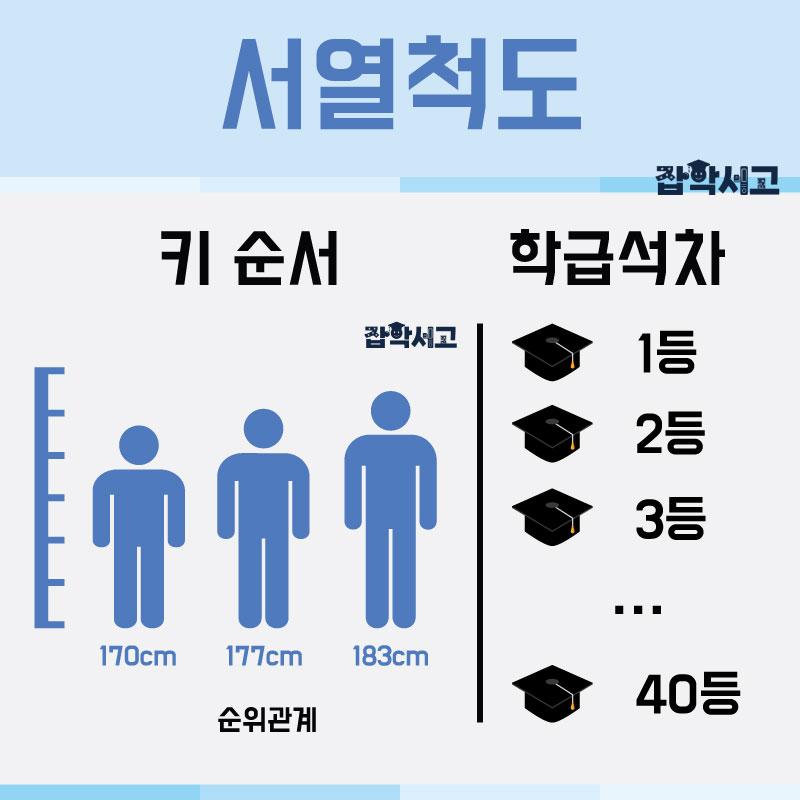 Examples of an ordinal scale
An ordinal scale has the nominal scale's property of distinguishing targets, and in addition contains information about the rank relationships among them. However, while it can show rank relationships, the differences between ranks cannot be regarded as equal.
Typical examples include rank relationships in exam results (1st, 2nd, 3rd place) and order by height (183 cm, 177 cm, 170 cm).
Comparison method: rank comparison
Operations: =, <, >
Statistics: mode, median
Applicable statistical methods: nonparametric statistics, rank correlation
3. Interval Scale
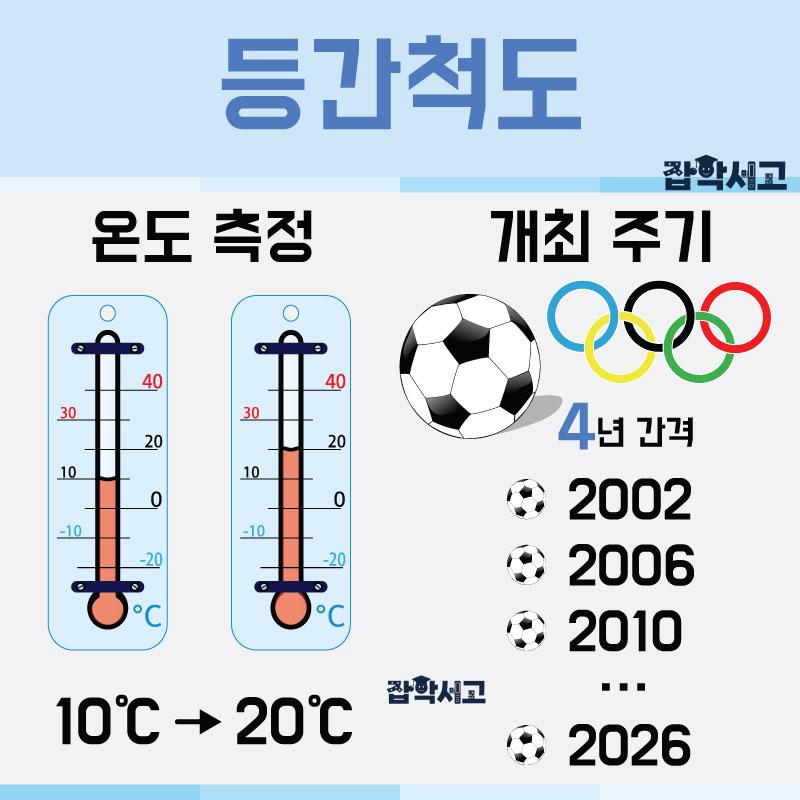 Examples of an interval scale
An interval scale has the information of the nominal and ordinal scales mentioned above and also includes interval information, meaning that differences between attribute values are equal. For this reason, it is also called an 'equal-interval scale.'
The most commonly cited examples of an interval scale are temperature and years. If the temperature change over two hours is measured at 8 a.m. and at 8 p.m., and the readings are 10 degrees → 20 degrees and 20 degrees → 10 degrees, we can tell that the temperature changed by the same 10 degrees in both cases.
Years, too, as in the case of the Olympics and the World Cup, contain information in which the numbers change at the same four-year interval: 2002, 2006 … 2022, 2026, and so on.
Comparison method: interval comparison
Operations: +, -, =, <, >
Statistics: mode, median, arithmetic mean
Applicable statistical methods: parametric statistics
4. Ratio Scale
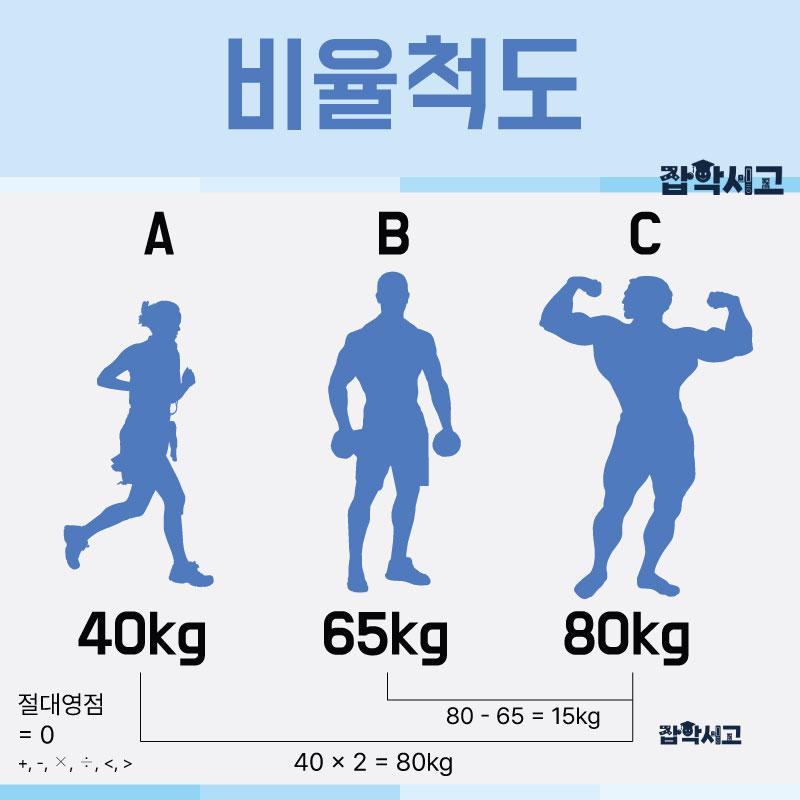 Examples of a ratio scale
A ratio scale includes the information of the nominal, ordinal, and interval scales above and also contains information about ratios. The biggest feature of a ratio scale is that it has an absolute '0' value (absolute zero) and allows all four arithmetic operations (+, -, ×, ÷).
Taking body weight as an example of a ratio scale, if A weighs 40 kg, B 65 kg, and C 80 kg, we can tell that C weighs twice as much as A (× multiplication) and that C weighs 15 kg more than B (- subtraction).
Comparison method: absolute magnitude comparison
Operations: +, -, ×, ÷, <, >
Statistics: mode, median, geometric mean, harmonic mean, etc.
Applicable statistical methods: parametric statistics

In addition, statistics also has the absolute scale, which includes nominal, ordinal, and interval information, has an absolute zero and absolute units, and represents the quantity of a particular item or attribute. In general, however, the nominal, ordinal, interval, and ratio scales are the ones mainly used, so it is enough to know just these four main scales.
That covers the four types of scales mainly used in the social sciences: the nominal, ordinal, interval, and ratio scales. I hope this article helped you understand these four types of scales and brought you one step closer to statistics, which can feel difficult.