
You have probably heard stories of a beach resort that was once packed with people and, a few decades later, was left with nothing but worn-out signs and empty hotels. On the other hand, a quiet village nobody knew about can suddenly become a famous travel destination one day. Tourist destinations seem to stay the same, but in reality they go through a process of being born, growing, and aging.
In tourism studies, this flow is called the ‘Tourism Area Life Cycle.’ It is a model proposed in 1980 by Canadian geographer Richard W. Butler, and it explains in several stages how the number of tourists visiting an area rises, levels off, and falls over time.
This article lays out, in an easy-to-understand way, the meaning and background of the Tourism Area Life Cycle, the characteristics of its six stages, examples of destinations standing at a crossroads after stagnation, and perspectives for putting the model to use.
Stages and Uses of the Tourism Area Life Cycle
What Is the Tourism Area Life Cycle?
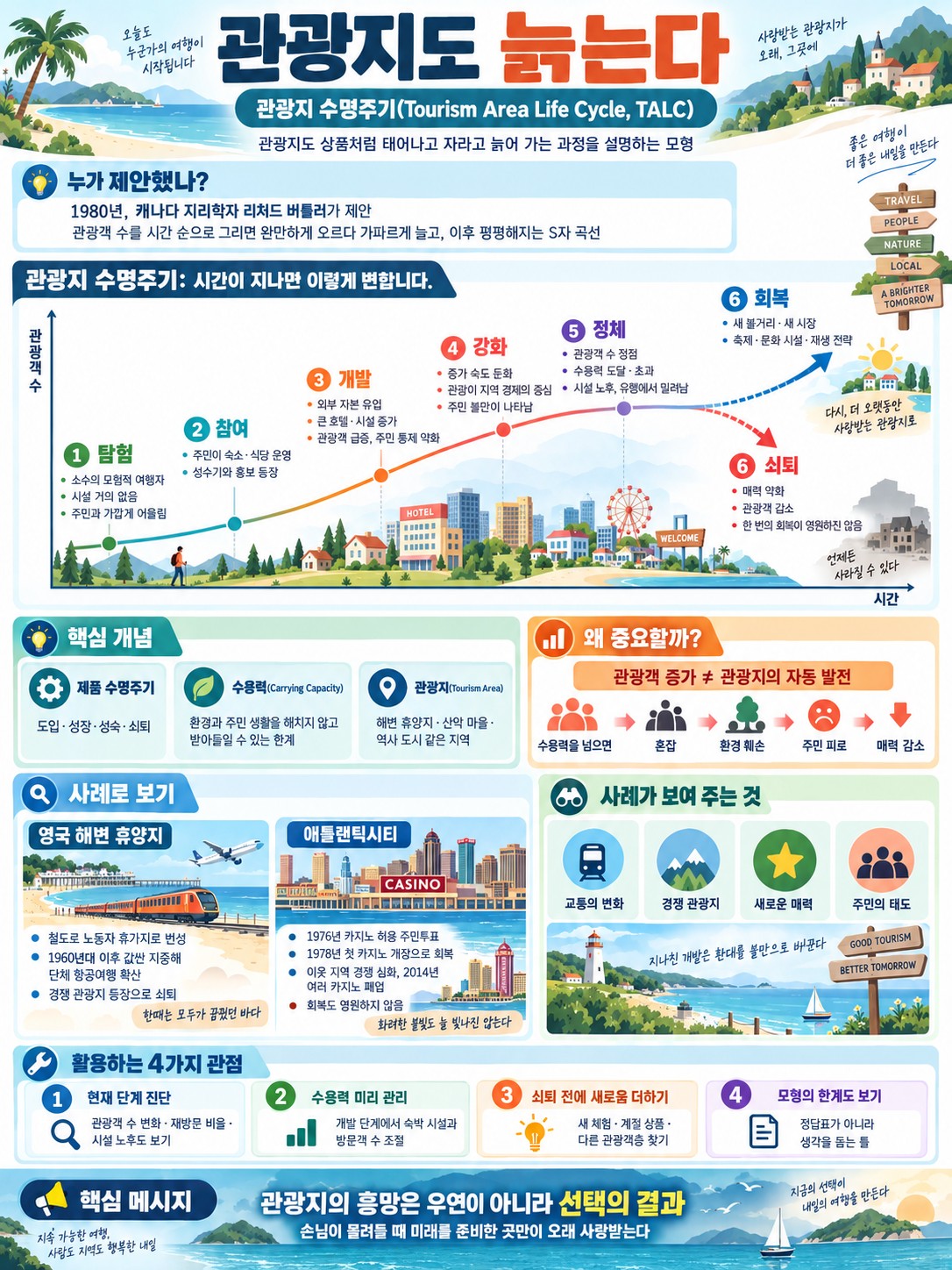

The Tourism Area Life Cycle starts from the idea that a tourist destination, like a product, goes through a life span. In a paper published in 1980 in the academic journal The Canadian Geographer, Butler argued that if you plot the number of tourists over time, an S-shaped curve appears: it rises gently at first, then shoots up steeply, and then flattens out again.
- Product Life Cycle: A marketing theory holding that products go through introduction, growth, maturity, and decline; it served as the basis for this model.
- Carrying Capacity: The limit on the number of tourists an area can take in without harming its environment and residents' lives.
- Tourism Area: A single area that tourists visit, such as a beach resort, a mountain village, or a historic city.
The key point of this model is that a destination does not automatically get better as the number of tourists grows. From the moment carrying capacity is exceeded, congestion, environmental damage, and residents' fatigue pile up, and the destination's appeal actually begins to decline.
The Six Stages of the Tourism Area Life Cycle

Butler divided the path a tourist destination follows into the stages below. Not every place passes through them at the same speed, but each stage has distinct characteristics.
(1) Exploration
A small number of adventurous travelers arrive. There are almost no tourist facilities, and travelers mingle closely with residents and enjoy nature and culture as they are.
(2) Involvement
Residents open lodgings and restaurants and begin welcoming tourists. A peak season emerges, and some promotion of the area gradually begins.
(3) Development
Outside capital flows in, large hotels and amenities are built, and the number of tourists grows quickly. In peak season tourists may even outnumber residents, and local people's control weakens.
(4) Consolidation
The number of tourists keeps rising, but the rate of growth slows. As tourism becomes the center of the local economy, some residents grow discontented with tourists and development.
(5) Stagnation
The number of tourists peaks and reaches or exceeds carrying capacity. Facilities grow old and the destination's image falls out of fashion, so it comes to rely on repeat visitors and group events.
(6) Decline or Rejuvenation
After stagnation, the destination stands at a crossroads. If it cannot find new appeal, tourist numbers fall and it declines; if it finds new attractions or markets, it enters the path of rejuvenation and grows again.
Destinations at the Crossroads After Stagnation

The Tourism Area Life Cycle is widely cited because what happens after the stagnation stage can actually be seen in many destinations.
Many seaside resorts in Britain flourished as holiday spots for workers once railways were laid. But from the 1960s, as cheap package tours that flew people to the sunny Mediterranean spread, many of them lost visitors and went into decline.
Atlantic City in New Jersey, USA, is often cited as an example of rejuvenation. Having been on a downward slide as an old seaside resort, it legalized casinos through a 1976 referendum, and when its first casino opened in 1978 it began drawing tourists again.
However, as casinos multiplied in neighboring areas, Atlantic City ran into trouble again, and in 2014 several casinos closed at once. This shows that a single rejuvenation does not guarantee growth forever.
[Case Points]
- Changes in transportation: Railways and air travel greatly changed the rise and fall of destinations
- Competing destinations: When newer, cheaper destinations appear, existing ones get pushed aside
- New attractions: Casinos, festivals, and cultural facilities can trigger rejuvenation
- Residents' attitudes: When development goes too far, hospitality easily turns into resentment
4 Perspectives for Using the Tourism Area Life Cycle

The Tourism Area Life Cycle is not a prophecy that reveals a fixed fate; it is closer to a mirror that lets a destination see where it stands right now.
(1) Diagnose the current stage
By looking at changes in tourist numbers, the share of repeat visits, and how worn the facilities are, you can gauge whether a destination is in its growth phase or its stagnation phase.
(2) Manage carrying capacity in advance
Controlling lodging and visitor numbers during the development stage can delay reaching stagnation early because of congestion and environmental damage.
(3) Add something new before decline
When signs of stagnation begin to appear, seeking out new experiences, seasonal products, and different groups of tourists makes it easier to open the path to rejuvenation.
(4) Keep the model's limits in view
Real destinations sometimes skip stages or stay in one for a long time, and which stage a place is in often becomes clear only in hindsight. So it is best to use this model not as an answer key but as a framework that helps you think.
In the end, the Tourism Area Life Cycle tells us that the rise and fall of a destination is not a matter of chance but the result of choices. Only the places that prepared for the future while visitors were flocking in stay loved for a long time.
Honestly examining the path a destination has traveled and where it stands now is the first step toward creating a destination that stays loved for a long time.