The westerlies are strong winds that blow from west to east in the Earth's mid-latitudes, an important atmospheric phenomenon with a major influence on climate and weather.
These winds arise as part of the Earth's atmospheric circulation system and bring about a variety of weather phenomena and climate changes. In particular, the westerlies play an important role in shaping global climate patterns through their interaction with the polar jet stream.
In this article, we will look at the concept of the westerlies and why they form, their relationship with the polar jet stream, their effects on climate around the world, and their specific effects on Korea.
How the Westerlies Form and Why
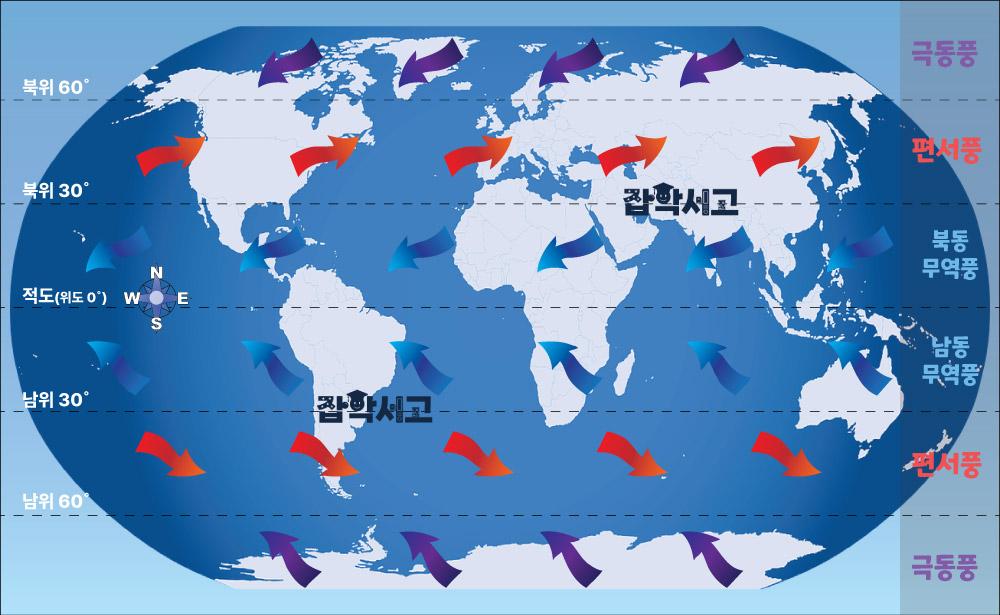 Why do the westerlies blow?
The westerlies are winds that blow from west to east in the mid-latitudes and play an important role in the Earth's atmospheric circulation system. They occur mainly between latitudes 30 and 60 degrees, and their formation and causes are determined by the following key factors.
Atmospheric circulation and the Coriolis effect
As the Earth rotates, it receives energy from the Sun, which heats the atmosphere. As a result, the equatorial region forms a tropical low pressure belt, and the air that rises there gradually cools as it moves toward higher latitudes. This cooled air then sinks again and forms the subtropical high pressure belt. The wind that arises from this process of atmospheric circulation is the westerlies. In particular, the Coriolis effect caused by the Earth's rotation turns the direction of this wind so that it blows from west to east.
Pressure differences and high and low pressure systems
The westerlies are strengthened by differences between high and low pressure systems. High pressure in the mid-latitudes forms as hot air that has moved from the equator sinks, and this causes relatively cold air to move in from the polar regions. This movement of air creates strong westerly winds in the mid-latitudes, and these westerly winds are the westerlies.
Seasonal changes
As the position of the Sun changes with the seasons, the strength and path of the westerlies also change. For example, in winter the temperature difference between the polar regions and the mid-latitudes grows, making the westerlies stronger. In summer, on the other hand, this temperature difference shrinks, and the westerlies can become weaker.
The influence of terrain
The westerlies are also affected by terrain. For example, in the Northern Hemisphere, the mountain ranges of North America and Eurasia can block or strengthen the flow of the westerlies. These terrain factors make regional climate and weather patterns even more complex.
The westerlies are an important wind formed by the combination of the Earth's complex atmospheric circulation system and various climate factors. Understanding them is essential for understanding and predicting global climate patterns.
The Westerlies and the Polar Jet Stream
 How do the westerlies and the polar jet stream interact?
The westerlies and the polar jet stream are closely linked atmospheric phenomena that have a major influence on global climate and weather patterns. Both occur in the mid- and high latitudes, and their interaction plays an important role in regulating the climate, especially around the polar regions and in the mid-latitudes.
What is the polar jet stream?
The polar jet stream is a narrow, strong band of wind that flows rapidly from west to east at an altitude of roughly 8 to 15 km. It forms mainly around latitude 60 degrees and is found in both the Northern and Southern Hemispheres. The jet stream forms because of the temperature difference between two air masses: cold polar air and relatively warm mid-latitude air. This temperature difference creates a strong pressure gradient, which forms the jet stream.
Interaction between the westerlies and the jet stream
The westerlies and the polar jet stream are closely connected. The jet stream flows strongly in the upper part of the westerlies, and as a result it also affects the path and strength of the westerlies at the surface. For example, when the jet stream bends northward (moves north), the westerlies also shift farther north, and when the jet stream bends southward (moves south), the westerlies also shift south. This interaction is an important factor in determining the weather and climate of particular regions.
Effects on climate and weather
The position and strength of the polar jet stream have a major influence on weather patterns in the polar regions and the mid-latitudes. When the jet stream is stable and close to a straight line, the mid-latitudes experience relatively mild and stable weather. However, when the jet stream meanders and swings widely, cold polar air can move south, or warm mid-latitude air can move north, leading to extreme weather. These events often take the form of cold waves, heat waves, and heavy rain.
Seasonal changes and variability
The position and strength of the polar jet stream change with the seasons. In winter, as the temperature difference between the polar regions and the mid-latitudes grows, the jet stream becomes stronger and moves south. In summer, on the other hand, the temperature difference shrinks, so the jet stream weakens and moves north. These seasonal changes directly affect the seasonal climate patterns of each region.
The westerlies and the polar jet stream shape the Earth's climate system through complex interactions in the atmosphere. Understanding them is very important not only for weather forecasting but also for research on long-term climate change.
The Global Climate Effects of the Westerlies
 What effects do the westerlies have?
The westerlies are winds that blow from west to east in the Earth's mid-latitudes and have a significant influence on climate around the world. As an important element of the atmospheric circulation system, these winds help shape the climate and weather patterns of many regions. The effects of the westerlies on the world's climate can be examined as follows.
Regulating mid-latitude climates
The westerlies play an important role in the mid-latitudes of both the Northern and Southern Hemispheres. As these winds move across the Atlantic and Pacific Oceans, they affect the climate of both oceans and continents. The westerlies carry warm air toward the poles and cold air toward the equator, regulating temperatures in the mid-latitudes. In the process, they cause precipitation patterns and temperature changes that determine the seasonal climate of particular regions.
Forming low and high pressure systems
The westerlies play an important role in the formation and movement of low and high pressure systems. Low pressure systems that develop in the mid-latitudes are often carried along by the westerlies and bring extreme weather such as storms. For example, in Europe and North America, the westerlies move across the Atlantic and carry winter storms and rain clouds. These systems largely determine the weather and climate patterns of those regions.
Climate interactions between oceans and continents
The westerlies promote climate interactions between oceans and continents. Westerlies blowing in from the sea carry the ocean's heat and moisture onto the continents, creating maritime climates and moderating the climate of inland areas. As a result, areas near the ocean have relatively warm winters and cool summers. Conversely, westerlies blowing from the continent create continental climates and can cause extreme temperature swings in inland areas.
Long-distance weather patterns
The westerlies play an important role in forming long-distance weather patterns. For example, weather systems that develop over North America often ride the westerlies across the Atlantic and affect Europe. These long-distance weather patterns strengthen climate interactions between regions and contribute to global climate change. The westerlies are also linked to large-scale climate phenomena such as El Niño and La Niña. These phenomena change the path and strength of the westerlies, affecting climate patterns around the world.
Climate change and shifts in the westerlies
Climate change also affects the path and strength of the westerlies. Because of global warming, rising temperatures in the polar regions can weaken the flow of the westerlies or increase their variability. These changes can bring uncertainty to climate patterns in the mid-latitudes and increase the frequency and intensity of extreme weather.
The westerlies play a central role in the Earth's climate system, and their influence reaches across the globe. Understanding the movement and variability of the westerlies is very important for climate prediction and for responding to change.
How the Westerlies Affect Korea
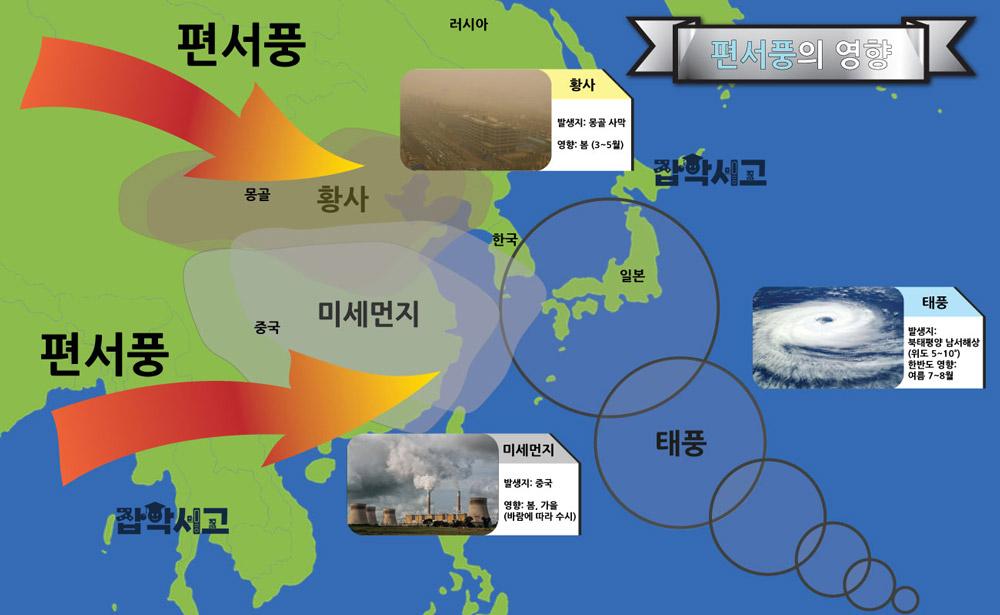 What effects do they have on Korea?
The westerlies are one of the atmospheric flows that have an important influence on Korea's climate and weather. Because Korea is located in the mid-latitudes, it is directly affected by the westerlies. These winds have an important influence on Korea in many respects, including seasonal climate patterns, weather changes, and air pollution.
Seasonal climate patterns
The westerlies play an important role in determining Korea's seasonal climate patterns. In winter, they combine with the Siberian High to bring cold air in from the northwest, causing cold waves. As a result, Korea experiences very low temperatures in winter. In summer, on the other hand, as the westerly belt shifts northward, the Korean Peninsula comes under the influence of the North Pacific High, and a hot and humid climate sets in.
The monsoon season and heavy rain
The westerlies also play an important role during the monsoon season. As the summer monsoon front moves north, it meets the westerlies, and at this point humid air flowing in from the south meets cold air from the north, forming a powerful rain belt. This is one of the main causes of heavy rain and flooding during Korea's monsoon season. During the monsoon season, the amount and pattern of rainfall vary depending on the path and strength of the westerlies.
Spread of air pollution
The westerlies also affect air pollution in Korea. In particular, yellow dust and fine dust generated in northeastern China in winter and spring travel to Korea on the westerlies. This worsens Korea's air quality and can cause health problems. On the other hand, when the westerlies blow strongly, they can quickly disperse pollutants and temporarily improve air quality.
Typhoon paths
The westerlies also affect the paths of typhoons. As typhoons move north, they come under the influence of the westerlies, and their paths are pushed eastward. Because of this, the likelihood that a typhoon will directly affect Korea can sometimes increase. Therefore, the state of the westerlies is an important factor in predicting the paths of typhoons and their effects on Korea.
Agriculture and ecosystems
The westerlies also affect Korea's agriculture and ecosystems. Combined with the seasonal monsoon winds, they are one of the main factors that determine crop growth and harvest times. In addition, shifts in the westerlies can affect changes in Korea's ecosystems, bringing changes to vegetation distribution and wildlife habitats.
The westerlies have a significant influence on Korea's climate and weather in many respects. Understanding and predicting them is essential for developing Korea's climate response strategies. Because the patterns of the westerlies may shift with climate change, ongoing research and monitoring are needed.
The westerlies are an atmospheric phenomenon that means more than just a wind, playing an important role in the Earth's climate and weather patterns. Through their complex interaction with the polar jet stream, they regulate the climate around the world, and in mid-latitude regions such as Korea in particular, they directly affect seasonal climate changes and weather patterns.
Understanding the westerlies is essential for responding to climate change and for developing effective strategies in many fields, such as agriculture, energy, and aviation. Going forward, it will be important to keep monitoring trends in the westerlies through research related to climate change and to prepare adaptation measures accordingly.