In this article, we will look at the marketing strategies used by companies, institutions, and other organizations, as they relate to business administration theory. A marketing strategy can be seen as an effort to understand the market for a product and to bring about change in that market through thorough analysis and planning.
 What does the customer want?
Here, marketing refers to finding out what customers want and then devising and carrying out strategies to satisfy those wants. This requires a detailed analytical procedure, and through the [3C - STP - 4P] process, companies systematically analyze how to organize their activities for selling a product.
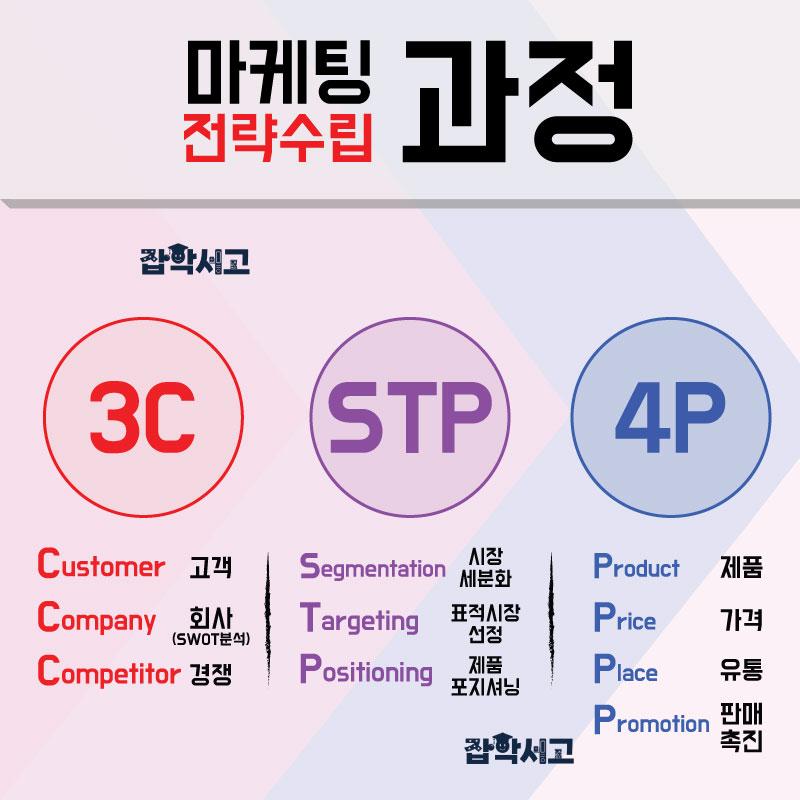 The marketing strategy development process
The strategy development process begins with environmental analysis and proceeds through marketing strategy and action plans, followed by evaluation and feedback. In this article, we will go through each of these stages in order, from the 3C analysis to SWOT analysis, the STP strategy, and the marketing mix (4P).
Marketing 3C
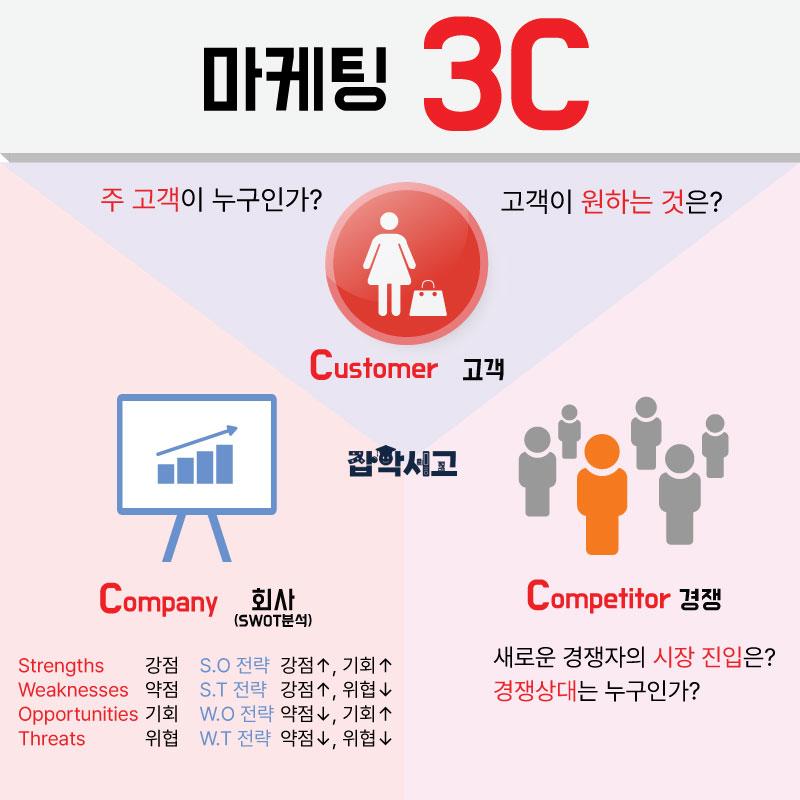 Marketing 3C - Customer, Company, Competitor
The 3C, carried out before a strategy is developed, refers to a company's marketing environmental analysis, in which the company analyzes itself, its customers, and its competitors in order to grow.
※ Customer - Identify what kind of interest consumers have in the product or brand, and who the main customers are.
※ Company - Analyze the company's internal and external factors and make plans through a SWOT analysis.
※ Competitor - Identify who the competitors are and how likely new competitors are to enter the market. Then decide on a policy for how to respond.
SWOT analysis, which is commonly used in marketing analysis, falls under the Company area of the 3C. Its details are as follows.
※ Strengths - A favorable market share, proprietary technology, high productivity, high job satisfaction, the ability to raise funds, etc.
※ Weaknesses - Outdated facilities, a weak brand image, a narrow product range, insufficient R&D capability, low advertising efficiency, etc.
※ Opportunities - A high economic growth rate, the emergence of new markets, low barriers to entry, the decline of competitors, the emergence of new technologies, etc.
※ Threats - The appearance of new competitors, an economic downturn, unfavorable policies and regulations, etc.
Here, strengths and weaknesses are internal factors that the company can control, while opportunities and threats are external factors that it cannot control directly.
In addition, by combining the elements of the SWOT analysis in pairs, the following strategies can be formulated.
※ S.O strategy uses strengths to take advantage of opportunities.
※ S.T strategy uses strengths to avoid or minimize threats in the market.
※ W.O strategy makes up for weaknesses in order to take advantage of opportunities.
※ W.T strategy makes up for weaknesses while avoiding and minimizing threats.
STP Strategy
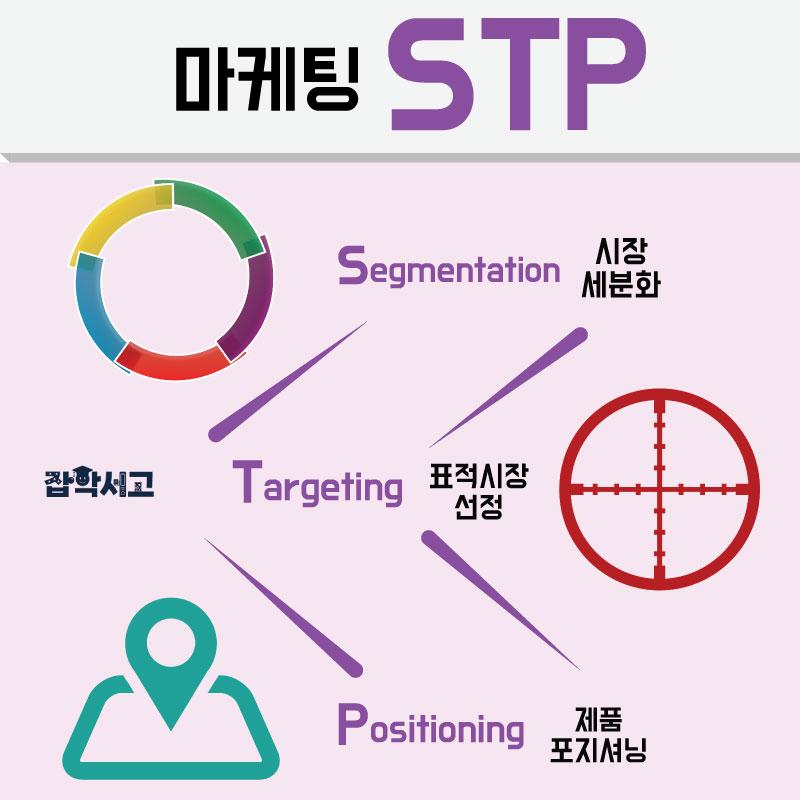 STP Strategy - Market Segmentation, Target Market Selection, Product Positioning
Once the company's marketing environment has been analyzed through the 3C analysis, the STP strategy is used to segment the product market (Segmentation) and evaluate the segments to select a target market (Targeting). Finally, the company goes through the step of determining the positioning (Positioning) of each product, and this whole process is called the STP strategy.
※ Segmentation - Dividing a single market according to its characteristics
※ Targeting - The market selected as the most attractive among the segmented markets
※ Positioning - Letting consumers know what kind of product this product is
Marketing Mix (4P)
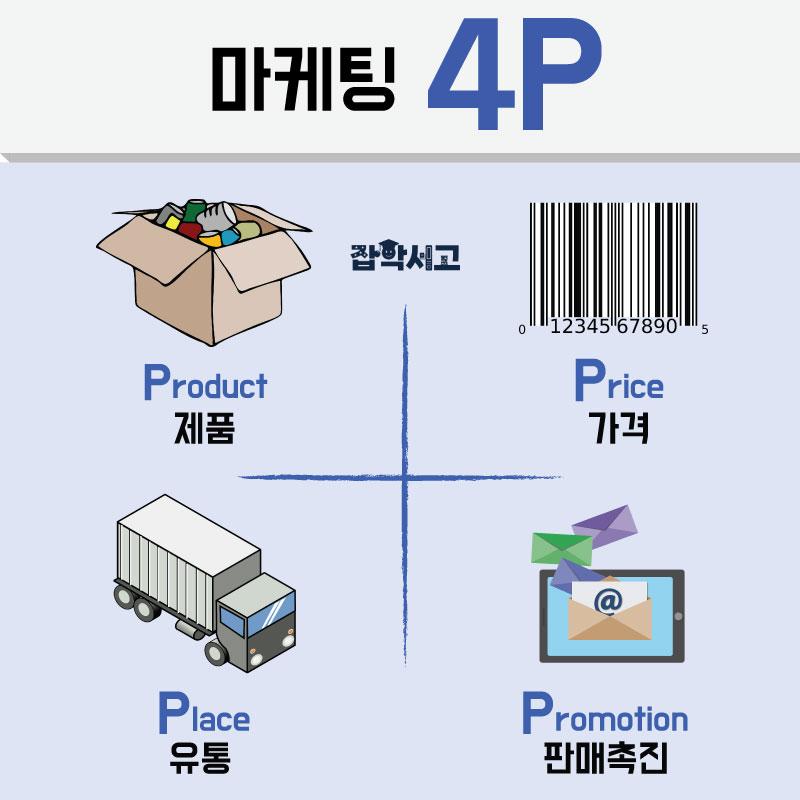 Marketing 4P (Marketing Mix) - Product, Price, Place, Promotion
To achieve marketing goals, a concrete strategy needs to be prepared. Here, the marketing mix refers to deciding on an appropriate combination of what product (Product) to sell, at what price (Price), through which channels to distribute it (Place), and how to make it known (Promotion). These four traditional marketing elements are called the marketing 4P.
※ Product - Refers to all related benefits, including the goods or services a company produces or provides, such as merchandise, services, packaging, design, brand, and quality.
※ Price - Refers to measuring and quantifying the value of a company's product, as with fixed pricing, discounts, credit, and installment plans.
※ Place - Managing the distribution channels through which a product travels from production to the consumer so that the product and customers can come into contact, including distribution channels, inventory, and transportation.
※ Promotion - Activities that lead consumers to make purchases through effective communication, such as advertising, PR, and personal selling.
--
So far, we have looked at the marketing strategies widely used by companies, institutions, and other organizations. Building on an understanding of each stage, from the 3C for analyzing the environment, to STP for segmenting the market and choosing targets, to the marketing 4P describing how a product reaches consumers, we hope you will be able to develop marketing strategies that satisfy your customers.