This time, we will explore the BCG matrix, a tool for assessing a company's current situation and analyzing the direction it should take in the future.
The BCG matrix is a corporate strategy evaluation method developed by the Boston Consulting Group in the United States in the 1970s, which considers a company's current position along two axes: market growth rate and relative market share.
In other words, it is used to understand a company's current situation in terms of cash inputs and outputs and to prescribe how it should develop its strategy going forward.
What Is the BGC Matrix?
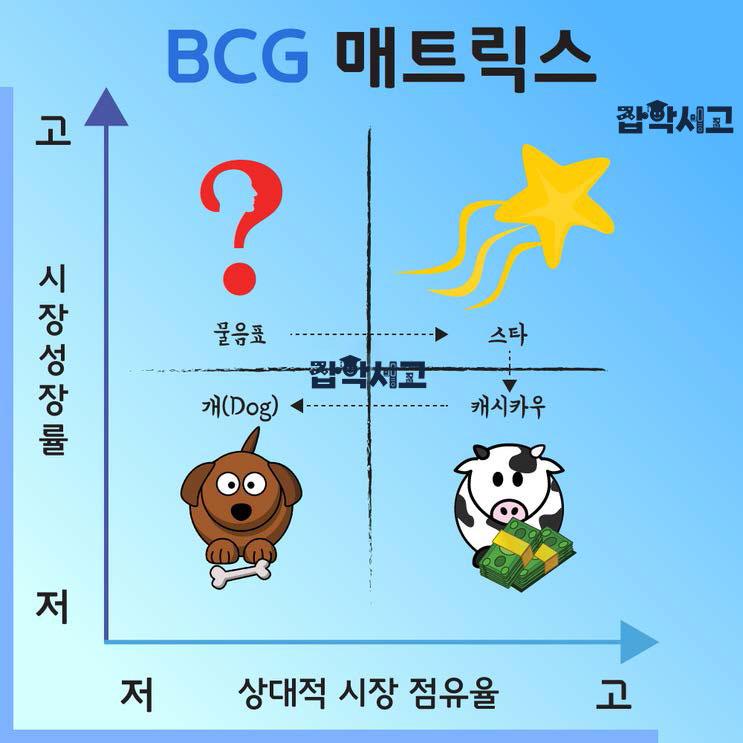 Conceptual Diagram of the BCG Matrix
The conceptual diagram above was created to make the BCG matrix easier to understand. Businesses are classified as question marks, stars, cash cows, or dogs according to their positions, based on relative market share on the X-axis and market growth rate on the Y-axis. A company is then placed in the appropriate category among these 4 categories according to its current situation.
Here, question marks, which have high market growth rates and low relative market shares, are regarded as businesses with uncertain futures; businesses with both high market shares and high growth potential are classified as stars; businesses with low market growth rates but high market shares, yielding high returns on investment, are classified as cash cows; and businesses with both low market shares and low growth rates are classified as dogs.
Strategic Applications
Once you have identified your company's position using the BCG matrix, you need to decide what strategy to adopt for each category.
1. Question Marks - Businesses under Development
 Startups or New Ventures
Question marks are mainly new businesses entering the market. This is a position of considerable uncertainty, and decisive action is needed because it is impossible to know clearly whether a business will become a star or a dog, depending on how it handles the situation.
Since both growth and failure are possible, if you decide to invest, you should make a substantial investment, and if you decide to give up, it would be best to cut your losses quickly.
2. Stars - Growth Businesses
 On a Growth Trajectory
Star businesses can be regarded as businesses that have already succeeded. Since they have both profitability and growth potential, continued investment and effort are needed to sustain their growth.
However, continued investment is needed for growth, which also leads to substantial spending. Being a star business does not mean that this position will last forever, and over time, it gradually transitions from a star to a cash cow.
3. Cash Cows - Sources of Profit
 A Cash Cow That Earns Money without Lifting a Finger
Cash cows are businesses with low market growth rates but high market shares, occupying a position where profits continue thanks to the effort previously invested.
This is not a stage for injecting new funds, and investment is limited to maintaining the resources already put into the business. These businesses can generate substantial output with little input, and it is effective to invest their profits in new question mark businesses or star businesses that are in their prime.
4. Dogs (Dog) - Declining Industries
 A Company at Risk of Running Aground
Dogs(Dog) are businesses that have neither market growth potential nor profitability. Reluctance to let go of the money already invested can lead to even greater losses, so it can be considered wise to wind down the business as soon as possible and look for new opportunities.
Possible strategies include maintaining the business without further investment to secure minimal profits, or closing it down completely and withdrawing.
Thus, the analytical tool for developing strategies based on a company's current position, the BCG matrix, has been explored.
The BCG matrix has the advantage of simplifying businesses into an easy-to-understand form, making their future direction clear, but it also has the disadvantage that its only criteria for evaluating a business are market growth rate and relative market share, creating a substantial risk of errors from oversimplification.
Therefore, taking these characteristics into account, using it as a reference for setting a company's direction alongside other tools can be considered a way to develop sound strategies.