This time, I would like to put together some material on thesauruses, dictionaries that show the various relationships among keywords when searching for the information you want.
A dictionary that shows the relationships among keywords (search terms) entered to find information is called a thesaurus, and these relationships are expressed through synonyms, narrower terms, related terms, and so on.
The reason for using a thesaurus is to retrieve as much content related to the keywords used in a search as possible, enabling broader and more varied searches. It also aims to ensure consistency when creating indexes.
 Words related to a keyword, all at once!
Users of portal sites will generally find it easier to understand by thinking of related search terms as a similar concept. Of course, related search terms differ from a thesaurus, which connects a broad range of related terms.
A thesaurus is a development of the concept of a subject heading list, which brings together search terms with various meanings and documents for unified use, and it presents relationships between terms and concepts to help select appropriate terms.
In other words, it is best understood as a way to present terms related to a keyword all at once so that searches can be performed efficiently.
Thesaurus Relationship Diagram
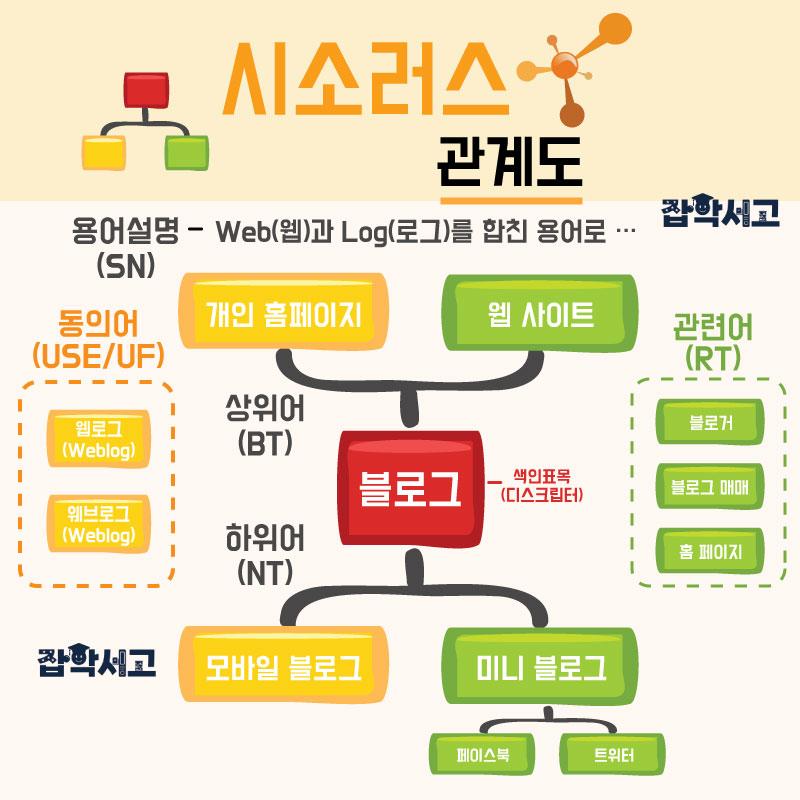 Thesaurus Relationship Diagram (Keyword Example: Blog)
To make a thesaurus easy to understand at a glance, I took an example and turned it into an image. The keyword selected here is 'blog,' and searching for blog in a thesaurus brings up various broader terms (BT), narrower terms (NT), synonyms (USE/UF), related terms (RT), explanations (SN), foreign-language terms, and so on for that term.
By checking the relationships among these various related terms all at once, searchers can expand the vocabulary they know from everyday knowledge and perform more efficient searches.
A more detailed explanation of the terms mentioned above is as follows.
Interrelationships Between Terms
- Equivalence Relationships(USE, UF) - Terms that are not adopted as indexing headings (base forms) are linked to the adopted indexing headings through a USE reference. Here, USE and UF are inverses of each other.
- Hierarchical Relationships(BT, NT) - These are relationships between a given term and its broader terms (BT) or narrower terms (NT), and they may also be expressed as generic relationships (+G), instance relationships (+I), or whole–part relationships (+P). Here, BT and NT are inverses of each other. Example: broader generic relationship (BT+I=BTI) / narrower whole–part relationship (NT+P=NTP)
- Related (Associative) Relationships(RT) - Most terms that are not included in equivalence or hierarchical relationships fall under associative relationships indicating relatedness, which are expressed as RT.
- Detailed Names of Relationship Indicators: SN(Scope Note), USE, UF(Used For), BT(Broader Terms), NT(Narrower Term), RT(Related Term)
- Hierarchical Relationships Detailed names: G(Generic=general), I(Instance=instance), P(Part=part), TT(Top term=topmost)
- Foreign Languages : ENG(English), GER(German), FRA(French), NK(North Korean), etc.
Thesaurus Examples
Sites offering services that organize these relationships among terms into searchable dictionaries include the National Archives of Korea's Related Term Search, the National Institute of Korean History's Korean Historical Terminology Thesaurus, and the Classical Terminology Thesaurus, but because these sites focus on specific fields, the words that can be searched are limited.
Of course, if you are searching in a specific field, such as historical or classical terminology, it may be more useful to use the sites mentioned above.
By contrast, the site called Urimal Thesaurus has collected a broad range of terms over a long period, including those encountered in everyday life, allowing it to be used for a variety of searches, so I would like to introduce it as an example in this material.
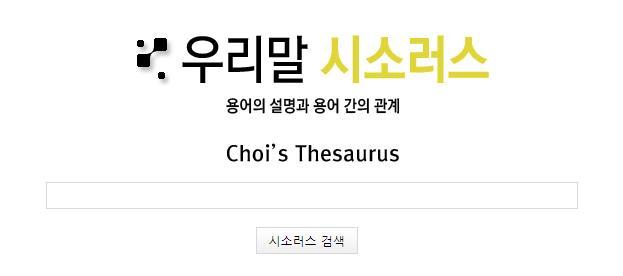 Search Box on the Urimal Thesaurus Homepage
The image above shows the homepage of Urimal Thesaurus, a site where you can examine relationships among the words you search for. The site's homepage design is simple, like Google's, so you can focus solely on searching.
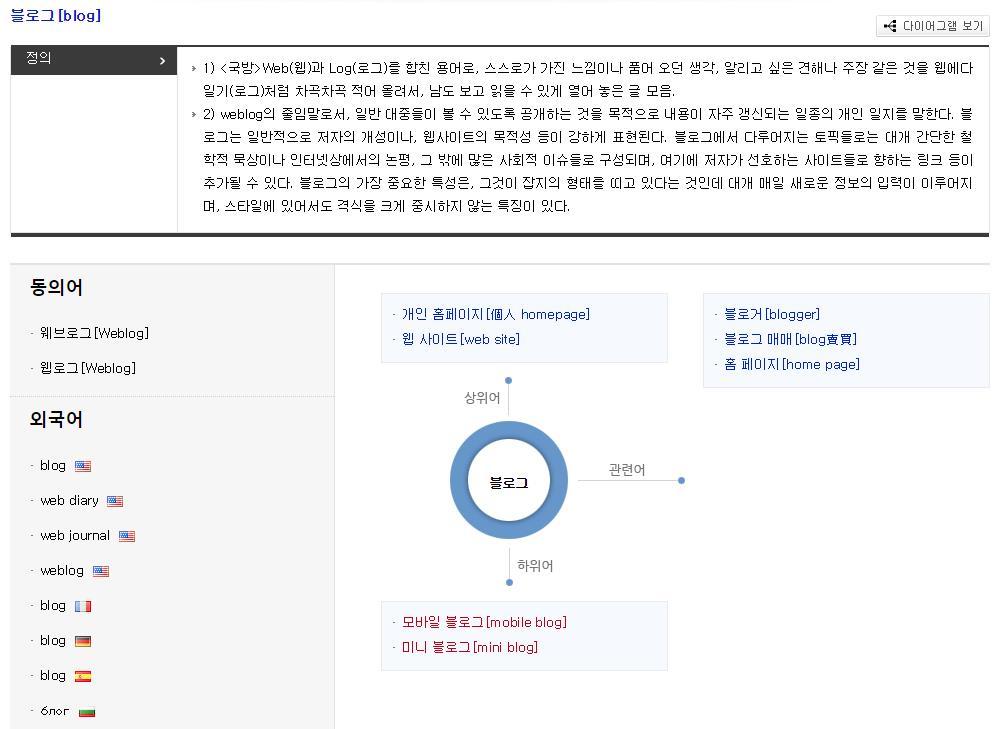 Thesaurus Entry for the Word 'Blog,' Introduced as an Example in This Material
The relationship diagram for the word blog, which was introduced earlier as a separate image, was created based on the search results above. Clicking on the words displayed on the site lets you view other broader terms, narrower terms, related terms, and so on for that word.
And clicking 'View Diagram' in the upper right displays a relationship diagram as a graph, as shown below.
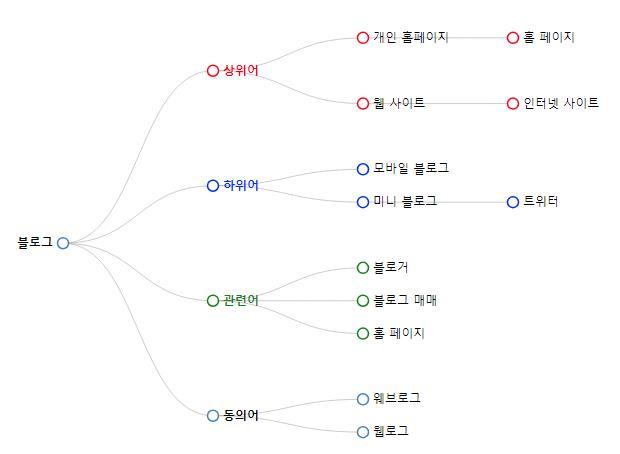 Diagram for the Word 'Blog'
In this example, the diagram was displayed neatly because there were few associated terms, but when there are many related words, the text can overlap and the display can become extremely complex, which may leave you feeling confused.
In such cases, read the explanation above the diagram and adjust the values to increase the spacing in the display.
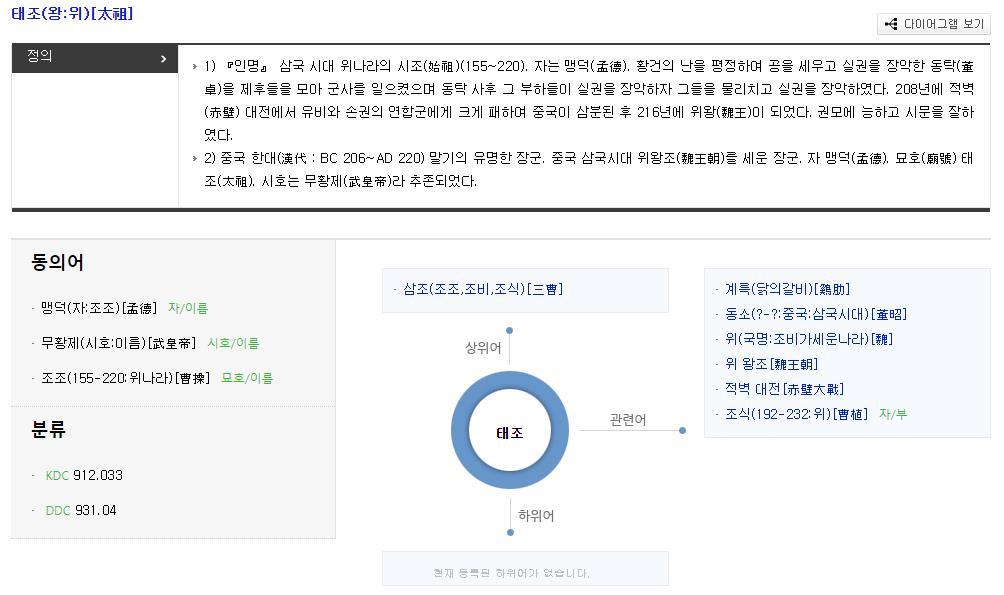 Thesaurus Entry for the Word 'Cao Cao'
This is another example, using the figure Cao Cao as the search keyword. Here, the 3 members of the Cao family—a father and his sons, including Cao Cao—were displayed as the broader term, and no narrower terms were shown.
And the synonyms shown as equivalent to Cao Cao were 'Mengde,' Cao Cao's courtesy name, and 'Emperor Wu,' the posthumous title he received when the state of Wei was founded.
And here, you can think of most words that are not included among broader or narrower terms as being displayed as related terms.
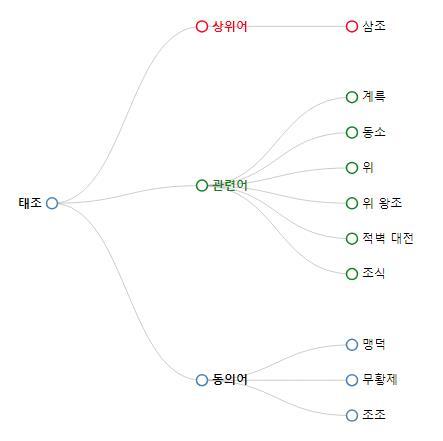 'Cao Cao' Diagram
The diagram above shows words related to Cao Cao. What these search results reveal is that, ultimately, there are limits to the information displayed.
In fact, if you think about it, countless words come to mind besides those shown above, but there are limits to the words presented in the thesaurus.
The same is true of search results from other thesauruses. These limitations ultimately arise because people build thesauruses manually, working through each item individually.
How Can Thesauruses Be Improved?
 Advances in Deep Learning Technology Are the Key!
Thesaurus — A Dictionary Showing Relationships Between Terms
To resolve these issues, A.I and big data analysis technologies must develop further so that computers can collect the vast amounts of data on the internet, analyze the associations among these words, and link related terms.
For this technology to become a reality, advances in deep learning are especially important, and this is also an area in which major big tech companies are currently investing heavily. Ultimately, linking vast numbers of words is considered a problem that only computers that learn and classify on their own will be able to solve in the future.
Just as AI amazed humans with its staggering computing power when it first appeared, we can look forward to more advanced thesauruses as AI develops and we make use of it.