This time, I'd like to introduce probability sampling, a way of drawing a sample from a population probabilistically when you need to select a sample in statistics.
Probability sampling usually refers to randomly selecting cases, as in opinion polls or social science research, so that every member of the population has a known probability greater than zero of being chosen for the sample. The probabilities do not have to be equal for all members.
When probability sampling is used, the resulting sample is much more likely to closely resemble the population than with non-probability sampling, in which the researcher chooses the sample arbitrarily.
In other words, probability sampling is used to draw the sample that best represents the population.
 How to draw an appropriate sample from a large number of people
The main methods of probability sampling include simple random sampling, stratified sampling, cluster sampling, and systematic sampling. In this guide, I've prepared images and colors to help you grasp the concept of each method visually a little more easily.
For simple random sampling, stratified sampling, and cluster sampling in particular, please pay a bit more attention to the colors.
Simple Random Sampling
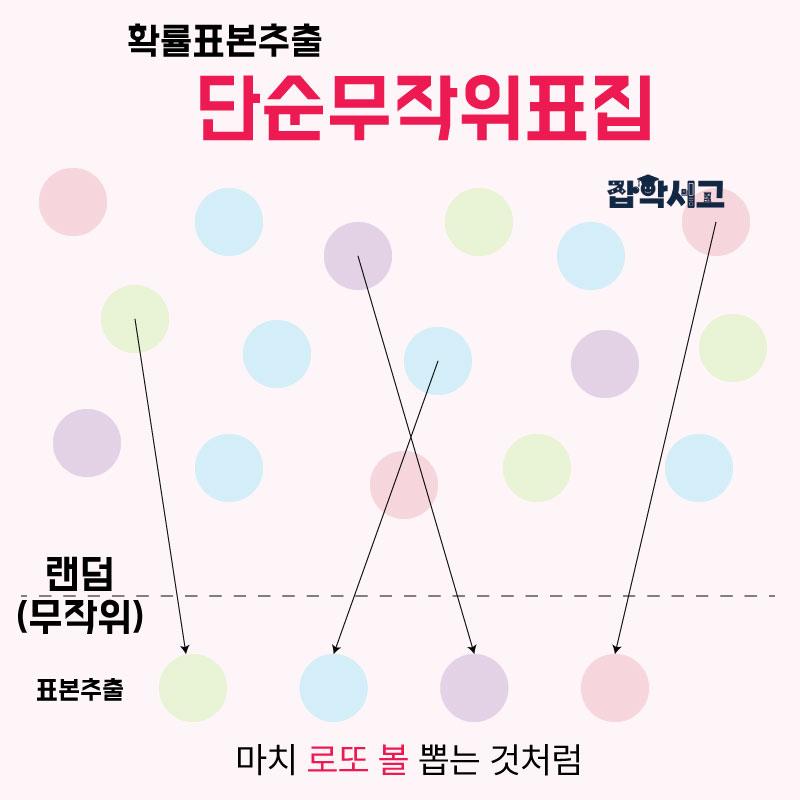 Probability sampling - simple random sampling
First, simple random sampling is the most basic of the probability sampling methods: it samples at random so that every member of the entire population has the same probability of being selected for the sample.
Stratified Sampling
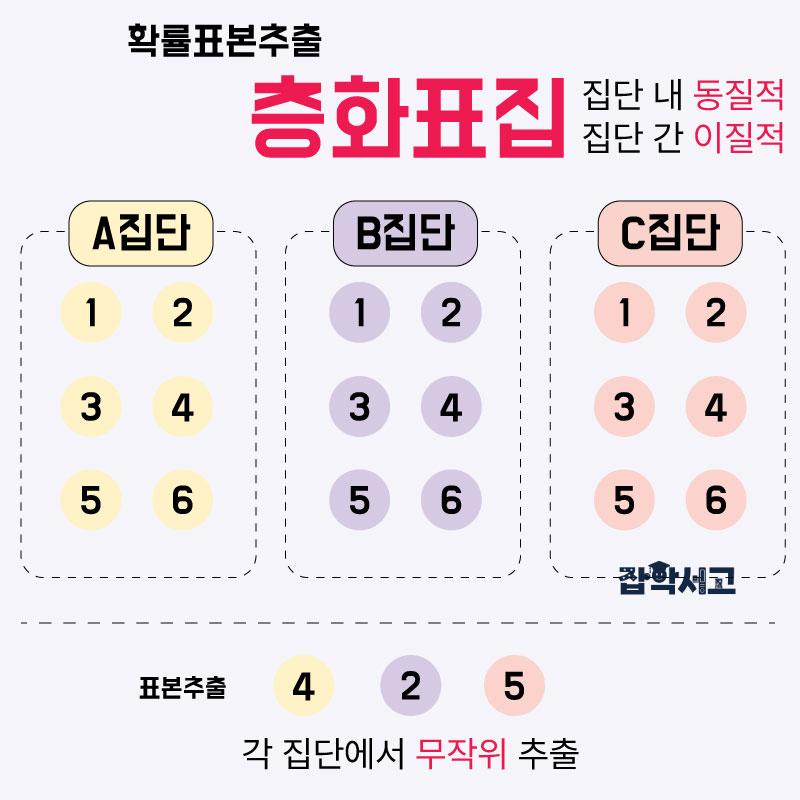 Probability sampling - stratified sampling
Stratified sampling is used when the population is made up of different subgroups; a sample is drawn from each group using as much simple random sampling as needed. (homogeneous within groups / heterogeneous between groups)
Examples include drawing samples from different religious groups (Protestant, Buddhist, Catholic, and so on) or drawing as many samples as you need from clubs and societies with different interests.
Cluster Sampling
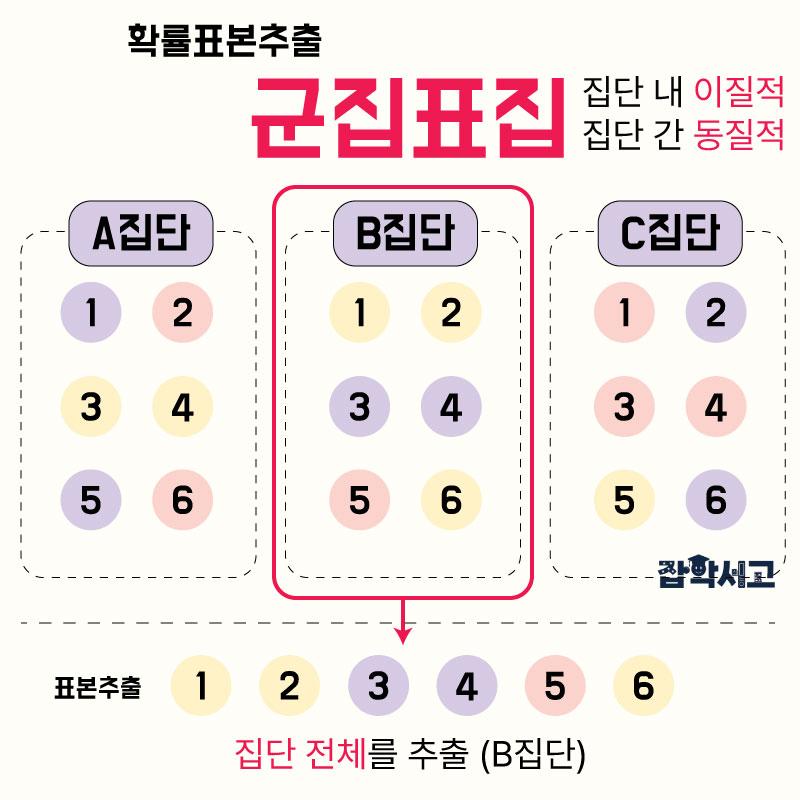 Probability sampling - cluster sampling
Cluster sampling divides the population into groups that are similar to one another and draws the relevant groups themselves as the sample. Here, the groups share the same characteristics, while the members within each group differ from one another. (heterogeneous within groups / homogeneous between groups)
Examples include selecting an entire third-year class at High School A as the sample to study high school seniors preparing for the college entrance exam, or selecting an entire household as the sample to study parent-child relationships.
Systematic Sampling
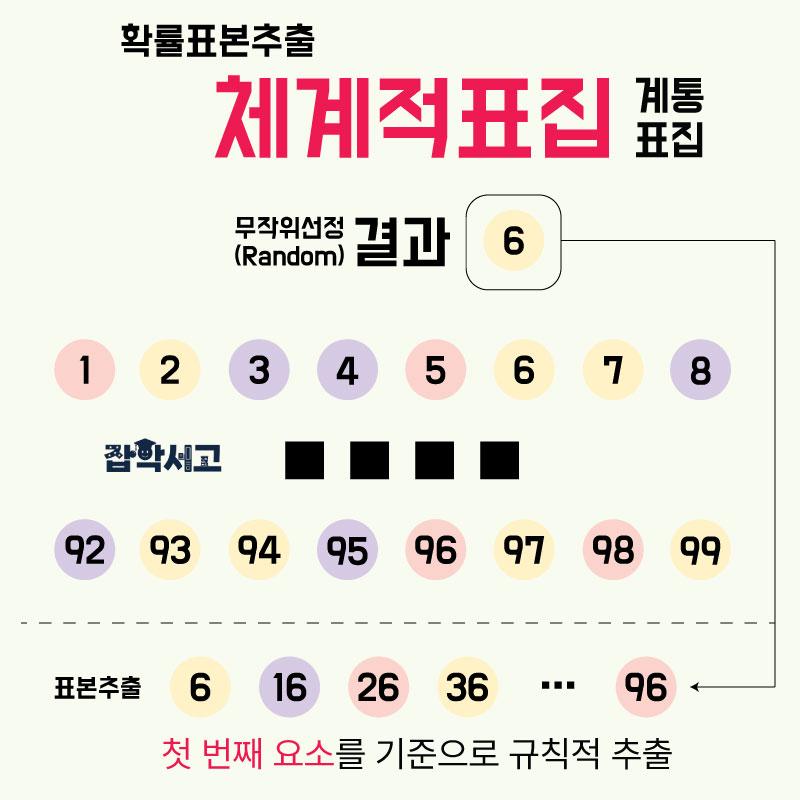 Probability sampling - systematic sampling (interval sampling)
Systematic sampling (interval sampling) is a method in which the first element, the 'K'th, is picked at random from the population list, and subsequent samples are then drawn from it according to a fixed order and rule.
An example of this is clearly marked in the image above, so please take a look.
That wraps up our look at the concept of probability sampling, which you will often come across in statistics and social science research. Since these terms and concepts can be hard to grasp for anyone encountering them for the first time, I tried to explain them through images as much as possible.
I hope this guide has made probability sampling methods easier to understand, and with that, I'll end here.