
What is the essence of human psychology? Because every person has different traits, people show a wide variety of sides: some have strong instinctive desires, some want to achieve self-development, and some value relationships with others.
The person who divided these essential human traits into five stages and proposed the theory commonly known as the five basic human needs was Maslow. In this material, I introduce Maslow's hierarchy of needs and look at what the five needs are.
First, to make the theory easy to see and understand at a glance, I created a model that shows the five needs.
Model of Maslow's hierarchy of needs
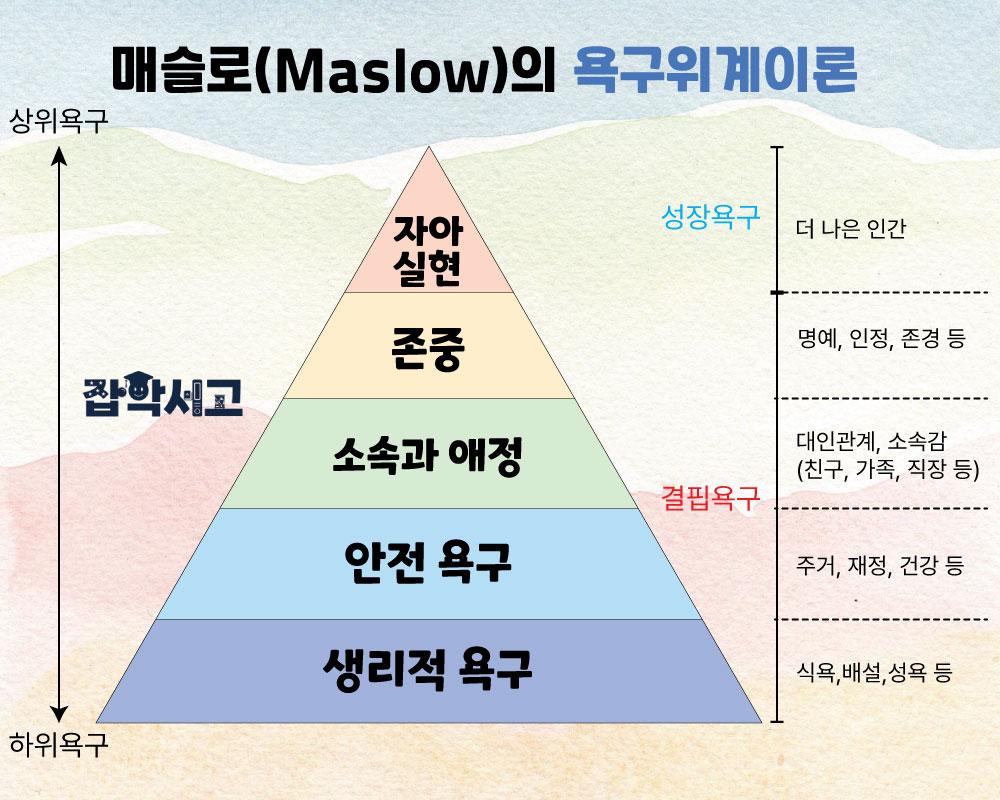 Model of Maslow's hierarchy of needs
As in the image above, the five basic human needs proposed by the American psychologist Maslow are divided into stage 1, physiological needs; stage 2, safety needs; stage 3, belonging and love needs; stage 4, esteem and honor needs; and stage 5, the need for self-actualization. Starting from the bottom, once a lower need is satisfied, a person moves on step by step to the higher need.
In other words, safety needs cannot arise first while physiological needs are unmet, and it is hard to pursue self-actualization ahead of everything else without first satisfying the needs for safety or love.
Here, stages 1 to 4 are deficiency needs that cause side effects when they are not met, while stage 5, unlike the earlier stages, is a need tied to personal growth that has no limit.
- Stage 1: Physiological Needs
 Stage 1: physiological needs
In stage 1, physiological needs are the most basic human needs. They include the desire to eat when hungry, the desire to go to the bathroom, the desire to sleep when sleepy, and sexual desire. They are the most basic and also the most powerful needs, and they are tied to human life itself.
Anyone reading this already knows well, without needing an explanation, how it feels when these needs are lacking.
- Stage 2: Safety and Security Needs
 Stage 2: safety needs
Stage 2 concerns needs such as physical safety and psychological security. These are the desire to protect the body from danger, the desire to stay healthy, and the wish for economic or job security. Stages 1 and 2 can be seen as needs that apply to every human being without exception.
Anxiety about illness and the psychological pressure of lacking financial room are typical situations of deficiency at stage 2. Diligently taking health foods and the growing popularity of civil service jobs, which are socially stable, are also ways of meeting these needs.
- Stage 3: Belonging and Love Needs
 Stage 3: interpersonal needs
From stage 3 on, people differ somewhat, but these are needs everyone basically has, only in different amounts. Stage 3 is the desire to form interpersonal relationships with others, or the desire to belong to a workplace, school, or similar group and become a member of society.
There are exceptions in modern society, but most people have the desire to interact with someone. Broadly across society, or at least within a single family, people end up interacting with someone.
With stage 3 needs, people may feel psychologically depressed when they feel isolated and unable to connect with others.
- Stage 4: Esteem and Honor Needs
 Stage 4: esteem and honor needs
Stage 4 is a fairly high-level need that everyone has, but it varies somewhat more from person to person. It is the desire to receive recognition from others or to get good evaluations. It is related to feelings such as pride and self-esteem, which can be badly hurt when one is ignored or judged poorly.
People may work hard at something in order to be well regarded, and they also want to achieve their goals. Typical examples are occupations that earn the recognition of others, such as politicians, judges, and prosecutors.
- Stage 5: The Need for Self-Actualization
 Stage 5: the need for self-actualization
The final need for self-actualization, unlike the earlier stages, is not a need that causes side effects when it is lacking. It is the desire to develop and grow on one's own, and the person keeps developing endlessly for their own sake. The need at this stage appears only after the previous four stages are satisfied.
This stage also refers to the desire to discover and maximize one's own potential. People pursue competence in their work and constant self-development, and they come to want to achieve these things by themselves rather than because of others. It is the highest-level stage of needs and is inwardly strong.
That concludes our look at Maslow's hierarchy of needs, which presents the five basic human needs. Since the content of this material adds the author's own thoughts to Maslow's theory, please note that some information may contain inaccuracies. With that, I end this post.