This time, we will explore the concepts of primary (1st-order) and secondary (2nd-order) sources, which are commonly discussed in library and information science. These are among the most basic concepts introduced in information retrieval, and sources are generally classified as primary (1st-order) or secondary (2nd-order) according to their characteristics and purposes.
The Concepts of Primary (1st-Order) and Secondary (2nd-Order) Sources
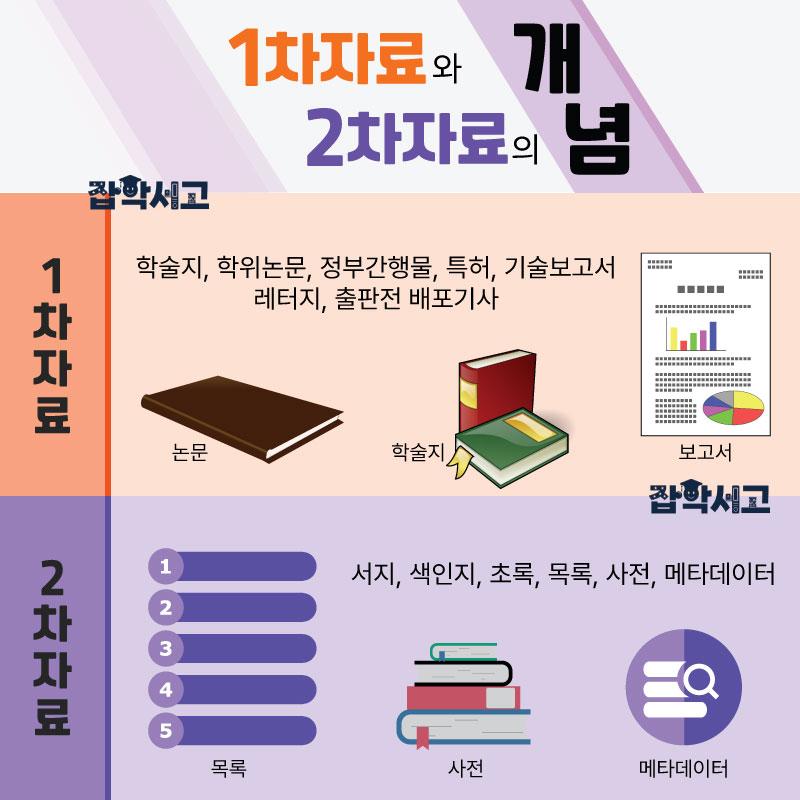 An Overview and Distinction of the Concepts of Primary (1st-Order) and Secondary (2nd-Order) Sources
Before discussing the concept of each type of source, the image above presents easy-to-understand representative examples classified as primary (1st-order) and secondary (2nd-order) sources.
For reference, letters journals in the primary (1st-order) source category involve announcing preliminary outlines through the media and other channels to establish priority in research, while press releases are also materials written and distributed to secure priority and to communicate research findings quickly and widely.
What Are Primary (1st-Order) Sources?
 Sources in Their Original Form
In information science, primary (1st-order) sources are original sources that record achievements, such as papers, reports, academic journals, and patents. They are sources in a completed form that users commonly encounter when searching for information, and they include video and audio materials as well as written documents.
They also include new information that did not previously exist and was produced through efforts such as research, works newly created by authors, and materials documenting existing research achievements.
What Are Secondary (2nd-Order) Sources?
 Data for Finding Primary (1st-Order) Sources
secondary (2nd-order) sources are sources created by systematically entering and organizing information using keywords such as the author names, titles, and subjects of primary (1st-order) sources in their original form, allowing users to find materials easily through these access points.
In other words, their purpose is to enable effective searches for primary (1st-order) sources, and representative examples include indexing publications, bibliographies, and catalogs. Taking this a step further, there is also the similar concept of tertiary (3rd-order) sources, which are entered to facilitate searches for secondary (2nd-order) sources.
Secondary (2nd-order) sources can be further divided according to their purpose. They can be divided into indexes, bibliographies, and catalogs for effectively finding primary (1st-order) sources, and dictionaries, handbooks, manuals, and statistical compilations that condense and organize vast amounts of data. In addition, abstracts and review papers combine both of these functions.
We have now explored the concepts of primary (1st-order) and secondary (2nd-order) sources as discussed in information science. Simply put, primary (1st-order) sources are materials in the original form written by their authors, while secondary (2nd-order) sources are materials entered and organized to make primary (1st-order) sources easy to find.
Because these categories are distinguished according to the purpose for which sources are used, even a primary (1st-order) source may sometimes become a secondary (2nd-order) source if it is used as a resource for consulting another source.
I hope that consulting this material will provide a foundation for distinguishing among sources in today's environment, where we live amid a vast flood of information.