At a resort, there is no room left to set foot on the beach, and in front of a famous historic site the entry line fills the alleys. We assumed that the more visitors a place welcomes, the more the local area thrives, yet at some point residents grow weary and travelers lose their sense of wonder. The threshold at which a place can no longer cope and begins to break down is called tourism carrying capacity.
Put simply, tourism carrying capacity means “the maximum number of visitors a destination can receive at the same time without seriously harming its environment, economy, or society and culture, and without seriously lowering visitor satisfaction.” It is a concept that takes in not just a single number but the condition of the place and how people feel.
In this piece we will look in turn at the meaning and origins of tourism carrying capacity, its several dimensions, including physical, ecological, social, and perceptual, easy examples from beaches and historic sites, and finally the ways of managing its limits.
The Structure and Uses of Tourism Carrying Capacity
What Is Tourism Carrying Capacity?

The term carries “carrying capacity,” which in ecology meant the upper limit on the population an environment can sustain, over into recreation and tourism. In 1964 J. Alan Wagar examined the carrying capacity of wild lands for recreation, and in their 1982 book Alister Mathieson and Geoffrey Wall defined it as the maximum level of use a place can bear without the physical environment being altered unacceptably and without an unacceptable decline in the quality of the experience visitors gain.
The World Tourism Organization (UNWTO) uses a similar definition: the maximum number of people who may visit a tourist destination at the same time without destroying its physical, economic, and sociocultural environment and without an unacceptable decrease in visitor satisfaction. The key point is that it asks not “how many can we attract?” but “how many can the place withstand?” Drawing people in through marketing is one matter; whether the place can absorb the traces those people leave behind is another.
- Tourism carrying capacity: the maximum number of visitors a place can receive without seriously harming its environment or the visitor experience.
- World Tourism Organization (UNWTO): the international organization that defined the upper limit on simultaneous visits to a destination in terms of environmental damage and declining satisfaction.
The Many Dimensions of Carrying Capacity

In 1983 Donald Getz divided carrying capacity into physical, economic, perceptual, social, ecological, and political dimensions, among others. Rather than settling on a single number, the idea is to look at which limit is reached first. Even in the same town, residents’ patience may run out before the roads jam, or the other way around.
(1) Physical and ecological carrying capacity
This is the limit that facilities such as roads, restrooms, water supply, and sewers can bear, along with the intensity of use that soil, vegetation, and wildlife can tolerate. Fixed natural limits are hard to expand.
(2) Social carrying capacity
This is the point at which residents no longer welcome tourism. As noise, rising housing prices, and intrusions into everyday spaces pile up, welcome turns into coldness.
(3) Perceptual carrying capacity
This is the point at which visitors themselves feel that “there are too many people.” Even with the same number of people, how crowded it feels varies with expectations and how visitor flows are designed.
- Physical carrying capacity: the upper limit of use that facilities and spaces can bear.
- Social carrying capacity: the limit, in attitudes and daily life, to how much tourism residents can accept.
- Perceptual carrying capacity: the limit up to which visitors feel they can put up with crowding.
Understanding Tourism Carrying Capacity Through Easy Examples
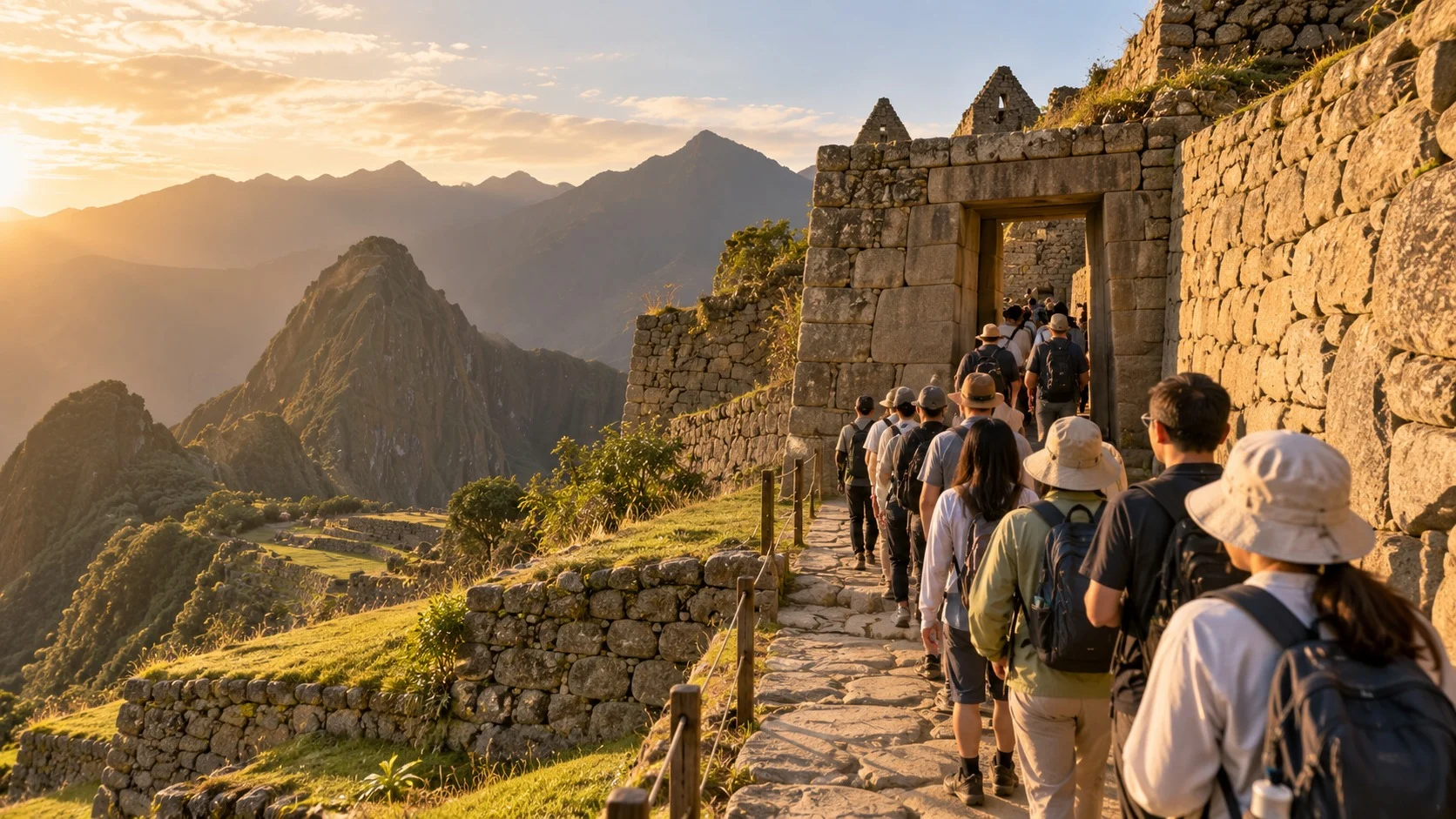
Carrying capacity is not an abstract theory; it shows up in everyday crowding and regulation.
(1) A narrow beach in the summer peak season
The area of sand and the number of safety staff are limited. When there are too many people, litter increases and parasols are packed closer together, making accidents more likely. Splitting entry numbers or spreading visits across time slots is done to protect physical and perceptual carrying capacity.
(2) A daily admission limit at a mountain ruin
Steep trails and stone steps wear away as footsteps accumulate. Setting a daily admission limit and taking advance reservations is a form of carrying-capacity management that protects the heritage while preserving the visitor experience.
(3) Residents’ daily lives in an old neighborhood
As alley cafés and photo spots multiply, outsiders may enjoy themselves, but residents grow tired of the foot traffic and noise. Even if shops prosper, once social carrying capacity runs out first, the community begins to turn visitors away.
Managing the Limits, and What to Watch Out For

Attempts to pin carrying capacity down to a single “magic number” are often criticized. When measurement methods and value judgments are mixed together, it is hard to promise an “exact upper limit.” When seasons, types of visits, management techniques, and residents’ expectations change, the limit shifts along with them. That is why many sites, instead of a simple cap, also use frameworks such as Limits of Acceptable Change, which build agreement on how much change is acceptable.
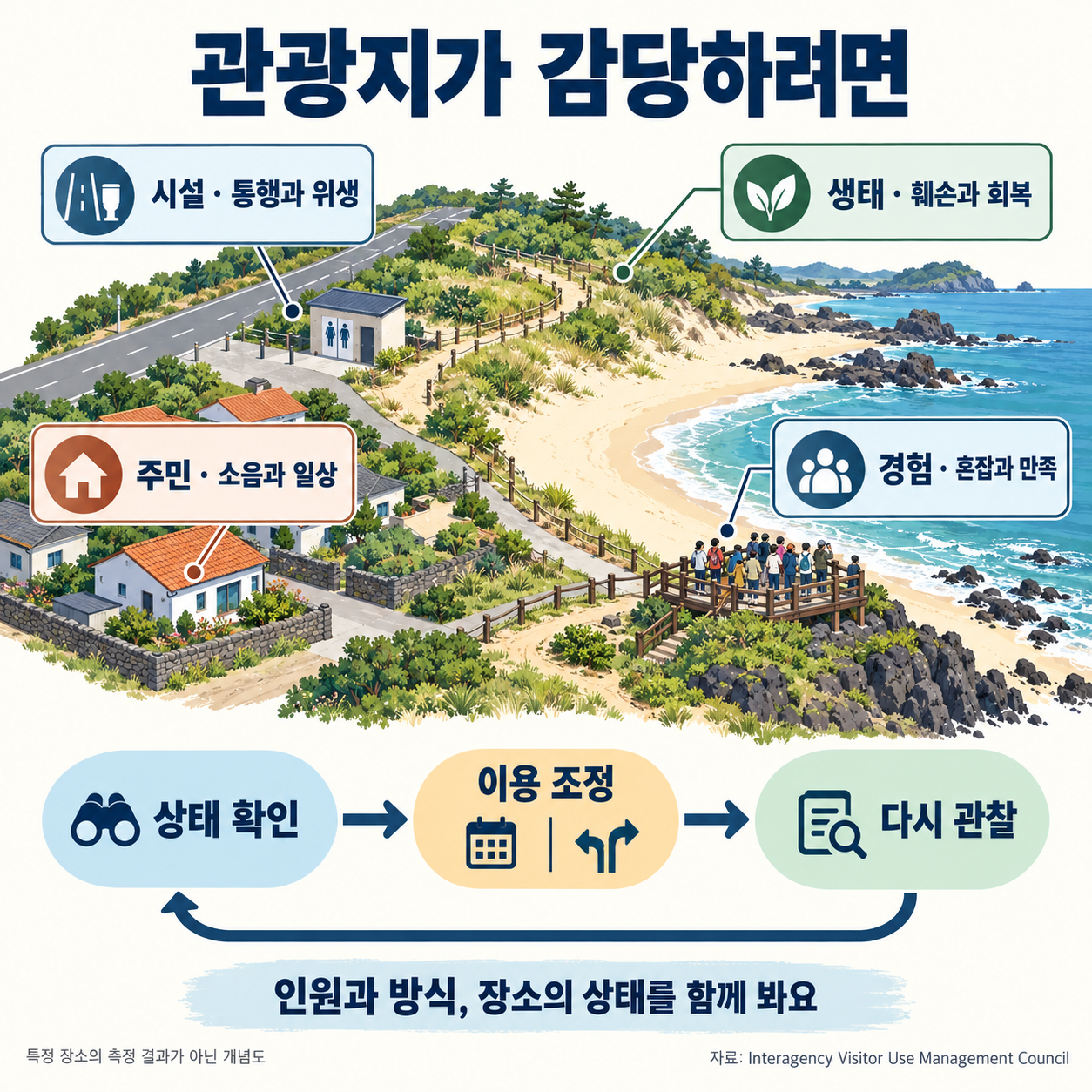
In practice, spreading out peak-season visits, advance reservations, separating visitor routes, protecting sensitive areas, surveying residents, and monitoring crowding indicators are often combined. Alongside a numerical cap, the core task is designing when, where, and how people come. In discussions of overtourism as well, carrying capacity is called on again as a compass that asks not “how many” but “how to cope.”
- Limits of Acceptable Change: a management framework that first sets the acceptable range of conditions for a place, rather than the number of users.
- Overtourism: a term for the state in which the scale of tourism exceeds what a place and its residents can handle.
Tourism carrying capacity is a way of looking at the upper limit on the visitors a place can receive, taking into account the environment, residents, and the visitor experience together. Growth that ignores limits ends up eroding the very appeal of the place.
Weighing what a place can withstand and what it might lose before the visitors increase: that is the first step in designing tourism that lasts.