In this article, we will explore methods for managing and evaluating performance when running a company or organization. Performance management is an organizational management method that provides feedback so members of an organization can perform their duties efficiently and achieve their objectives, while establishing an organizational environment in which these processes can operate systematically.
The performance management methods introduced in this material are the long-established management method MBO and the concept developed in the 90s to complement it, BSC.
These concepts may feel somewhat difficult when you first encounter them or are unfamiliar with them. To make them easier to understand, we have created simple illustrations. Now, we will explain MBO and BSC in turn.
MBO
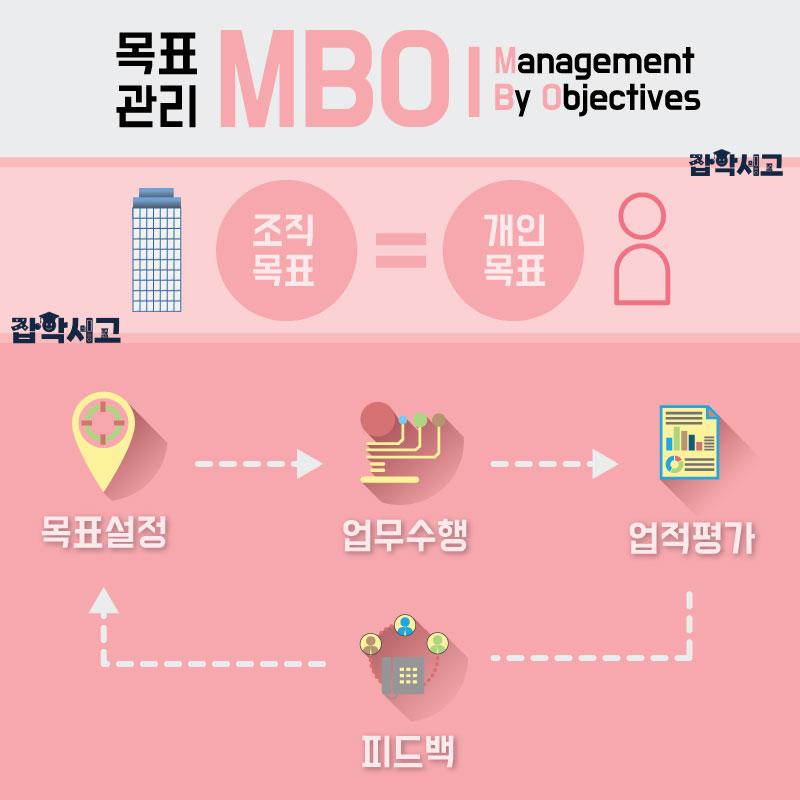 The Concept and Cycle of MBO (Management by Objectives)
MBO(management by objectives) is also called 'goal management.' This concept was proposed by Peter Drucker in his book The Practice of Management and systematized over the course of the 1960s.
This management method links organizational objectives with individual objectives, motivates people within the organization through clear objectives, and satisfies individuals' interests and needs through the achievement of shared objectives.
It emphasizes self-management based on objectives set by individuals, with a scope ranging from strategy to everyday work. When setting objectives, the factors to check are: Are they specific and measurable? Are they achievable and realistic? Is the deadline for achieving them clear?
The MBO management process begins with setting organizational and individual objectives and carrying out work to achieve them. Performance is then evaluated, feedback is provided to members, and rewards or personnel appraisals are carried out. The points to consider for each element are as follows.
- Objective Setting: Measurable, short-term objectives
- Participation: Assumes that subordinates have the ability to pursue and manage their own objectives
- Feedback: The most important element in MBO, requiring mechanisms that allow it to flow in both directions. Clear feedback improves problem-solving ability and job performance.
 Limitations of MBO
However, MBO tends to be used in a results-oriented way as the management technique shifts from management 'by' objectives to management 'for' objectives, and it has the limitation of failing to consider individual development and learning.
Other limitations of MBO in various areas will be revisited in comparison with BSC at the bottom of this post.
BSC
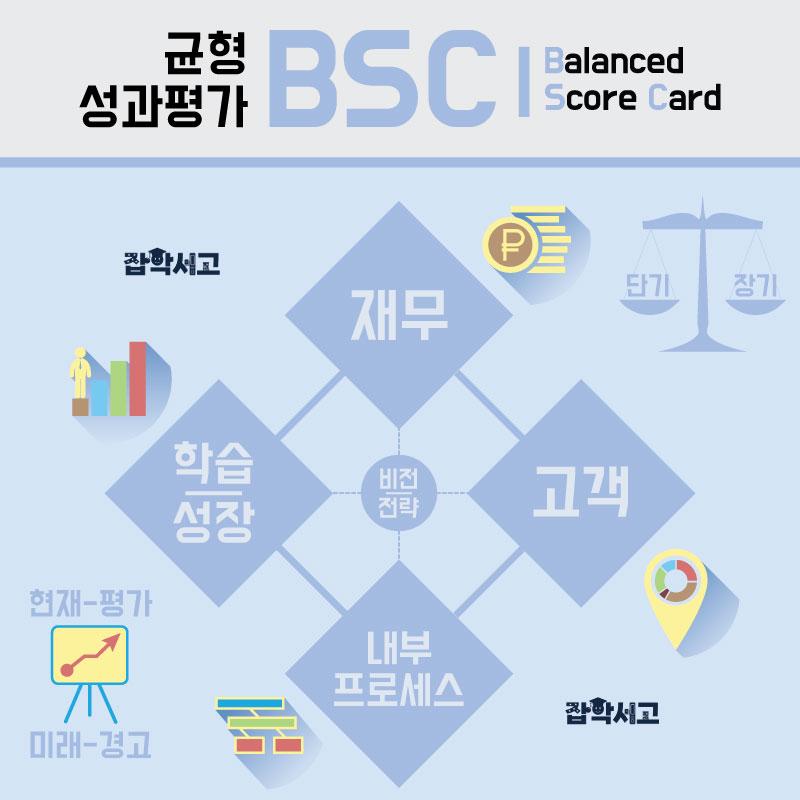 BSC – Balanced Performance Evaluation
BSC (Balanced Score Card) is a business performance measurement methodology proposed by Robert Kaplan and David Norton. Its distinguishing feature is that it manages leading indicators for measuring organizational performance alongside financial indicators.
It is a performance measurement scorecard that comprehensively evaluates corporate performance across 4 performance indicators, such as finance, customers, internal processes, and learning and growth, to realize the organization's objectives and vision.
- Finance: How much funding should be secured and invested to carry out the mission?
- Customers: What value and policy effects should be demonstrated to customers?
- Internal Processes: Which processes must excel to improve the quality of policies?
- Learning and Growth: How should the organization's capabilities be improved?
BSC establishes strategic objectives by adjusting these 4 key indicators in a balanced way so that short-term and long-term target values are in harmony, and it can also evaluate the current situation and serve as a warning about the future.
Comparison of MBO and BSC
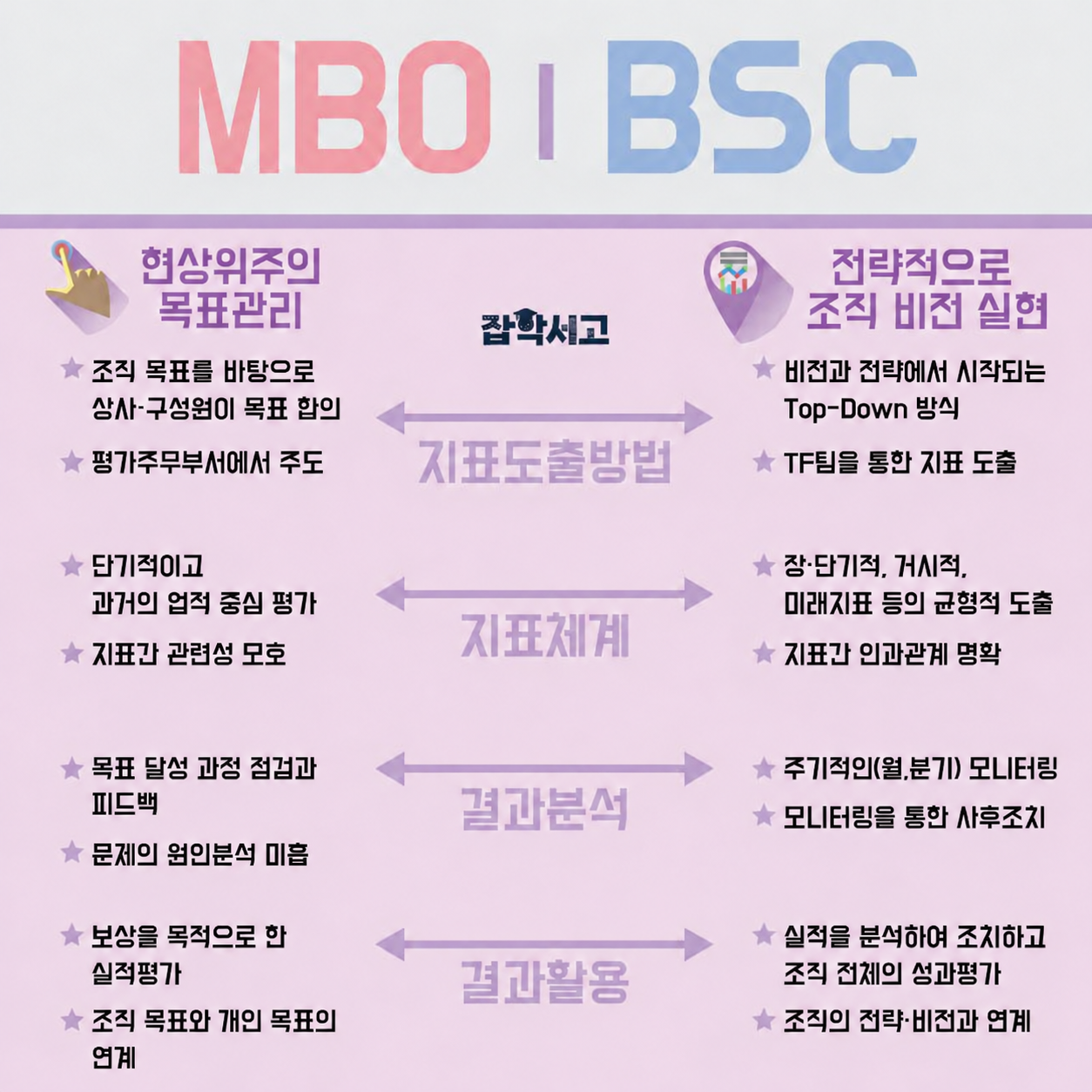 Comparison of MBO and BSC This is a simplified comparison of operating practices and design emphases. These distinctions do not apply uniformly to every organization, and causal relationships in a BSC are strategic assumptions that require testing.
MBO, which has a strong short-term orientation, and BSC, a comprehensive and balanced performance management method developed to complement it, differ in various respects, from the process of developing indicators to the use of results.
Overall, BSC is considered more efficient, as summarized in the image above, and the content below presents that summary in text form.
※ MBO – Management by Objectives Focused on the Current Situation
- Managers and employees jointly set objectives based on organizational goals
- Led by the department responsible for evaluations
- Short-term evaluation focused on past achievements
- Unclear relationships between indicators
- Periodic monitoring of progress toward objectives and feedback
- Insufficient analysis of the causes of problems
- Performance evaluation for the purpose of rewards
- Performance evaluation linking organizational and individual objectives
※ BSC – Strategically Realizing the Organization's Vision
- A Top-Down approach that begins with vision and strategy
- Development of indicators through a TF team
- Focused on participation and discussion
- Balanced development of indicators, including long-term, short-term, macro-level, and future-oriented indicators
- Clear causal relationships between indicators
- Regular monitoring (monthly and quarterly)
- Follow-up action based on monitoring
- Analysis of performance, action based on that analysis, and evaluation of the performance of the organization as a whole
- Linked to the organization's strategy and vision
We have now explored MBO and BSC, methods for managing performance within organizations. As a refined concept, BSC does appear to be more balanced and efficient than MBO in some respects.
However, introducing BSC requires consideration of various aspects, and because it focuses more on the organization's vision than on individual members, it has different characteristics from MBO. It is therefore appropriate to understand the characteristics of MBO and BSC thoroughly and adopt a performance management method that suits the nature of your organization.