Algorithms are one of the core concepts in computer science. An algorithm refers to a precise procedure or method of computation for solving a problem.
Understanding and analyzing these algorithms is very important for people who program. In this article, we will explore the concept of algorithms, their importance, and how to analyze them.
What Is an Algorithm?
 What procedure should we follow to solve a problem?
An algorithm is a series of clear procedures or a set of rules for solving a problem. The core of an algorithm is carrying out a process in a specific order and manner, starting with a given input and producing the desired result as output.
For example, suppose we have a problem that involves finding whether a particular number is present in an array. A simple algorithm for solving this problem is to check the numbers one by one, from the first element of the array to the last.
An algorithm that finds a number in this way is called 'linear search.' Algorithms express methods or procedures for solving problems in this manner, and many algorithms have been developed for various types of problems.
Why You Need to Understand Algorithms
 Why do we need to understand algorithms?
Understanding algorithms is very important for programmers. In particular, understanding algorithms allows you to develop logical thinking for solving problems.
Understanding algorithms also allows you to write code that is easy to maintain and develop efficient programs.
The benefits of understanding algorithms are examined individually below.
Efficiency
The same problem can be solved in various ways, and depending on which algorithm you choose, you can use fewer resources in terms of execution time, memory usage, and so on. Choosing an efficient algorithm allows you to create software that runs quickly and uses fewer resources.
Improved Problem-Solving Skills
Learning algorithms improves the way you analyze and approach problems. You can develop the ability to break down even complex problems into steps and solve them.
Preparation for Technical Interviews
Many technology companies ask questions about algorithms and data structures when hiring software engineers or developers. Understanding algorithms can help you perform better in these interviews.
Software Scalability
For systems that handle high traffic or large amounts of data, efficient algorithms play an important role in ensuring system scalability.
Basic Programming Knowledge
Algorithms are one of the foundations of programming. Knowledge of basic algorithms is essential for developing good software.
Creative Thinking
Learning algorithms encourages you to consider various solutions, which helps improve your creative thinking skills.
Applications in Various Fields
Algorithms are used in various fields, including mathematics, physics, and biology, in addition to computer science and programming. Knowledge of algorithms can be put to useful applications across many fields.
To summarize, algorithms are essential tools for solving problems, so a good understanding of them can improve your problem-solving skills in various fields.
Understanding Algorithms Through Flowcharts
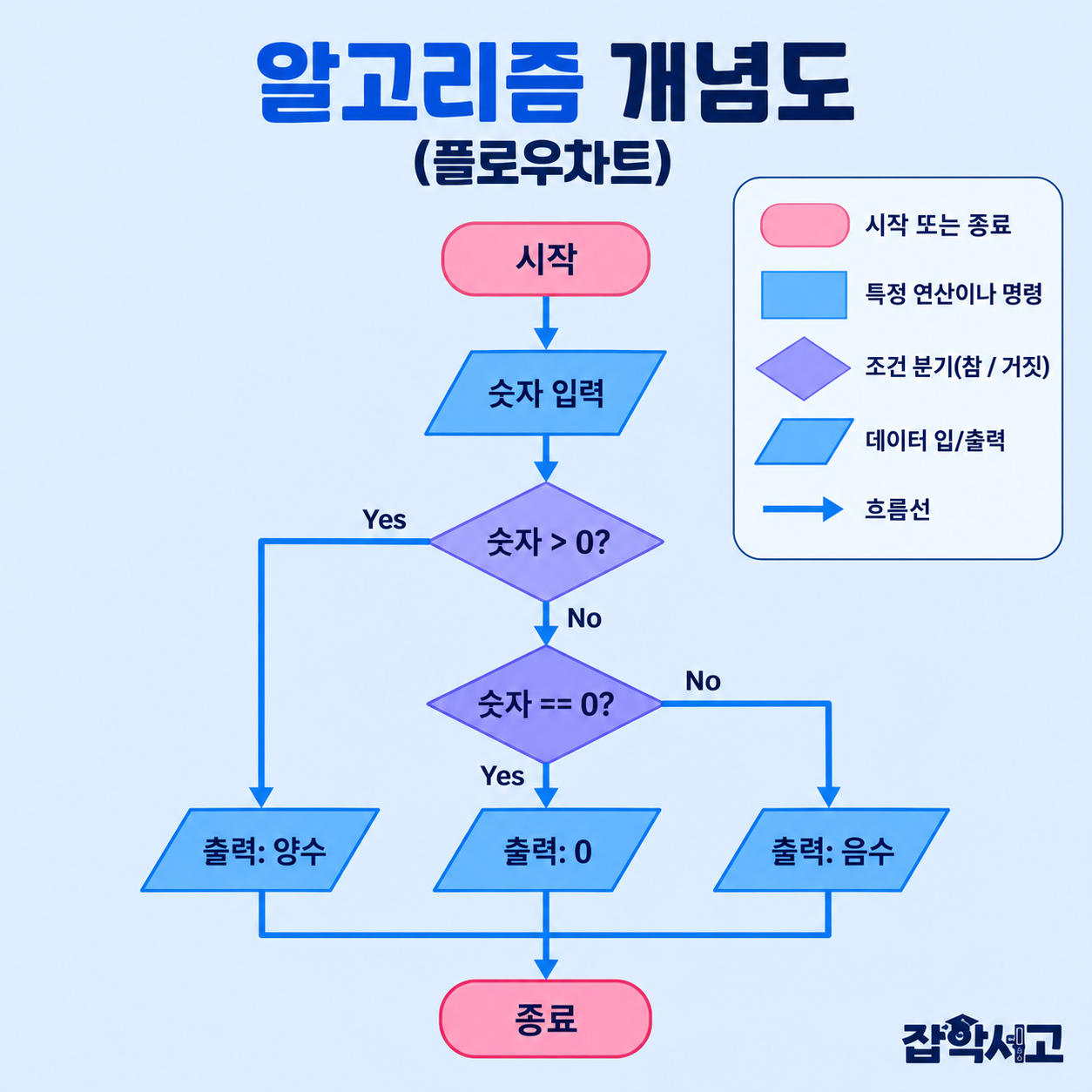 A flowchart for classifying a number as positive, zero or negative. Each decision has Yes and No branches, and all three outputs lead to the end. Valid integer input is assumed, as in the Java example.
First, a flowchart is a diagram that visually represents the process of solving a problem. It uses various symbols to represent tasks such as operations, conditional branching, and data input/output.
Flowcharts help you understand and design algorithms and are useful for reviewing the logical flow before writing program code.
The image above is a flowchart of the concept we will use as an example in this article. Based on this image, we will also look at how the actual code is written later.
The example in this article is a case in which a program receives a numerical value from the user, determines whether the number is positive, 0, or negative, and outputs the result. The actual code based on this is as follows.
An Actual Programming (Coding) Example
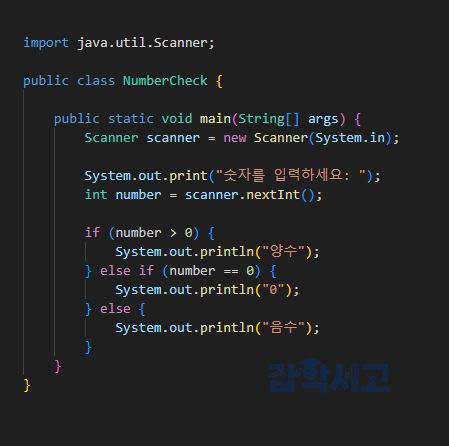 Determining Whether a Number Is Positive, Negative, or 0
The Java code above is an example that implements an algorithm which receives a number from the user, determines whether it is positive, negative, or 0, and outputs the result.
Please examine how the conditions set in the earlier flowchart are expressed in code and what syntax is used.
<Useful Related Resources>
 Programming Syntax (Learn More)
Understanding and analyzing algorithms plays a very important role in practical programming. By understanding algorithms, you can write efficient code and develop programs that meet constraints or performance requirements.
Methods for Evaluating Algorithm Efficiency
 Algorithm Efficiency Analysis
This is one method of algorithm analysis and is the process of understanding and measuring how efficiently an algorithm operates. When analyzing algorithms, we primarily examine two aspects: time complexity and space complexity.
Time Complexity (Time Complexity)
Time complexity provides an estimate of the time an algorithm takes to solve a problem. The most commonly used way to express it is 'Big O' notation. For example, O(n) indicates that an algorithm's execution time is linearly proportional to the input size n.
To explain this simply, time complexity indicates how long an algorithm takes to complete a task. For example, when looking for a particular word in a book, reading through it one page at a time in order would take a long time.
On the other hand, if there were a method of searching that started in the middle of the book and determined whether the word you were looking for was before or after that point, you would be able to find it more quickly.
Space Complexity (Space Complexity)
Space complexity provides an estimate of the amount of memory an algorithm needs to solve a problem. Like time complexity, space complexity can also be expressed using 'Big O' notation. For example, O(1) indicates that an algorithm uses only a constant amount of memory, regardless of the input size.
To explain this concept simply as well, space complexity indicates how much memory (storage space) an algorithm needs to perform a task.
For example, if you wrote down every word in a book on note paper, you would need a lot of note paper, but if you recorded only particular words, a small amount of note paper would be enough.
To summarize in a single line, time complexity concerns "How fast is it?" and space complexity concerns "How much storage space is needed?"
We have now explored why we need to understand algorithms, how to analyze them, and related topics.
Understanding and analyzing algorithms is essential in programming and computer science. Understanding algorithms allows you to develop the logical thinking and programming skills needed to solve problems. In addition, knowing how to analyze algorithms allows you to develop efficient programs and improve performance.
Algorithms are at the core of problem-solving and program development, and designing and analyzing efficient algorithms plays a major role in leading projects to success.
Therefore, understanding the concept and importance of algorithms and learning how to analyze them will be an essential process for every programmer.
By learning various algorithms, applying them in practice, and practicing the analysis of their performance, you should strive to improve your programming skills so that you can develop better programs.