In college life, writing reports plays a major role in exploring knowledge in depth, developing ideas, and improving academic skills.
However, writing reports can also feel difficult for first-year college students. So this material introduces report-writing methods that are helpful for college life, for students who struggle with writing reports (assignments).
Structure of a Report
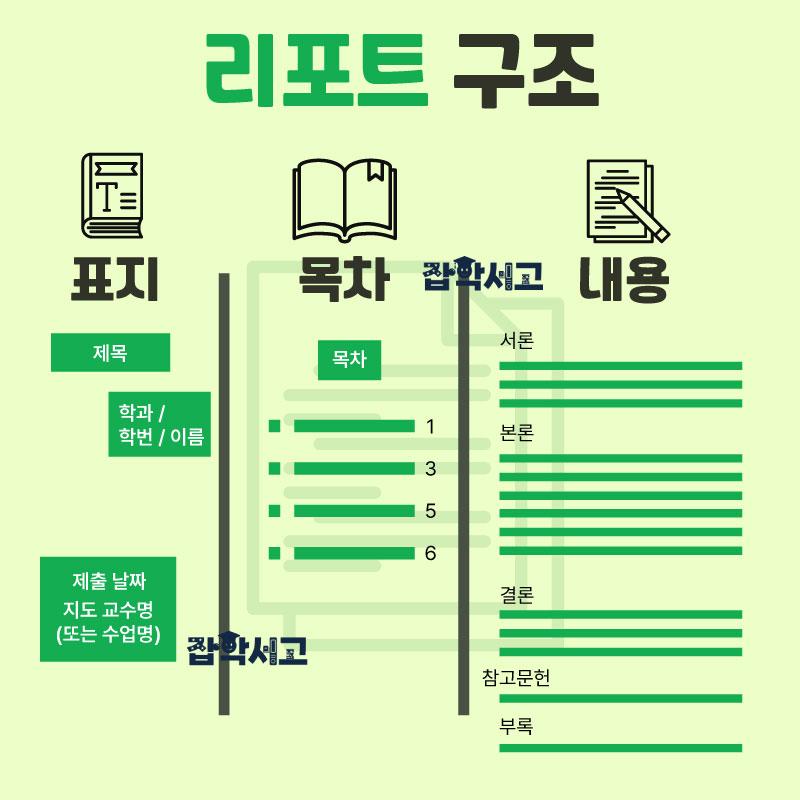 What elements make up a report?
A report should have a set structure. This is so that it delivers a clear message to the reader.
A report usually consists of an introduction, a body, and a conclusion. The introduction presents background information on the research topic and the purpose of the research, and the body covers detailed information on the topic along with analysis, interpretation, and discussion.
Finally, the conclusion summarizes the research findings and suggests the limitations of the research and directions for future research.
The structure of a college report (assignment) may vary somewhat depending on the professor, the course, and the topic, but the commonly used basic structure is as follows.
Cover Page
- Report title
- Department, student ID number, student name
- Submission date
- Name of supervising professor (or course name)
Table of Contents
- Main sections of the report and their page numbers
Introduction
- Background explanation related to the report topic
- Definition of the main research question or purpose
- Brief explanation of the report's structure (if necessary)
Body
The body can be further divided into several sections.
- Literature review: an overview of related theories, research, or existing work
- Methodology: research methods, data collection, analysis methods, etc.
- Results and interpretation: research results and their interpretation
Conclusion
- A summary of what was covered in the body
- Key findings of the research or report
- Further research or recommendations (if necessary)
References
- All sources consulted in writing the report
- References must follow a consistent citation style. (e.g., APA, MLA)
Appendix
Additional information, data, figures, etc. that are not directly related to the main content but are useful for reference
This structure can vary depending on the topic or type of report, as well as each university's educational goals and style.
Therefore, before starting an assignment, it is a good idea to check the instructions or guidelines carefully and, if necessary, ask the professor or teaching assistant.
Research
 Research is the source of a high-quality report.
The core of writing a report is thorough research. Through research, you can secure reliable information and support your arguments.
You can use a variety of sources, such as the school library, the internet, and academic papers. When searching for sources, it is important to look for them from trustworthy sources, and it is good to consult related studies to gather rich information.
Research Tips
Clearly identify what you want to learn about the topic and what key question the report aims to answer. At the start of your research, it is good to use Wikipedia, expert blogs, textbooks, and similar resources to understand basic background information and terminology about the topic.
Once you have a grasp of the basics, use online databases where you can search for academic papers, reports, articles, and so on. (e.g., Google Scholar, RISS, DBpia, KISS) Your university's library website may also provide its own databases. For reference, you can also search for papers on this site (GK Library).
You can find information efficiently by using keyword combinations, negative searches (e.g., -keyword), and exact phrase searches (e.g., "keyword"), and you can also discover additional sources by checking the references of related papers or reports.
For information obtained from the internet, check the source and the author to judge whether the information is reliable, and since materials or sources may be biased toward a particular viewpoint or position, consider multiple perspectives in your analysis.
Plan to secure enough time before the report deadline so that you can carry out your research systematically. Since research is the foundation of report writing, the time and effort you invest ultimately raise the quality of the report.
Cover Page and Table of Contents
 The cover page draws attention, and the table of contents gives a rough overview of the content.
When writing a report, it is important to put together the cover page and table of contents properly. The cover page should include information such as the report title, the author's name, the school, department, and professor's name, and the date written.
The table of contents shows the structure of the report visually and should clearly separate sections such as the introduction, body, and conclusion. It is a good idea to draft the table of contents in advance, before writing the report.
Cover Page
- Title: Clearly express the topic of the report. Place it in large type in the center or at the top.
- Subtitle: If necessary, add details about the topic.
- Author's name: Write the name of the person who wrote the report.
- Submission date: Indicate the date the report was submitted or written.
- Affiliation: Write the author's affiliation, such as the school name, department or faculty, and course name.
- Name of supervising professor or instructor: Write the name of the professor or instructor supervising the report or assignment.
Table of Contents
The table of contents is a page that lists the main components of the report and their page numbers. It allows the reader to grasp the overall structure and the flow of the content.
- Title: Use the title 'Table of Contents' and place it at the top center of the page.
- Contents: List the contents in the following order.
- Introduction
- Body
- Conclusion
- References
- Appendix (if necessary)
*Page numbers: Write the corresponding page number next to each item.
How to Write the Content (Introduction, Body, Conclusion)
 Explain systematically and logically, in the order of introduction, body, and conclusion.
When writing the content of a report, it is important to structure it to suit its purpose. The introduction should present the research topic and its importance and state the purpose of the research.
The body covers detailed information and the theoretical background of the topic, and presents findings on the topic through analysis and discussion.
The conclusion briefly summarizes the results of the preceding content and suggests the limitations of the work and directions for future research.
A detailed look at the components that go into the introduction, body, and conclusion is as follows.
Introduction
The introduction is the opening part of the report, and its main purpose is to introduce the topic to the reader and provide the overall context.
Topic introduction: Clearly introduce the topic of the report.
Background information: Briefly introduce the importance of the topic, the current situation, and related existing research or problems.
Purpose statement: Present the main purpose or research question of the report.
Scope: Specify the scope of what the report will cover.
Body
The body is the core part of the report and includes the evidence, analysis, and discussion related to the topic or research question.
Subsections: Structure the information by dividing it into several subsections according to the topic or content.
Claims and evidence: Present the main claims and provide evidence or examples to support them.
Data and analysis: Present data such as the results of research, experiments, or surveys, and discuss the results of their analysis.
Theoretical background: Explain related theories or concepts and discuss the topic based on them.
Conclusion
The conclusion is the final part of the report, where you summarize the main findings or insights and reconfirm the overall content.
Summary of key findings: Briefly summarize the main results or findings mentioned in the body.
Meaning and implications: Discuss implications such as the significance of the results, the limitations of the research, and directions for future research.
Recommendations: If necessary, you can add recommendations for specific actions or future research.
When writing a report, it is important to use an appropriate heading for each section so that the information is clear and specific, and to organize it with the logical flow of information in mind.
It is best to write systematically so that readers can easily understand the content and gain insight into the topic.
References
Writing the references properly is also important for increasing the credibility of a report (assignment). This part also involves things worth learning in depth, so I have prepared it as a separate article. I hope you will also learn about citation styles through the link below.
 Reference Citation Styles (Read More)
In this material, we have looked at report-writing methods that are helpful for college life. Writing reports is an important part of college life and helps improve academic skills.
When writing a report, you should keep in mind a clear structure, thorough research, a well-organized cover page and table of contents, and how to write the core content.
I hope you will master and put these elements into practice so that you can write effective reports. Writing reports successfully will help you achieve academic success and make your college life even richer.