References are an important element used in academic research and in writing papers. Their purpose is to clearly indicate sources so that other researchers can verify and make use of our research.
In this article, we will look at what references are and why they are cited, the main reference citation styles, and how to format references by type of material.
What Are References?
 What are references?
References are the reference materials used in a piece of research or written work. They represent all the materials consulted, including other people's research and work, and can be recorded in a variety of types and formats.
References are important because they can, in and of themselves, increase academic credibility and verifiability, and they help other researchers find related materials or extend the research.
Why You Should Cite References
 Why should we write references?
The biggest reason for citing references is to ensure clarity of sources and the credibility of the research. By accurately citing sources when using other people's ideas, research findings, or quoted material, you can prevent plagiarism and academic misconduct.
In addition, citing sources can help readers check the original materials or study the relevant parts in more depth.
Reference Styles
 There are many different styles for writing references
Reference citation provides a method for listing the materials used in research or academic work accurately and consistently. There are many styles for this, and we would like to introduce a few of the major ones below.
Since these styles were created and are used abroad, we also introduce the English formats along with them. The formats mainly used in Korea will be covered separately in the next section.
IEEE (Institute of Electrical and Electronics Engineers)
Mainly used in engineering, computer science, and telecommunications. It uses numbered citations, and the reference list is arranged in the order in which the sources are cited.
Book
[Number] Author's initials, surname, title. Place of publication: publisher, year of publication.
Journal
[Number] Author's initials, surname, article title, journal name, volume, issue, page range, year of publication.
In English
[1] A. Author, "Title of paper," Abbrev. Title of Periodical, vol. x, no. x, pp. xx-xx, Abbrev. Month, year.
MLA (Modern Language Association)
Widely used in the humanities, especially in research on language and literature. When citing in the text, the author's surname and the page number are placed in parentheses.
Book
Author. Title. Publisher, year of publication.
Journal
Author. Article title. Journal name, volume, issue, year of publication, page range.
In English
Author's Last name, First name. "Title of the Article." Name of the Journal, vol. number, issue number, year, page range.
APA (American Psychological Association)
Widely used in the social sciences, and especially common in fields such as psychology, education, and sociology. When citing in the text, the author's surname and the year of publication are placed in parentheses.
Book
Author. (Year of publication). Title. Publisher.
Journal
Author. (Year of publication). Article title. Journal name, volume(issue), page range.
In English
Author, A. A. (Year of publication). Title of work: Capital letter also for subtitle. Publisher.
Chicago Manual of Style
Mainly used in the humanities and some social sciences. It is also widely used in the field of history.
Book
Author. Year of publication. Title. Place of publication: Publisher.
Journal
Author. Year of publication. Article title. Journal name volume(issue): page range.
In English
Author's First name Last name, "Title of Article," Title of Journal volume number (year of publication): page number(s).
Harvard Referencing System
Mainly used in the social sciences; the author and year of publication are cited in parentheses.
Book
Author (Year of publication) Title. Publisher, place of publication.
Journal
Author (Year of publication) Article title, journal name, volume(issue), page range.
In English
Author’s Last name, Initial(s). (Year) 'Title of article', Title of Journal, volume(issue), page range.
Because each field, journal, and publisher prefers a different reference format, researchers, students, and writers must always check the relevant rules when submitting a publication or research paper.
Reference Formats by Type of Material
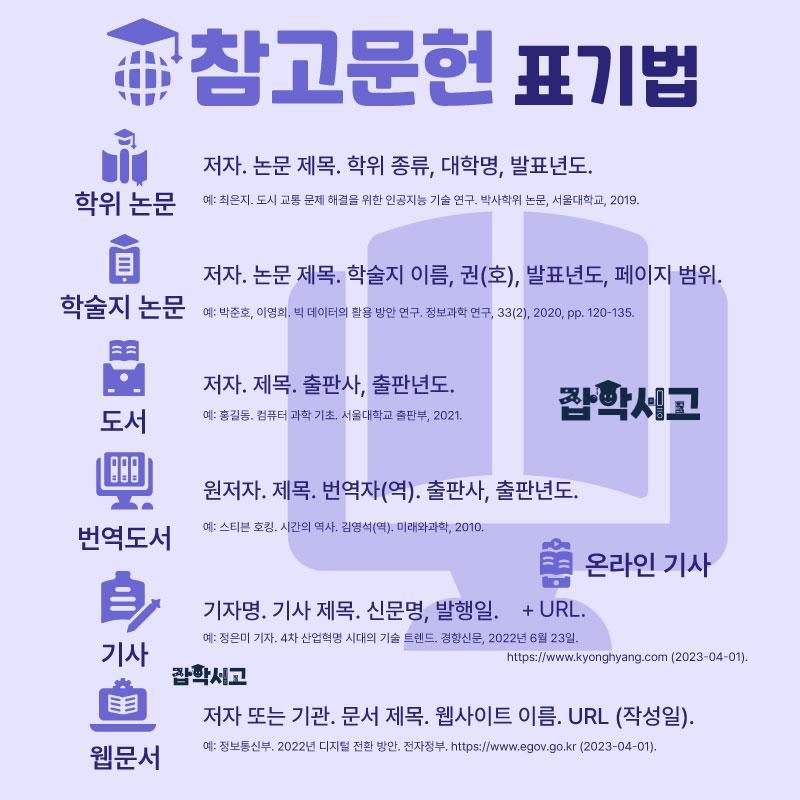 Reference formats by type of material
When citing references in Korean papers or reports, specific formats are followed for each of the various types of material.
The examples explained here are general ones; they may vary slightly according to the rules of the actual journal, publisher, school, and so on, so you must always check the rules of the relevant institution.
Thesis or Dissertation
Author. Thesis title. Degree type, university name, year of publication.
Example: Choi Eun-ji. A Study on Artificial Intelligence Technology for Solving Urban Traffic Problems. Doctoral dissertation, Seoul National University, 2019.
Journal Article
Author. Article title. Journal name, volume(issue), year of publication, page range.
Example: Park Jun-ho, Lee Young-hee. A Study on Ways to Utilize Big Data. Information Science Research, 33(2), 2020, pp. 120-135.
Book
Author. Title. Publisher, year of publication.
Example: Hong Gil-dong. Fundamentals of Computer Science. Seoul National University Press, 2021.
Translated Book
Original author. Title. Translator(trans.). Publisher, year of publication.
Example: Stephen Hawking. A Brief History of Time. Hong Gil-dong(trans.). Miraewa Gwahak, 2010.
Newspaper Article
Reporter's name. Article title. Newspaper name, date of publication.
Example: Reporter Jeong Eun-mi. Technology Trends in the Era of the Fourth Industrial Revolution. Kyunghyang Shinmun, June 23, 2022.
Online Article
Reporter's name. Article title. Newspaper name, date of publication. URL.
Example: Reporter Jeong Eun-mi. Technology Trends in the Era of the Fourth Industrial Revolution. Kyunghyang Shinmun, June 23, 2022. https://www.khan.co.kr (2023-04-01).
Web Document
Author or organization. Document title. Website name. URL (date written).
Example: Ministry of Science and ICT. 2022 Digital Transformation Plan. e-Government. https://www.egov.go.kr (2023-04-01).
As shown above, the required information and format differ by type of material, so you need to understand them clearly and cite them correctly.
These formats may be written in a brief form attached in the main text, in notes (footnotes), or at the end of a sentence, or they may be compiled into a separate reference list that records detailed information.
Reference citation is a key tool and method for increasing academic credibility and verifiability. By clearly citing sources, it prevents plagiarism and academic misconduct and helps other researchers verify and make use of research.
In addition, various formats apply depending on the type of material, and formats can differ according to standard rules and the needs of the field.
Therefore, all students and researchers conducting research should understand reference formats well and apply them correctly to make their own research more credible.