Frameworks provide standardized structures and methods for software development, helping developers build applications more efficiently and consistently.
These tools are often closely integrated with specific programming languages and provide developers with predefined classes and libraries to improve code reusability and shorten development time.
This material explains the basic concepts and characteristics of frameworks and examines the languages supported by various frameworks.
It also explores the practical value of frameworks through their general usage and an example using the Java Spring framework.
Framework Concepts and Characteristics
 The concept is to use a prewritten structure needed for development.
A framework (Framework) is a system that provides a kind of structure or foundation for software development. To understand it a little more easily, think of it as a greatly expanded template that provides more control and a larger structure, along with various features and support throughout an application's entire lifecycle.
Frameworks provide a set of rules and guidelines along with libraries, components, and toolkits to help developers create software in a standardized way. This makes the development process faster, easier, and more effective.
Frameworks also provide common solutions to specific problem areas in software development. This allows developers to implement specific features while following a basic structure.
The main characteristics of frameworks are code reusability, modularity, and extensibility, which help standardize the development process and improve productivity. Their main characteristics are summarized below.
Reusability (Reusability)
Frameworks generally provide reusable code. This allows developers to shorten development time by using existing libraries and components.
Modularity (Modularity)
Frameworks use a modular structure, allowing each module to operate independently and integrate easily with other modules. This makes code easier to maintain and improves extensibility.
Extensibility (Extensibility)
Extensibility is one of the important characteristics of frameworks, allowing developers to easily extend and modify existing code.
Standardization (Standardization)
Frameworks provide specific standards and rules to promote consistent development practices within a development team. This improves code quality and makes projects easier to maintain.
Inversion of Control (Inversion of Control, IoC)
Frameworks adopt the principle of inversion of control (IoC), with the framework controlling the program's flow on behalf of the developer. This allows developers to focus only on the necessary business logic.
Testability (Testability)
Frameworks generally provide a structure that makes unit testing and integration testing easy to perform. This helps developers improve code quality and quickly identify bugs.
Languages Supported by Frameworks
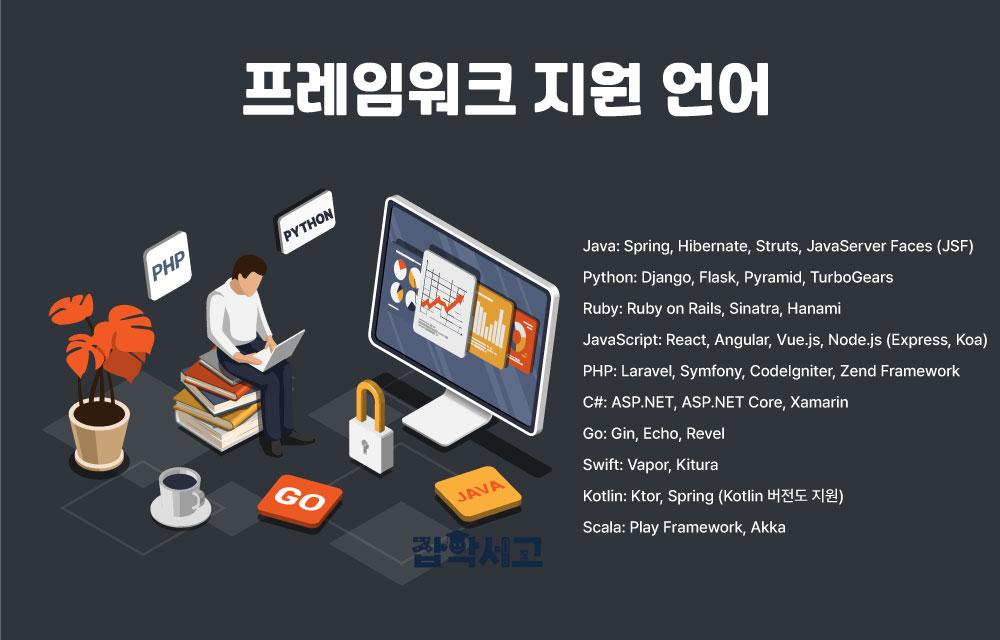 Languages That Support Frameworks
Most frameworks are written in a specific programming language, and frameworks exist in various languages. Each framework reflects the characteristics, strengths, and weaknesses of its language and provides developers with tools to maximize the language's advantages.
Each framework is designed to maximize the performance, productivity, and usability of a specific language. Below is a partial list of several major programming languages and their corresponding frameworks.
Java
Spring Framework: Spring is a framework widely used for developing enterprise-level applications. It provides various features, including inversion of control (IoC), aspect-oriented programming (AOP), and transaction management.
Hibernate: Hibernate is an object-relational mapping (ORM) framework that supports efficient data management between Java applications and databases.
Python
Django: Django is a high-level framework for developing fast and powerful web applications. It uses the model-view-template (Model-View-Template, MVT) architecture and helps developers write straightforward, reusable code.
Flask: Flask is a micro web framework that provides a simple, lightweight structure, allowing developers to easily build web applications.
Ruby
Ruby on Rails (Rails): Rails is a web application framework that emphasizes development speed and follows the principles of convention over configuration (CoC) and DRY (Don't Repeat Yourself).
JavaScript
React: React is a user interface library created by Facebook, primarily used to build the view layer of single-page applications (SPAs).
Angular: Angular is a platform and framework created by Google, used to build web applications and dynamic web pages.
How to Use Frameworks
 What Are the Steps for Using a Framework?
Using a framework allows developers to build applications by following predefined structures and rules. This maintains a consistent code structure, promotes collaboration among team members, and makes projects easier to maintain.
The general steps for using a framework are outlined below.
1. Select a Framework
First, select an appropriate framework based on the project's requirements and goals. Considerations include the languages supported by the framework, community activity, licensing, documentation, and the learning curve.
2. Installation and Configuration
Install the selected framework and complete the necessary configuration. This is often done by following the installation guide provided on the framework's official website.
3. Understand the Project Structure
Frameworks generally recommend or provide a specific project structure. It is important to understand and follow this structure.
4. Use Libraries and Tools
Use the libraries and tools included in the framework to carry out development tasks. These may include various tasks such as connecting to databases, building web services, and developing user interfaces.
5. Use the Community and Resources
Use the framework's community, documentation, tutorials, and example projects to learn and solve problems.
6. Testing and Debugging
Frameworks often provide tools that support testing and debugging. Use these tools to test code and find and fix bugs.
7. Deployment
Once development is complete, deploy the application by following the framework's deployment guide.
8. Maintenance and Updates
Using a framework simplifies maintenance and updates, and when a new version of the framework is released, update it to keep the project current.
How a framework is used may vary depending on the characteristics of the framework and the project. The framework's official documentation and community resources can help you better understand and apply its usage.
Java Spring Example
The Java Spring framework is a powerful and flexible framework for building enterprise-level applications. Here, as an example, we will introduce how to build a simple web application using the Spring framework and examine Spring's main features and benefits.
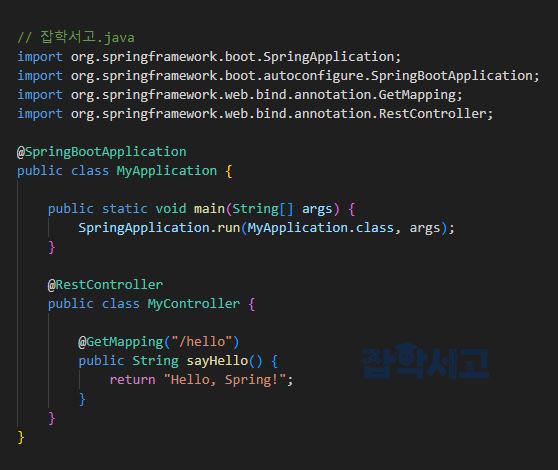 Java Spring Framework Example
The elements used in the example code above are explained below.
@SpringBootApplication Annotation
This annotation is placed on the main class, bootstraps the Spring Boot application, and automatically configures Spring's application context.
main Method
This is the entry point of a Java application. The SpringApplication.run method starts the Spring Boot application.
@RestController Annotation
The @RestController annotation indicates that this class is a controller for a RESTful web service. This annotation combines @Controller and @ResponseBody, handling HTTP requests and returning data as the HTTP response body.
@GetMapping Annotation
The @GetMapping annotation handles HTTP GET requests to the /hello endpoint. The sayHello method returns the string "Hello, Spring!", which is used as the HTTP response body.
This simple example shows that Spring Boot provides all the configuration needed to quickly build and run a web application.
We have now explored the characteristics and usage of frameworks, along with a simple example of using Java Spring.
This material covered topics ranging from understanding the basic concepts of frameworks and the characteristics of various frameworks to the languages they support and their general usage.
In addition, an example using the Java Spring framework demonstrated practical ways to use frameworks and their benefits.
Frameworks greatly help standardize the software development process, shorten development time, and improve code quality.
Therefore, understanding and using these tools is an important competency for developers, enabling more efficient and effective software development.