This time, I would like to prepare material on the product life cycle, which describes a product's life from its launch through growth and decline. Understanding it can help businesses with their marketing strategies and risk management, and give them greater flexibility in responding to the market.
What Is the Product Life Cycle?
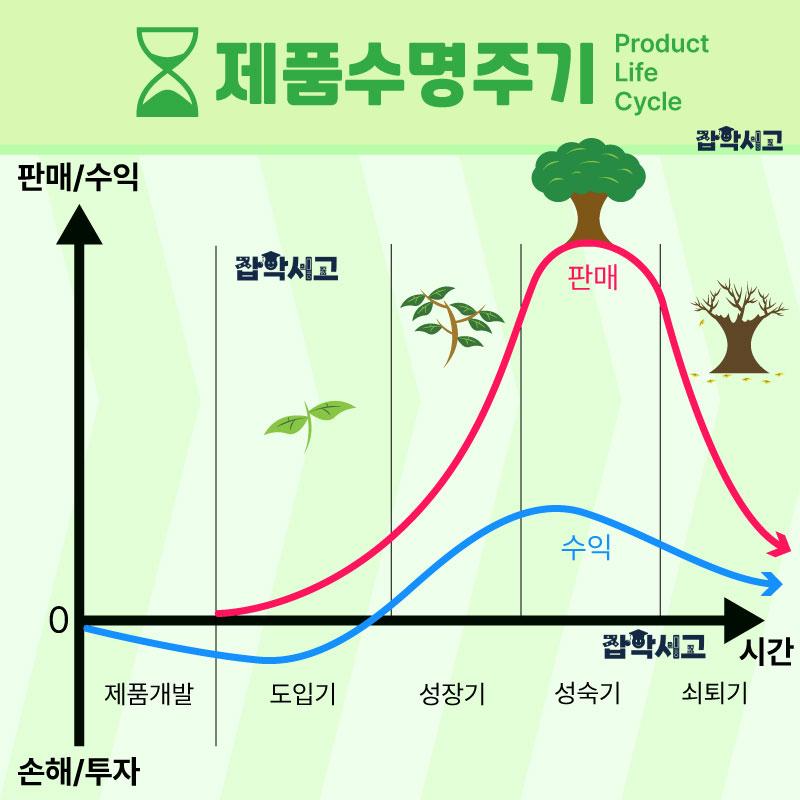 Product Life Cycle Graph
The Product Life Cycle (PLC) is generally divided into 4 stages—introduction, growth, maturity, and decline—with marketing strategies, profits, sales volume, and other factors varying at each stage.
As the graph above shows, growth tends to be slow or losses are incurred in the early days after a product's launch, but as it gains recognition in the market and progresses through the growth and maturity stages, sales and profits increase significantly, followed by a period of gradual decline.
Now, we will look at the characteristics of each stage a product goes through, one by one and in order.
Introduction Stage
 The stage when product development is complete and the product enters the market
The introduction stage begins when a company's new product is first launched on the market. It takes time for the product to gain recognition and establish itself in the market, and sales volume gradually begins to increase.
At this stage, product sales are low because of limited awareness, and high distribution and promotion costs lead to losses or very low net profits.
There are few competitors at this early stage, and a marketing strategy is needed that clearly defines the product's positioning and target customers while emphasizing its features and benefits.
Growth Stage
 The growth stage, when awareness builds and sales increase rapidly
Once a product gains acceptance in the market, it moves beyond the introduction stage and enters the growth stage. From this point, sales begin to rise rapidly, early adopters continue to buy the product, and mainstream consumers then begin to buy it as well.
If word of mouth is positive at this point, growth becomes even more pronounced, and competitors begin to enter the market after seeing the company make a profit. As competitors join the competition with their own differentiation strategies, the market expands further.
During this period, the company must work to improve and diversify its products to gain a competitive advantage, and its pricing strategy also becomes important as price competition with competitors begins.
This is not a time to raise prices because the company is making a profit, but instead a time to lower prices so that consumers can buy more products.
Maturity Stage
 The stage when the market reaches its peak
The maturity stage is when growth in a product's sales slows or stops, and it tends to last longer than the growth stage. The market has become oversaturated, competition with rivals becomes extremely intense, and differentiation also becomes difficult.
As competitors also step up price discounts and sales promotions and increase product development budgets, the company's profits begin to decline gradually. Competitors that have failed to establish themselves slowly begin to leave the market, and only well-established competitors survive.
The company must make efforts to strengthen consumers' brand loyalty and develop marketing strategies that encourage repeat purchases.
This is also a time when the company must work to diversify and improve its products to compete in an intensely competitive market and maintain as much market share as possible.
Decline Stage
 The stage when sales and profits fall and competitors also face a crisis
The decline stage is when a product's sales gradually or rapidly fall. Depending on the product's characteristics, the decline may be slow or may be a sudden plunge.
Most products enter the decline stage after passing through the maturity stage, and there are various reasons for this, including technological advances, changes in consumer preferences, and intensified competition with rivals.
As sales have fallen, the company cuts its marketing and research and development (R&D) budgets to reduce costs, and may also narrow its product range and lower prices further.
This is a time when the company, as well as its competitors, must decide whether to retain or abandon a product that has entered the decline stage, or try to revitalize it through repositioning.
Summary of Product Life Cycle Characteristics and Strategies
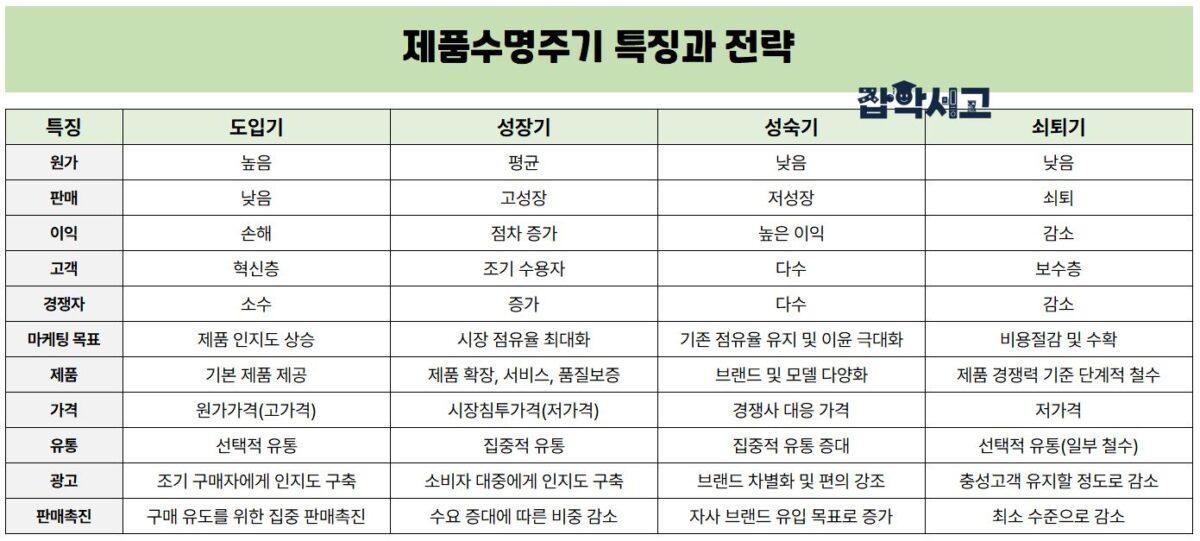 Product Life Cycle Characteristics and Strategies
The image above summarizes the characteristics of the product life cycle and its marketing strategies, providing an at-a-glance overview of the content introduced in this material.
Early after launch, low sales resulting from a lack of awareness create a crisis, but once the product starts to establish itself in the market through differentiation, it enters the growth stage and presents an opportunity to earn substantial profits.
However, in society, when someone profits, competitors inevitably emerge to imitate them and seek similar gains. The more sales and profits a product generates, the more competitors emerge, the market becomes saturated, and changes in technology and trends, among other factors, gradually lead the product into the decline stage.
This concludes our look at the product life cycle, which shows the stages a product goes through from launch to decline. Managing the product life cycle enables companies to develop effective strategies at each stage and adapt to market changes.
It is also one of the things companies need to know to compete successfully and grow in the market. I hope this material has provided an opportunity to deepen your understanding of the product marketing process.